

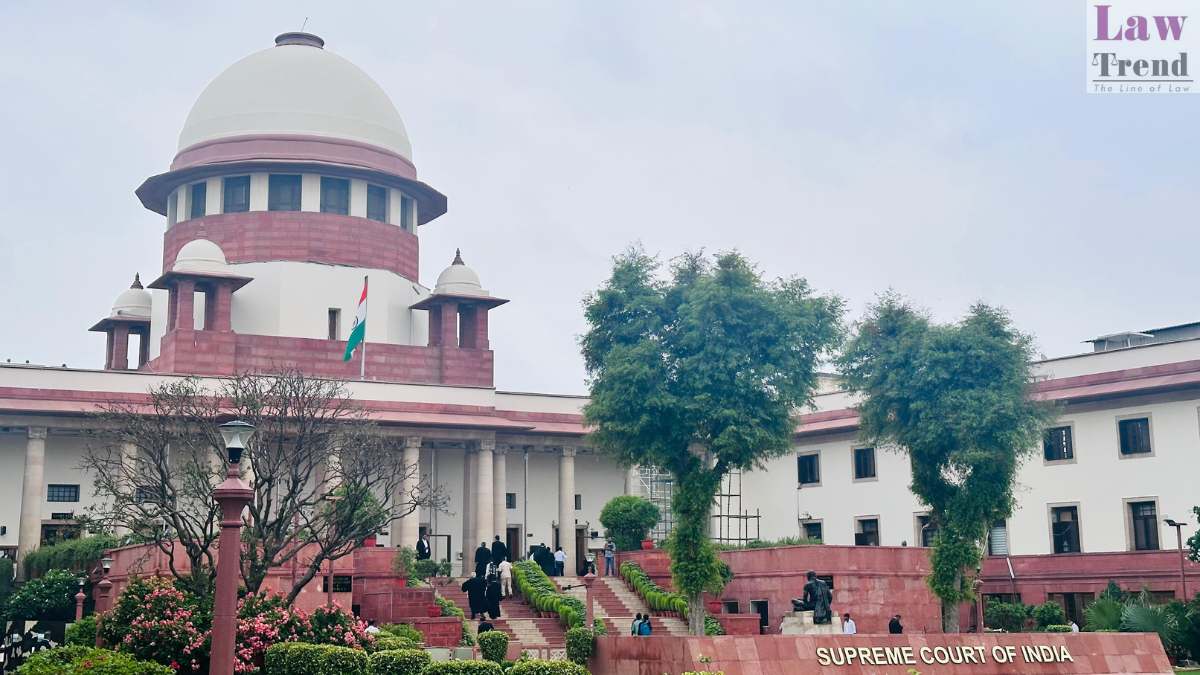
The Supreme Court of India has quashed criminal proceedings against three individuals—Sajal Bose, Chandidas Joardar, and Sautrik Joardar—ruling that “unimpeachable” CCTV footage forming part of the prosecution’s own record demonstrated they were not involved in the alleged assault. The Bench, comprising Justices Vikram Nath, Sandeep Mehta, and N. V. Anjaria, set aside a Calcutta High Court order that had declined to quash the charges against these appellants while granting relief to their female family members.
Background of the Case
The matter originated from an incident on October 11, 2022, in an apartment building in Kolkata. The complainant, Sushil Chakrabarti (a 77-year-old former Public Prosecutor), alleged that one Sourav Sen forcibly entered the building after breaking the entrance door. An altercation ensued regarding a scooter parked near electric meter boxes.
The complainant alleged that the appellants joined the altercation and manhandled him with an intention to cause injury, specifically directing blows toward his pacemaker. He further claimed they slapped and kicked him and his family members. FIR No. 150 of 2022 was registered at Survey Park Police Station under various sections of the Indian Penal Code (IPC), including Sections 143 (Unlawful Assembly), 323 (Voluntary causing hurt), and 354 (Assault or criminal force to woman with intent to outrage her modesty).
The High Court of Calcutta, on March 8, 2024, quashed the proceedings against the wives of the appellants but permitted the trial to continue against Sajal Bose, Chandidas Joardar, and Sautrik Joardar.
Arguments of the Parties
On behalf of the Appellants: Senior Advocate Gaurav Agarwal argued that the proceedings were “maliciously instituted” to wreak vengeance due to personal animosity. He contended that the appellants acted as “good Samaritans” trying to pacify a dispute. Crucially, he pointed to the CCTV footage, asserting it “clearly demonstrated that the appellants were not present at the spot at the time when the alleged altercation is stated to have taken place.”
On behalf of the Complainant: Senior Advocate Siddharth Luthra argued that the accused formed an unlawful assembly and assaulted the elderly complainant and his family. He relied on the statement of a witness, Dr. Aparajita Bandopadhyay, recorded under Section 164 of the CrPC, which attributed specific acts to the appellants, such as “igniting a lighter allegedly to burn” her father.
On behalf of the State: The State of West Bengal maintained that the investigation was conducted according to law and that the CCTV footage, medical records, and witness statements established a prima facie case fit for trial.
The Court’s Analysis and Observations
The Supreme Court personally viewed the CCTV footage during the hearing. The Bench observed:
“Upon a careful and comprehensive examination of the said footage, it emerges that the appellants are not visible at the scene during the relevant time when the alleged acts of assault are stated to have taken place… On the contrary, the visual recording indicates that the appellants made efforts to placate the situation and to dissuade the participants from further escalation of the dispute.”
The Court found that the High Court failed to provide a “meaningful analysis” of this electronic evidence. The Bench noted that the specific allegation that one appellant tried to burn the complainant’s father with a lighter was “completely dislodged by the CCTV footage, wherein no such act is discernible.”
The Court applied the principles laid down in State of Haryana v. Bhajan Lal (1992) and the four-step test from the recent decision in Pradeep Kumar Kesarwani v. State of Uttar Pradesh (2025). The judgment stated:
“Where the material relied upon by the accused is of sterling and impeccable quality; is sufficient to negate the allegations in the complaint… the High Court would be justified in exercising its inherent powers to quash the proceedings.”
The Bench criticized the High Court for drawing an arbitrary distinction by quashing proceedings for some co-accused while denying the same relief to the appellants despite “substantially similar assertions.”
Final Decision
The Supreme Court concluded that the continuation of the prosecution would amount to a “misuse of the criminal process.”
“Compelling appellant Nos. 1, 2 and 3 to face a full-fledged criminal trial would serve no meaningful purpose,” the Court observed.
Consequently, the appeals were allowed, and the chargesheet (No. 135 of 2022) arising out of FIR No. 150 of 2022, pending before the Additional Chief Judicial Magistrate, Alipore, was quashed insofar as it related to Sajal Bose, Chandidas Joardar, and Sautrik Joardar.
CASE DETAILS
Case Title: Sajal Bose v. The State of West Bengal and Ors.
Case Number: Criminal Appeal arising out of SLP(Criminal) No. 8672 of 2024 (and connected matters)
Bench: Justice Vikram Nath, Justice Sandeep Mehta, Justice N. V. Anjaria
Date: April 06, 2026




