

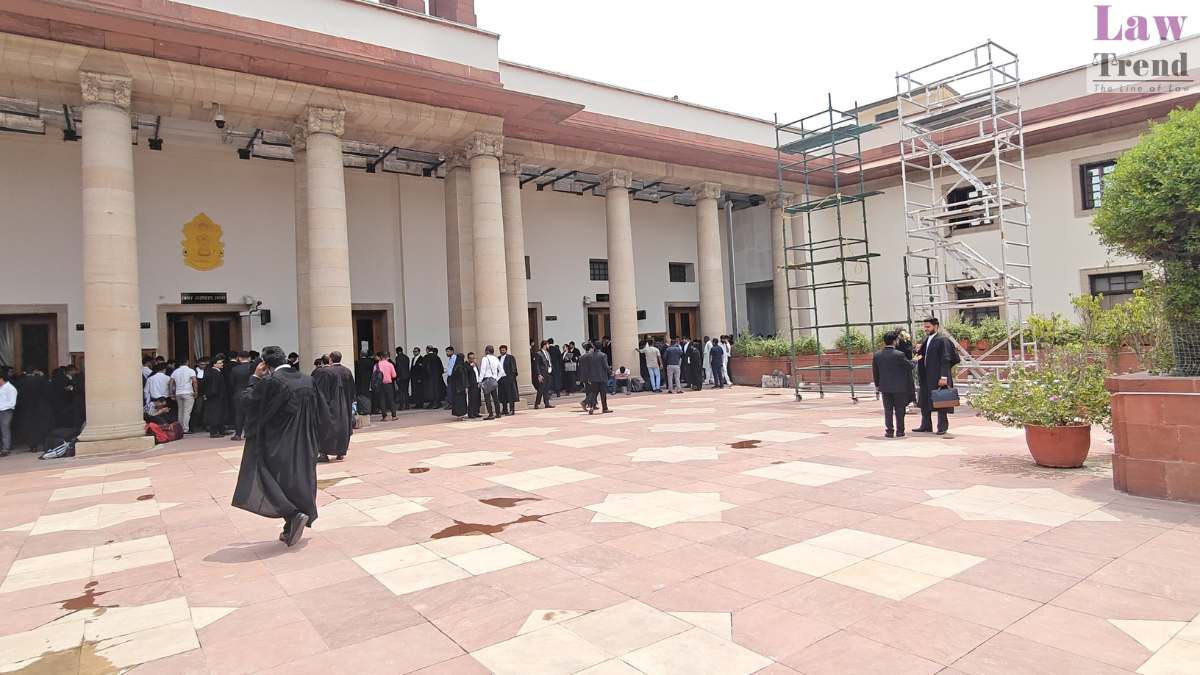
The Supreme Court of India has set aside orders from the Trial Court and the Allahabad High Court that refused to summon additional accused persons in a murder case. A Bench comprising Justice Sanjay Karol and Justice Augustine George Masih held that while exercising power under Section 319 of the Code of Criminal Procedure (CrPC), courts should not conduct a “mini-trial” or a “threadbare” analysis of minor inconsistencies in witness testimonies.
Background
The case originates from an FIR dated August 22, 2017, registered at Police Station Kotwali Nagar, Muzaffarnagar. The complainant, Mohammad Kaleem (PW-1), alleged that his associate, Mohammad Ammar, was shot and killed while they were traveling to court. According to the FIR, the attack was a conspiracy hatched by several individuals, including those already in jail.
Following the examination of witnesses Khalil (PW-6) and Tazeem (PW-7), the complainant moved an application under Section 319 CrPC to summon two additional persons, Rajendra and Mausam, as accused. The complainant alleged that these two individuals had met with the jailed conspirators approximately 15 days before the incident to plan the murder.
Lower Courts’ Findings
The Trial Court rejected the application on November 30, 2011, and the High Court subsequently upheld this refusal. The Trial Court’s decision was based on several factors:
- Inconsistencies: Discrepancies between the accounts of PW-1, PW-6, and PW-7 regarding which jailed individuals Rajendra and Mausam had met.
- Lack of Corroboration: The absence of official jail registers to prove the meeting took place.
- Physical Implausibility: The Court questioned why the complainant, who was sitting as a pillion on the scooter with the deceased, did not sustain any injuries despite being in close proximity during the firing of five shots.
- Evidence Contradictions: Doubts were raised regarding the route taken by witnesses and the identity of the person who brought the deceased to the hospital.
Supreme Court’s Analysis
The Supreme Court clarified the varying standards of evidence required at different stages of criminal proceedings:
- Prima Facie Standard: Required to proceed with formal charges.
- Strong and Cogent Standard: Required for summoning additional accused under Section 319 CrPC.
- Beyond Reasonable Doubt: Required for a final conviction.
Justice Sanjay Karol, writing the judgment, observed that the Trial Court misdirected itself by applying an overly strict standard. The Court noted:
“The Trial Court, in this regard appears to have misdirected itself. In evaluating minor contradictions between witness statements and plausibility issues such as whether the complainant could have avoided injury, effectively applied a stricter standard than necessary.”
The Bench further criticized the “fragmented approach” taken by the lower courts:
“The Trial Court treated each inconsistency in isolation rather than assessing the cumulative weight of all testimonies and circumstances… The Court overstepped the intended scope of pre-trial scrutiny, overemphasized minor inconsistencies, and did not fully consider the cumulative force of the evidence.”
The Supreme Court emphasized that while the power under Section 319 CrPC is “extraordinary and should be exercised sparingly,” the evidence must simply be “reliable and reasonably persuasive” at that stage, and not necessarily proven beyond reasonable doubt.
Decision
The Court held that the sworn testimonies of three witnesses (PW-1, PW-6, and PW-7) were sufficient to meet the “strong and cogent evidence” standard required to summon the additional accused.
The Supreme Court allowed the appeals, setting aside the previous judgments. It ordered that Rajendra and Mausam be produced as additional accused and proceeded with in accordance with the law. The Trial Court has been directed to take necessary action.
Case Details
- Case Title: Mohammad Kaleem v. State of Uttar Pradesh & Ors.
- Case Number: Arising out of SLP (Crl.) No. 11085 of 2023)
- Bench: Justice Sanjay Karol and Justice Augustine George Masih
- Judgment Date: March 17, 2026




