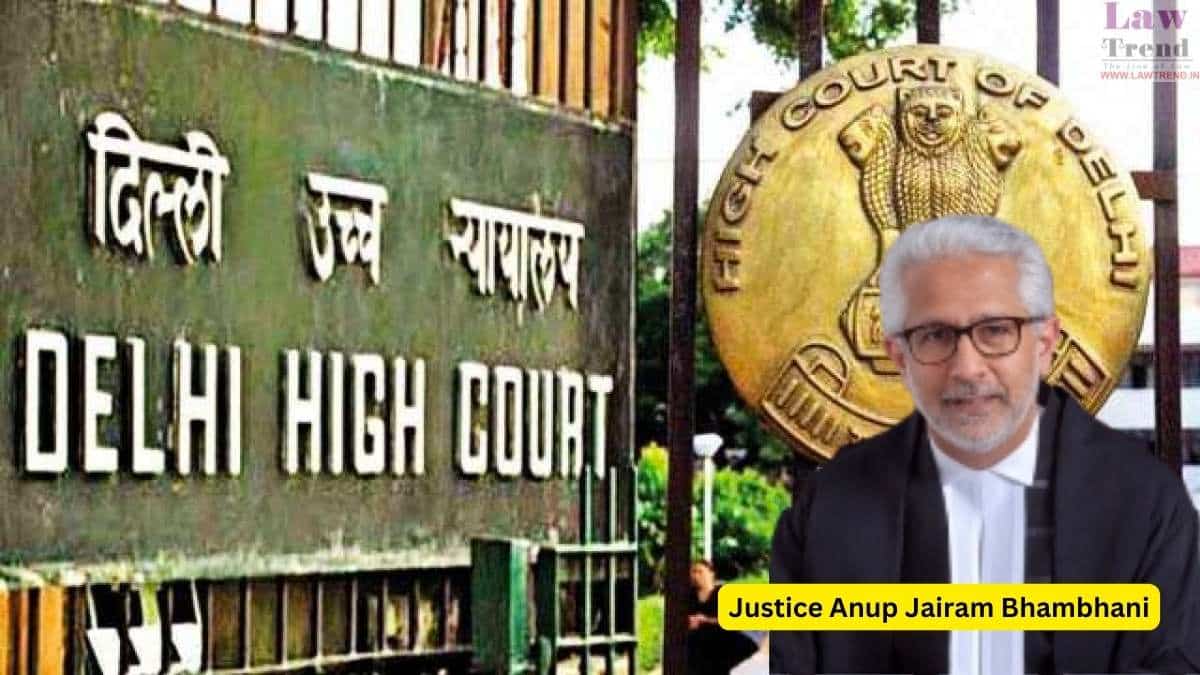
The Delhi High Court has held that a trial court cannot effectively decree a suit based solely on findings in a contempt petition under Order XXXIX Rule 2A of the CPC, without adjudicating the core issues of title and ownership on their merits. Dismissing cross-appeals filed by the legal representatives of the late Shri Satya Narain and the Delhi Development Authority (DDA), Justice Anup Jairam Bhambhani upheld a First Appellate Court’s decision to remand a 30-year-old land dispute for a fresh trial, emphasizing that the “essential dispute” regarding title had been left undecided.
The primary legal question was whether a First Appellate Court could remand a matter for fresh adjudication when the Trial Court had struck off the main issue regarding ownership and decided the suit merely on the basis of a contempt application. The High Court affirmed the remand, ruling that since the Trial Court had “decided nothing” on the substantive rights of the parties, a decision based on evidence was necessary.
Case Background
The dispute involves land measuring 1 bigha 18 biswa situated in Khasra No. 67, Patti Hamid Sarai, Mauza Hauz Rani, Begum Pur, Malviya Nagar, New Delhi.
- 1991: Satya Narain instituted Suit No. 1332/1991 seeking permanent and mandatory injunction, claiming ownership via a registered sale deed dated August 27/28, 1958.
- Interim Orders: A status-quo order was passed by the High Court on April 30, 1991.
- 1999: The plaintiff alleged that on May 18, 1999, the DDA demolished the structure on the land and dispossessed him in violation of the court’s order.
- Trial Court Proceedings: The suit was transferred to Tis Hazari Courts (CS No. 66/2014). On January 11, 2019, the Trial Court disposed of the suit by allowing a contempt petition against the DDA for violating the injunction. Crucially, the Trial Court struck off Issue No. 1 (regarding plaintiff’s ownership) and Issue No. 4 (statutory bar under the Delhi Development Act), and held Issues No. 2 and 3 to be infructuous.
- First Appeal: On December 24, 2020, the Additional District Judge set aside the Trial Court’s judgment and remanded the matter, directing it to decide Issues No. 1 to 3 afresh.
Arguments of the Parties
Satya Narain (Appellant in RSA 42/2021): Counsel for the landowner argued that the First Appellate Court erred in remanding the case after a “full-dressed trial” spanning nearly 30 years. They contended that the remand allowed the DDA to fill “gaping holes” in its defense. The appellant asserted that the land was “non-evacuee” property, never acquired by the government, and that his dispossession was illegal and without due process.
DDA (Appellant in RSA 67/2021): The DDA argued that the suit land was acquired under the Resettlement of Displaced Persons (Land Acquisition) Act, 1948, and transferred to it in 1982. The Authority contended that the First Appellate Court should have decided the matter itself under Order XLI Rule 24 CPC instead of remanding it. Furthermore, the DDA argued that a suit for injunction simpliciter was not maintainable when the title was seriously disputed, relying on the Supreme Court’s judgment in Anathula Sudhakar vs. P. Buchi Reddy & Ors.
Court’s Analysis and Observations
Justice Bhambhani observed that the Trial Court’s judgment had proceeded “only on its decision on an application under Order XXXIX Rule 2A CPC,” while striking off the issue of ownership. The High Court found this approach legally unsustainable.
1. On Remand and Trial Court’s Failure to Adjudicate Merits: The Court noted that the “essential dispute” between the parties—whether Satya Narain held title or the DDA had acquired the land—was never decided by the Trial Court.
“The correct perspective therefore is, that the suit has not been decided on merits at all, even though it remained pending for 03 decades or so. This is hardly a position that can be countenanced.”
2. Necessity of Proving Title: The Court agreed with the DDA’s submission regarding the necessity of a declaration of title in injunction suits where a cloud is raised over the plaintiff’s ownership. Citing Anathula Sudhakar, the Court held:
“Since in the present case there are rival contentions as to title to the suit land, there cannot be any cavil with the proposition that a party claiming relief against dispossession must first seek declaration of its title before it can claim any other relief in court.”
3. Power of Appellate Court: Rejecting the argument that the Appellate Court could not direct the recording of evidence, the High Court cited Order XLI Rules 23 and 23A of the CPC. It held that the First Appellate Court was empowered to remand the case where a retrial was considered necessary because the Trial Court had disposed of the suit without deciding the preliminary points or merits.
4. Settled Possession: The Court affirmed that even the plea of “settled possession” requires evidence to be examined, which the Trial Court failed to do comprehensively.
“The settled possession is not a magic word… The learned trial court has failed to consider the said ingredients [of settled possession], even in the light of the said Judgment [Rame Gowda].”
Decision
The Delhi High Court dismissed both second appeals, upholding the judgment dated December 24, 2020. The matter stands remanded to the Trial Court to decide the issues of ownership and injunction afresh.
The Court clarified that:
“Considering that the core issue relates to title to land, which is a valuable right that would inure for decades to come, it would be inadvisable for this court to adopt any shortcut by directing the learned first appellate court to decide the issues.”
Parties were granted liberty to lead further evidence before the Trial Court in accordance with the law.
Case Details:
- Case Title: Shri Satya Narain (Since Deceased) Through LRs vs. Chairman Delhi Development Authority & Anr. (and connected appeal)
- Case Numbers: RSA 42/2021 & RSA 67/2021
- Coram: Justice Anup Jairam Bhambhani
- Date of Decision: January 09, 2026
- Counsel for Satya Narain: Mr. Anil K. Khaware with Mr. Yogendra Kumar and Mr. Manoj Ram
- Counsel for DDA: Ms. Chand Chopra, Ms. Anshika Prakash