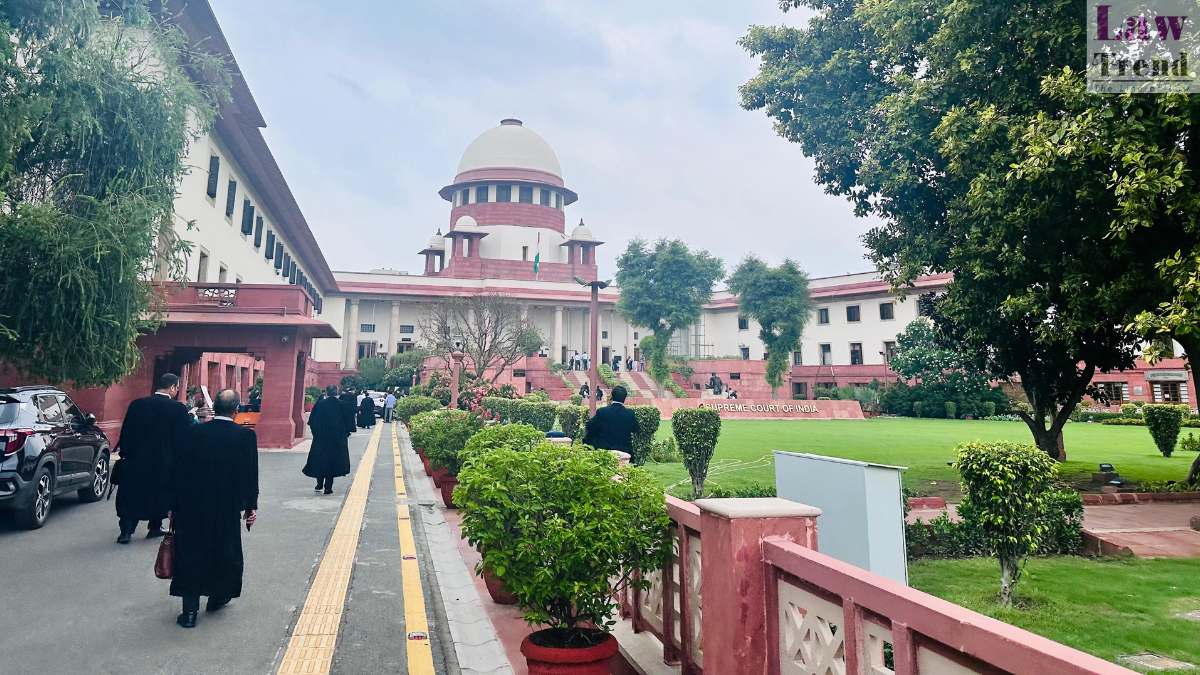
The Supreme Court has held that a transferee pendente lite—a person who purchases property during the pendency of a suit—cannot resist the execution of a decree and is bound by the outcome of the litigation. Dismissing the appeals filed by subsequent purchasers, the Court ruled that the doctrine of lis pendens under Section 52 of the Transfer of Property Act, 1882, renders such transfers subservient to the decree passed by the court.
A Bench comprising Justice Manoj Misra and Justice Ujjal Bhuyan observed that allowing a transferee pendente lite to obstruct execution would defeat the object of Section 52 and undermine the sanctity of the judicial process.
The Supreme Court dismissed two civil appeals challenging the judgment of the Bombay High Court, which had upheld the removal of obstruction caused by the appellants (subsequent purchasers) in the execution of a decree for specific performance. The Court affirmed that the appellants, having purchased the suit property during the pendency of the original civil suit, had no independent right to resist the execution. The Court directed the appellants to hand over actual physical possession to the decree holder by February 15, 2026, and invoked Article 142 of the Constitution to bar any further litigation in the matter.
Background of the Case
The dispute originated from an agreement for sale dated April 26, 1973, entered into between the plaintiff (Respondent No. 1, decree holder) and the defendant (Respondent No. 2, judgment debtor). Due to the defendant’s failure to perform the contract, the plaintiff instituted Regular Civil Suit No. 910 of 1986 on April 28, 1986, and registered a lis pendens notice on May 2, 1986.
Between May and August 1987, during the pendency of the suit, the judgment debtor transferred various parts of the suit property to different persons. The appellants claimed title based on subsequent sale deeds executed in 1995 and 1996 from these intermediate purchasers.
The Trial Court decreed the suit in favor of the plaintiff on November 30, 1990, directing the defendant to execute the sale deed. Following the defendant’s failure to do so, the Court Commissioner executed the sale deed in favor of the plaintiff on March 25, 1993. This decree and sale deed attained finality after the dismissal of appeals and revision applications filed by the judgment debtor.
When the decree holder sought possession in 2019, the appellants resisted, claiming independent ownership and possession. The Executing Court rejected their objections on February 29, 2020, holding them bound by the decree. This decision was upheld by the Appellate Court and subsequently by the Bombay High Court in the impugned judgment dated December 19, 2024.
Arguments of the Parties
Appellants’ Contentions: Senior Advocate Vinay Navare, appearing for the appellants, argued that they were bona fide subsequent purchasers who had acquired title through registered sale deeds. He contended that since the decree holder had notice of the transfers and the construction of a bungalow on the land, the subsequent purchasers should have been joined in the sale deed executed by the Court Commissioner to pass valid title. Reliance was placed on the Supreme Court’s decisions in Thomson Press (India) Limited v. Nanak Builders and Investors Private Limited and Lala Durga Prasad v. Lala Deep Chand, arguing that specific performance decrees merely recognize a claim and do not automatically transfer title without joining the title-holders.
Respondent’s Contentions: Respondent No. 1 (Decree Holder), appearing in person, argued that the transfers were hit by Section 52 of the Transfer of Property Act as they occurred after the institution of the suit and registration of lis pendens. He submitted that a transferee pendente lite steps into the shoes of the judgment debtor and is bound by the decree. Citing Silverline Forum Pvt. Ltd. v. Rajiv Trust and Usha Sinha v. Dina Ram, he argued that such transferees have no locus standi to obstruct execution.
Court’s Observations and Analysis
The Supreme Court conducted a detailed analysis of Section 52 of the Transfer of Property Act and Order XXI Rules 97 to 102 of the Code of Civil Procedure (CPC).
On Doctrine of Lis Pendens: The Court reiterated that Section 52 encapsulates the doctrine of lis pendens, meaning “pending the suit nothing should be changed.” The Bench cited its recent decision in Celir LLP v. Somati Prasad Bafna, stating:
“The doctrine of lis pendens… bars the transfer of a suit property during the pendency of litigation. The only exception to the principle is when it is transferred under the authority of the court… Where one of the parties to the suit transfers the suit property… to a third-party, the latter is bound by the result of the proceedings even if he did not have notice of the suit or proceeding.”
On Section 19(b) of Specific Relief Act vs. Section 52 of TPA: The Court clarified the interplay between Section 19(b) of the Specific Relief Act (which protects bona fide purchasers without notice) and Section 52 of the TPA.
“Section 19(b) of the Specific Relief Act would be available to a party to a contract who suffers a subsequent transfer of property. However, the moment a suit or proceeding is instituted… Section 19(b) of the Specific Relief Act would have to give way to Section 52 of the Transfer of Property Act in which event the doctrine of lis pendens would come into force.”
On Resistance to Execution: Referencing Usha Sinha v. Dina Ram, the Court observed:
“Resistance at the instance of transferee of a judgment-debtor during the pendency of the proceedings cannot be said to be resistance or obstruction by a person in his own right and, therefore, is not entitled to get his claim adjudicated.”
The Court distinguished the case of Lala Durga Prasad, noting that it involved a transfer prior to the filing of the suit, whereas the present case involved transfers pendente lite. Thus, the requirement to join the subsequent purchaser in the conveyance did not apply here.
Decision
The Supreme Court dismissed the appeals, holding that the Executing Court had rightly rejected the appellants’ objections. The Court noted that the decree and conveyance in favor of Respondent No. 1 had attained finality, and the appellants, being transferees pendente lite, must give way.
Key Directions:
- Possession: “Appellants are directed to hand over actual physical possession of the suit property to respondent No. 1 (decree holder) on or before 15.02.2026.”
- Bar on Further Litigation: observing that the decree holder has waited over three decades to enjoy the fruits of the decree, the Court invoked its powers under Article 142 of the Constitution:
“Accordingly, we direct that no further application(s) or petition(s) either by the appellants or by the judgment debtor i.e. respondent No. 2 or by any other person claiming right qua the suit property through them shall be entertained by any court.”
Case Details
Case Title: Alka Shrirang Chavan & Anr. v. Hemchandra Rajaram Bhonsale & Ors.
Case No.: Civil Appeal No. of 2026 (Arising out of SLP (Civil) No. 27660 of 2025)
Bench: Justice Manoj Misra and Justice Ujjal Bhuyan