

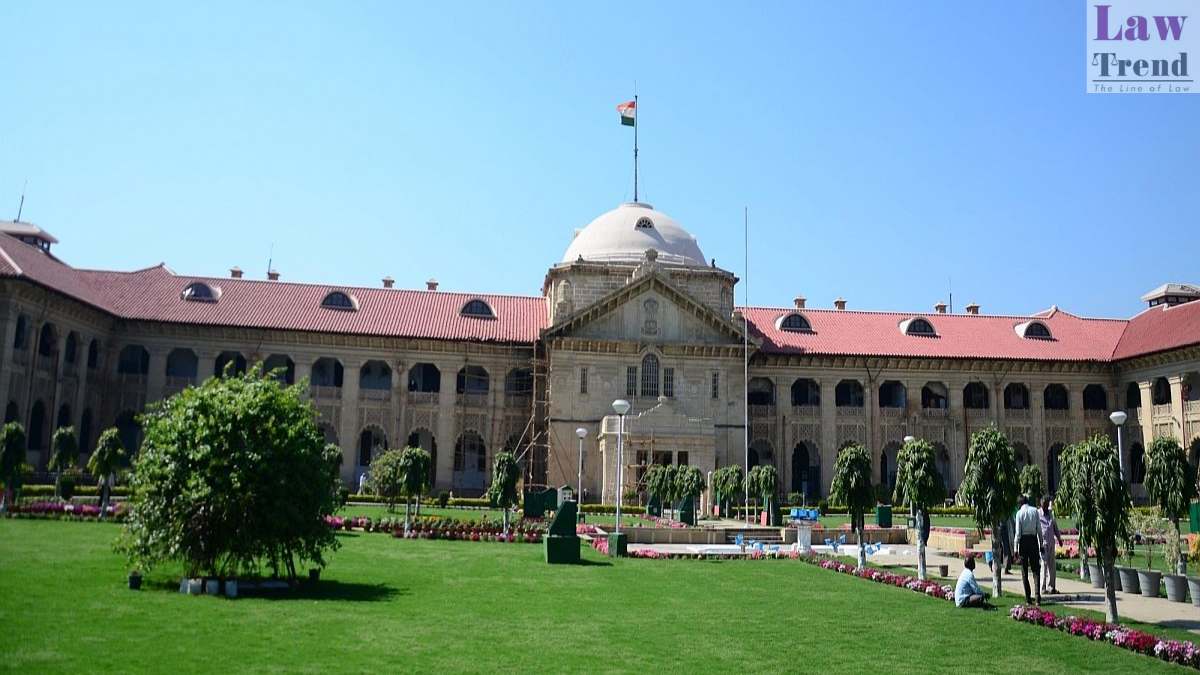
The High Court at Allahabad has upheld the administrative orders transferring maintenance proceedings from Family Courts to Gram Nyayalayas, ruling that in the event of an inconsistency between two special statutes, the later enactment—in this case, the Gram Nyayalayas Act, 2008—must prevail.
A Division Bench comprising Justice Ajit Kumar and Justice Swarupama Chaturvedi dismissed two writ petitions filed by the Civil Court Bar Association, Maharajganj, and the Bar Association, Civil Court, Gorakhpur. The petitioners had challenged administrative orders passed by the District Judges and Principal Judges of the Family Courts in Maharajganj and Gorakhpur, which directed the transfer of cases under Chapter IX of the Code of Criminal Procedure (Cr.P.C.) to various Gram Nyayalayas.
Background of the Case
The dispute arose from administrative orders issued in late 2025, directing the transfer of pending maintenance cases from Family Courts to village courts (Gram Nyayalayas) in Nautanva, Nichlaul, and other regions. The petitioners argued that these transfers were based on an administrative communication from the Registrar General dated December 16, 2021, which suggested that the Gram Nyayalayas Act would have an overriding effect.
Arguments of the Parties
The petitioners contended that the Family Courts Act, 1984, is a “special Statute” that creates an exclusive forum for family disputes, and its jurisdiction could not be divested by administrative orders. They highlighted a significant difference in the appellate structure: while Section 19 of the Family Courts Act allows an appeal directly to the High Court, Section 33 of the Gram Nyayalayas Act relegates litigants to the Court of Session. It was argued that this deprivation of a statutory right to appeal to the High Court was arbitrary and ultra vires.
Conversely, the respondents maintained that the Gram Nyayalayas Act, 2008, is beneficial legislation intended to decentralize justice. They cited Section 12 and the First Schedule of the Act, which explicitly bring maintenance proceedings under the jurisdiction of Gram Nyayalayas. They further relied on Section 18, which provides an overriding effect to the Act in criminal trials.
The Court’s Analysis
The Court examined whether maintenance proceedings pending before a Family Court could be transferred to a Gram Nyayalaya under Section 16 of the 2008 Act. The Bench observed that while both are special legislations, the principle of harmonious construction should be applied first.
However, the Court noted that if two special statutes are irreconcilably inconsistent, the later enactment must prevail. Referring to the legal maxim “leges posteriores priores contrarias abrogant,” the Court stated:
“The underlying rationale is grounded in legislative intent as the legislature, being presumed to be aware of the existing law, is taken to have consciously enacted the subsequent statute to either modify, override, or supplant the earlier provision.”
The Bench cited the Supreme Court decision in Solidaire India Ltd. v. Fairgrowth Financial Services Ltd. (2001), which held that “it is the later Act which must prevail” when two special statutes contain non-obstante clauses.
Regarding the petitioners’ concern over the different appellate forums, the Court noted that Section 33 of the 2009 Act (Gram Nyayalaya Rules) provides for an appeal to the Court of Session, and subsequently, an aggrieved party can approach the High Court under Article 226. “Therefore, there is a layer of protection of rights of parties to the proceedings in every case,” the Bench remarked.
The Court also emphasized that the petitioners had not challenged the vires (legal validity) of Sections 12, 16, or 18 of the Gram Nyayalayas Act. Relying on Edukanti Kistamma v. S. Venkatareddy (2010), the Court held:
“It is a settled legal proposition that challenge to consequential order without challenging the basic order/statutory provision on the basis of which the order has been passed cannot be entertained.”
The Decision
The High Court concluded that the legislative intent behind both statutes was to provide litigant-friendly and accessible forums. It held that the transfer of maintenance proceedings from Family Courts to Gram Nyayalayas under Section 16 of the Gram Nyayalayas Act, 2008, is valid.
“The challenge to impugned orders is not maintainable in the absence of any challenge to the validity of the statutory provision under which it is passed,” the Bench ruled, dismissing both writ petitions.
Case Details
- Case Title: Civil Court Bar Association And Another Versus High Court Of Judicature At Allahabad And 3 Others
- Case No.: WRIT-C No. 37 of 2026
- Bench: Justice Ajit Kumar and Justice Swarupama Chaturvedi
- Date: March 24, 2026




