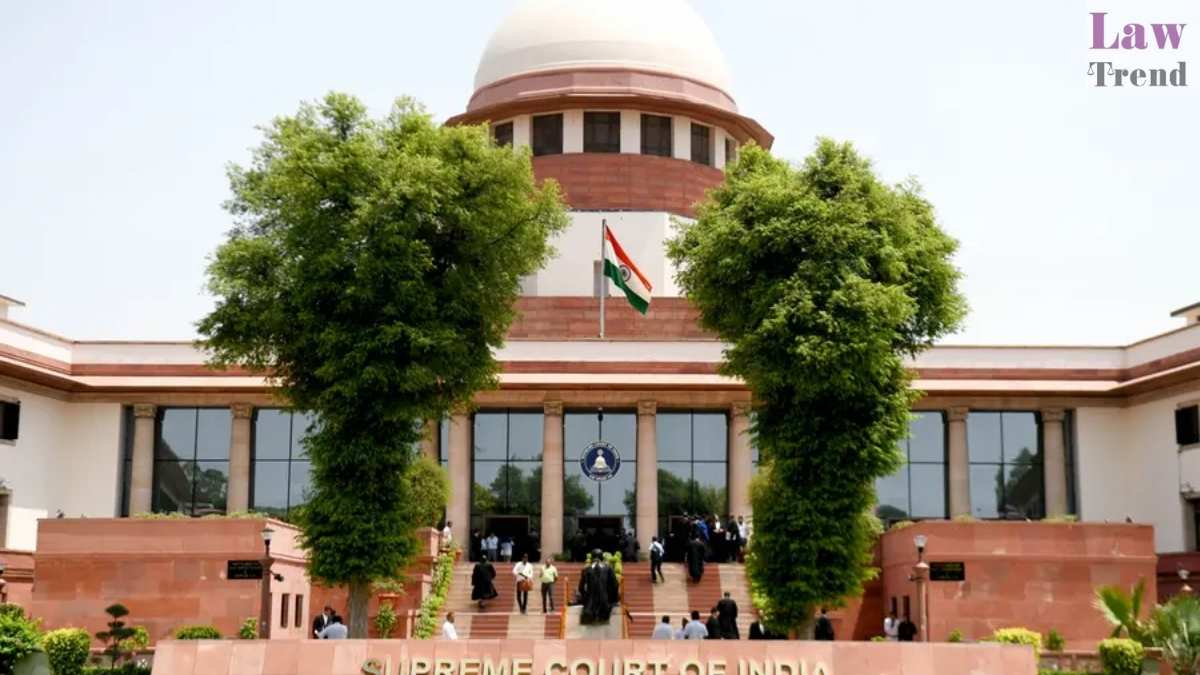
The Supreme Court of India has dismissed an appeal filed by NAK Engineering Company Pvt. Ltd., upholding a High Court order that set aside the company’s impleadment in a suit for the recovery of service charges. The Court held that the appellant was neither a necessary nor a proper party to the suit instituted by the property owners against the original tenant, M/s Kishore Engineering Company.
The Bench, comprising Justice Pankaj Mithal and Justice Prasanna B. Varale, observed that the plaintiff is dominus litis and cannot be compelled to fight against a person against whom they do not claim any relief.
Background of the Dispute
The case originated from a commercial premise located at Churchgate House, Mumbai, originally owned by Keshrichand Shah. The premises were let out to M/s Modern Products Pvt. Ltd., which subsequently sublet an area of 525 sq. feet to Respondent No. 3 (M/s Kishore Engineering Company). In addition to rent, Respondent No. 3 was liable to pay service charges of Rs. 2,100 per month for the use of furniture and fixtures.
Following the death of Keshrichand Shah, his heirs (Respondent Nos. 1 and 2) filed Suit No. 6117 of 2007 in the Bombay City Civil Court against Respondent No. 3 for the recovery of arrears of service charges amounting to Rs. 75,600 for the period from November 2004 to October 2007.
The suit proceeded ex-parte against Respondent No. 3 as they failed to appear. Subsequently, on April 2, 2018, NAK Engineering Company Pvt. Ltd. (the Appellant) filed a Notice of Motion seeking impleadment as a defendant. The Appellant claimed to be the successor of Respondent No. 3 under Part IX of the Companies Act, 1956, and asserted that it was in possession of the premises and running the business.
The Court of First Instance allowed the impleadment vide order dated October 5, 2018. However, the Bombay High Court, exercising jurisdiction under Article 227 of the Constitution, set aside this order on February 21, 2022, holding that the Appellant was not a necessary party. NAK Engineering appealed this decision to the Supreme Court.
Arguments of the Parties
Appellant’s Contentions: Senior Counsel Shri Chander Uday Singh, appearing for the Appellant, argued that the High Court exceeded its supervisory jurisdiction under Article 227 by interfering with an interlocutory order. The Appellant contended that it was the successor to Respondent No. 3 and had been paying service charges and using the furniture since 1991. They argued that any decree passed against the defunct Respondent No. 3 would ultimately be executed against the Appellant, making them a necessary party.
Respondent’s Contentions: Dr. Abhinav Chandrachud, counsel for Respondent No. 1, argued that the Appellant had not approached the court with clean hands. He submitted that summons served on Respondent No. 3 in 2008 bore the Appellant’s stamp, proving they had knowledge of the suit nine years prior to seeking impleadment. The Respondents maintained they were dominus litis (masters of the suit) and had sought no relief against the Appellant in this specific suit for money recovery. They further argued that the Appellant failed to provide authentic proof of being the legal successor of the partnership firm, Respondent No. 3.
Court’s Analysis and Observations
The Supreme Court examined whether the Appellant qualified as a “necessary” or “proper” party under the Code of Civil Procedure.
1. Distinction Between Necessary and Proper Parties Citing the precedent in Ramesh Hirachand Kundanmal v. Municipal Corporation of Greater Bombay (1992), the Court reiterated:
“A necessary party is one without whom no order can be made effectively. A proper party is one in whose absence an effective order can be made but whose presence is necessary for a complete and final decision on the question involved in the proceeding.”
2. Application of the ‘Dominus Litis’ Principle The Court emphasized that the plaintiffs (Respondent Nos. 1 and 2) sought recovery of money solely from Respondent No. 3. Relying on Kanaklata Das v. Naba Kumar Das (1918), the Bench observed:
“…the plaintiff being a dominus litis cannot be compelled to make any third person a party to the suit… against his wish unless such person is able to prove that he is a necessary party to the suit and without his presence, the suit cannot proceed.”
3. Failure to Prove Successorship The Court noted that Respondent No. 3 was a partnership firm with four partners and could not have been converted into a company under Part IX of the Companies Act, 1956, which requires at least seven members. The Court observed:
“The appellant has nowhere established its independent right to be impleaded to defend the suit except for claiming to be the successor of respondent No.3 which, in our opinion, has no legs to stand.”
4. Delay and Conduct The judgment highlighted the Appellant’s delay in approaching the court. The Court noted that the Appellant had knowledge of the suit in 2008 but moved for impleadment only in 2018, after the evidence was closed.
“The impleadment application was filed almost after nine years of the knowledge of the pendency of the suit. Thus, the impleadment has been rightly refused to the appellant by the High Court.”
Decision
The Supreme Court dismissed the appeals, affirming the High Court’s decision to set aside the impleadment. The Court clarified that since the Appellant is not a party, the decree in the suit cannot be executed against it.
“In view of the above discussion, we are of the opinion that the appeals lack merit and are dismissed but with the direction that the decree passed in the suit would not be used against the appellant and would not be implemented against it.”
Case Details:
- Case Title: NAK Engineering Company Pvt. Ltd. v. Tarun Keshrichand Shah and Ors.
- Case No.: Civil Appeal Nos. of 2026 (Arising out of SLP (C) Nos. 6024-6025 of 2022)
- Bench: Justice Pankaj Mithal and Justice Prasanna B. Varale