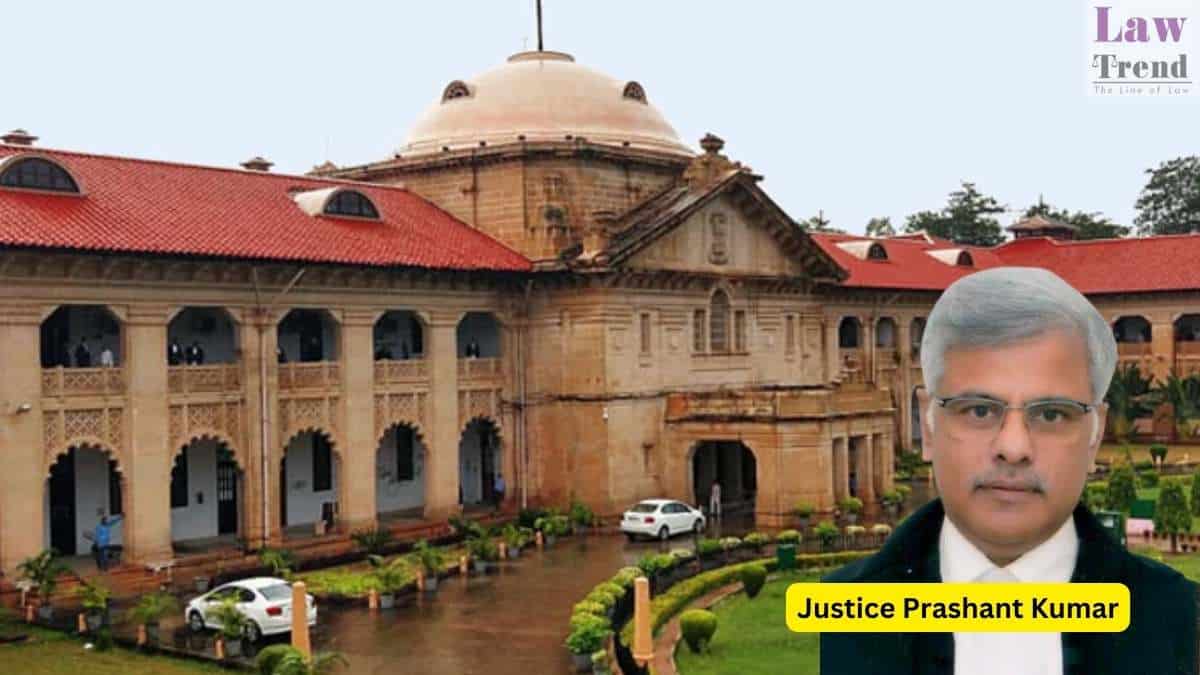
The Lucknow Bench of the Allahabad High Court has dismissed two first appeals, ruling that the Shri Ram Laxman Janki Ji Virajman Mandir Trust in Sitapur is a private trust. Justice Prashant Kumar held that a temple constructed inside a private residential compound, where management remains with the founder’s descendants, cannot be deemed a public trust merely because the public is allowed to worship. Consequently, the Court held that a suit filed under Section 92 of the Code of Civil Procedure (CPC) for the removal of its manager (Sarvarahkar) is non-maintainable.
Background
The dispute relates to a temple constructed by Late Gulzari Lal, a member of the Mali caste, within his residential compound. On January 11, 1973, Gulzari Lal executed a registered Will creating a trust and dedicating his entire property for the management of the temple. He appointed five panchas (members)—Shiv Gopal, Shesh Narain, Puttulal, Munnu Lal, and Brijmohanlal—to supervise the trust. Gulzari Lal passed away on January 16, 1973, and his daughter, Smt. Paraga, succeeded him as the Sarvarahkar.
Following Smt. Paraga’s death in 1977, the panchas appointed Shiv Gopal as the Sarvarahkar. Shiv Gopal successfully defended the trust’s properties in multiple civil suits over the decades against external attempts to collect rent or encroach on the premises. Before his death, Shiv Gopal passed a resolution on August 8, 2004, appointing his son, Shri Narain, as the successor Sarvarahkar.
The appellants, Mool Chandra and others (who are relatives of individuals involved in the earlier litigations), filed Civil Suit No. 2 of 1999 under Section 92 of the CPC. They sought the removal of the Sarvarahkar and the framing of a new administrative scheme to ensure that a majority of the trust members belonged to the Mali caste, aiming to prevent what they termed as the “dominance of Brahmins.” The trial court dismissed the appellants’ suit and decreed a related injunction suit (Civil Suit No. 120 of 2006) in favor of the trust, prompting these appeals.
Arguments
- Arguments of the Appellants:
- The trust is a public trust because the trust deed was executed alongside five non-family members, indicating that they represented the society at large.
- The general public was freely allowed to enter the temple, offer prayers, and make offerings, and worship was never restricted exclusively to the founder’s family.
- The trust deed did not mandate that the Sarvarahkar must belong to the founder’s family, and control was vested in individuals outside the family.
- The photocopy of the resolution dated October 23, 1977, produced by Shri Narain to establish his status as Sarvarahkar, is legally inadmissible under Sections 64 and 65 of the Indian Evidence Act.
- Previous judgments declaring Shiv Gopal as the Sarvarahkar do not bind the appellants as those suits were for injunction or recovery, not declarations under Section 92 of the CPC.
- Arguments of the Respondents:
- The trust is private in nature as the temple was built inside Gulzari Lal’s residential premises and the income generated was not dedicated to any public purpose.
- The founder and his descendants retained continuous control over the management, satisfying the established judicial tests for private trusts.
- The appellants’ suit was not maintainable because the trust itself was a necessary party but was never impleaded, violating core civil procedure rules.
- The issue of Sarvarahkarship is barred by the principles of res judicata under Section 11 of the CPC because the status of Shiv Gopal had already been conclusively decided in Suit No. 277 of 1998, which involved the appellants’ relatives.
- The appellants are rank outsiders attempting to usurp the trust properties and offerings after failing in previous litigations.
Court’s Analysis
Justice Prashant Kumar analysed the character of the trust by evaluating the tests laid down in precedent cases, including Deoki Nandan v. Murlidhar and Radhakanta Deb v. Commissioner of Hindu Religious Endowments.
The Court observed that merely allowing the public to worship does not convert a private temple into a public one. Applying the facts of the case to these tests, the Court observed that the temple’s origin was undisputed: it was established in a private residential compound, the founder retained control, and his daughter succeeded him.
The Court stated: “since the control and management of the Trust in the present case are not vested with large bodies of persons or members of the public at large… the instant Trust cannot be treated as a public Trust, rather it is a private Trust.”
On the maintainability of the suit under Section 92 of the CPC, the Court remarked: “On bare reading of the provisions of Section 92 (public charity) of CPC, it is clear that this provision is applicable only to public trust and not applicable to private trust.”
Regarding the validity of Shri Narain’s appointment, the Court noted that while the photocopy of the 1977 resolution might not be independently admissible, judicial orders in Suit No. 277 of 1998 and Suit No. 50 of 1978 had already affirmed Shiv Gopal’s status. Since Shri Narain was substituted without objection after his father’s death, and his status was never disputed by any committee member, his appointment was held valid.
The Court also found the suit barred by res judicata under Section 11 of the CPC. Noting that the appellants’ relatives had repeatedly litigated the same issue, the Court observed: “the suit in the present case is barred under Section 11 CPC so far as the issue of Sarvarhkarship of the Trust namely, Ram Laxman Janki Ji Virajman Mandir Trust is concerned.”
Decision
The Allahabad High Court dismissed both First Appeal No. 21 of 2023 and First Appeal No. 22 of 2023, finding the arguments raised by the appellants to be without merit. The Court directed the immediate return of the lower court records to the trial court. The Court conclusively ruled that:
- The Shri Ram Laxman Janki Ji Trust is a private trust.
- A suit under Section 92 of the CPC is not maintainable against a private trust.
- The appointment of Shri Narain as the Sarvarahkar is valid.
- The suit is barred under Section 11 of the CPC regarding the issue of Sarvarahkarship.
Case Details
- Case Title: Mool Chandra and another v. Shri Narain (along with First Appeal No. 22 of 2023)
- Case Number: First Appeal No. 21 of 2023
- Bench: Justice Prashant Kumar
- Date: May 27, 2026