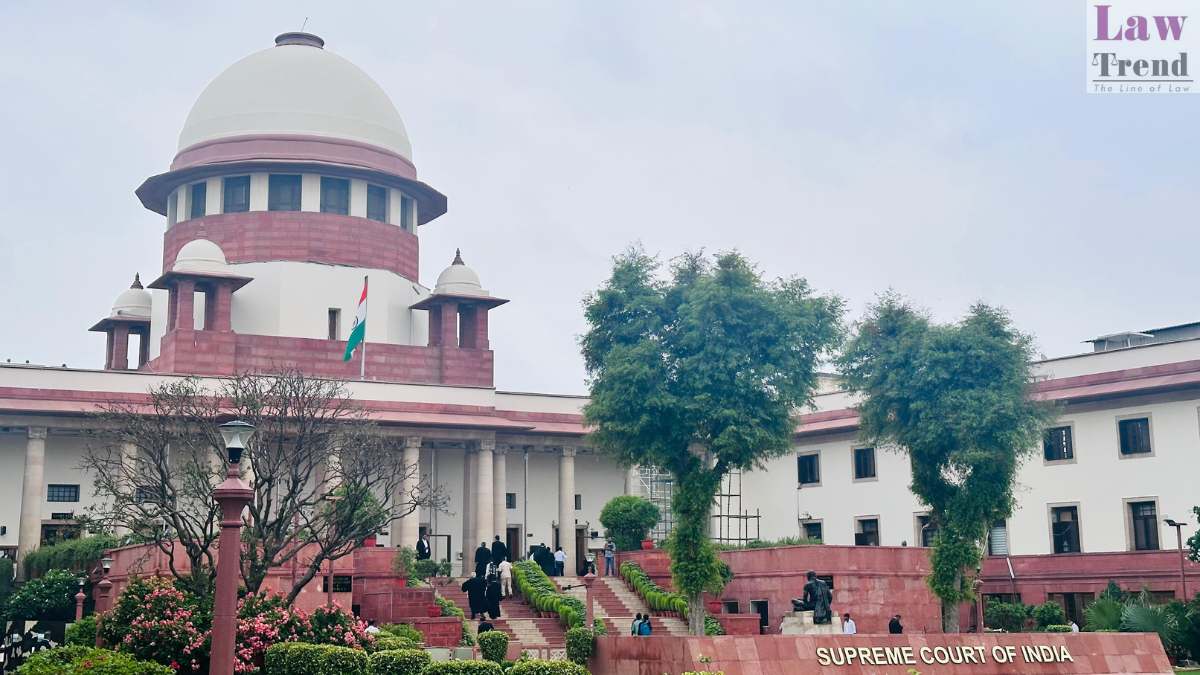
A nine-judge Constitution bench of the Supreme Court will begin hearing on March 17 a long-pending legal issue concerning the meaning of the term “industry” under the Industrial Disputes Act, 1947. The case, which has significant implications for labour law and the scope of employer–employee disputes, will be heard by a bench led by Chief Justice of India Surya Kant.
According to the Supreme Court’s cause list for March 17, the Constitution bench will comprise Chief Justice Surya Kant along with Justices B V Nagarathna, P S Narasimha, Dipankar Datta, Ujjal Bhuyan, Satish Chandra Sharma, Joymalya Bagchi, Alok Aradhe and Vipul M Pancholi.
The court had earlier, on February 16, framed key legal questions that the nine-judge bench will examine. One of the central issues is whether the legal test laid down in paragraphs 140 to 144 of Justice V R Krishna Iyer’s opinion in the landmark Bengaluru Water Supply and Sewerage Board case correctly determines whether an enterprise falls within the definition of “industry”.
Another important question before the bench is whether later legislative developments, including the Industrial Disputes (Amendment) Act, 1982 and the Industrial Relations Code, 2020, have any bearing on how the expression “industry” should be interpreted under the 1947 Act.
The court will also examine whether social welfare activities, schemes, or other functions carried out by government departments and their instrumentalities can be treated as “industrial activities” for the purposes of Section 2 of the Industrial Disputes Act.
While setting the schedule for the hearing, the court allowed the parties additional time to revise or file fresh consolidated written submissions by February 28. The hearing is expected to begin on March 17 and conclude on March 18.
The issue has a long judicial history. In 2017, a seven-judge Constitution bench headed by then Chief Justice T S Thakur directed that the matter be placed before a nine-judge bench, noting the “serious and wide-ranging implications” of the question.
Earlier, in May 2005, a five-judge bench had referred the case to a larger bench to reconsider the interpretation of the word “industry” under Section 2 of the Industrial Disputes Act. The bench observed that the larger bench would have to examine the legal questions in depth and in light of developments over time.
The 2005 order also noted that although the definition of “industry” had been amended by legislation, the amendment had remained dormant for more than two decades. It stated that competing interests of employers and employees, coupled with the legislature and executive’s inability to operationalise the amendment, made it necessary for the court to refer the matter to a larger bench.
The dispute originally arose after a three-judge bench found an apparent conflict between two Supreme Court decisions delivered in 1996 and 2001. In the 1996 ruling, the court relied on a 1978 seven-judge bench judgment and held that the social forestry department fell within the definition of “industry”. However, a two-judge bench in 2001 adopted a different interpretation, prompting the matter to be referred to a five-judge bench.
With the formation of the nine-judge bench, the Supreme Court is now set to undertake a comprehensive examination of the definition of “industry” under the Industrial Disputes Act, a question that could have far-reaching consequences for labour relations and the applicability of labour laws to government and public sector activities.