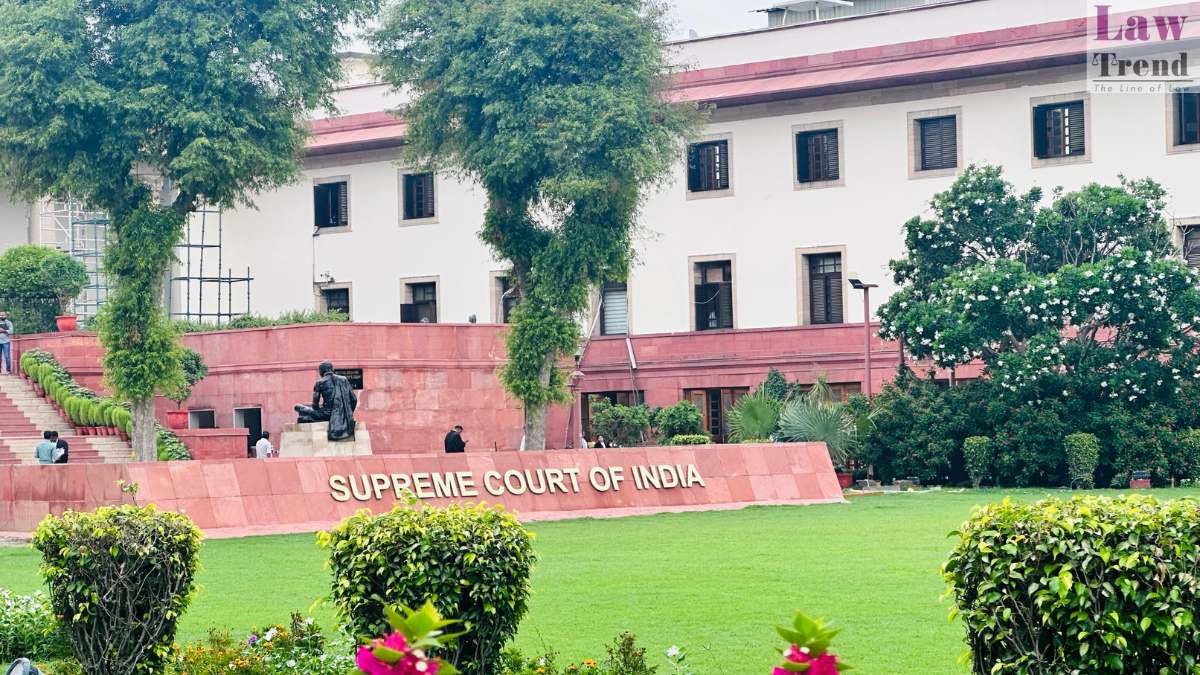
The Supreme Court on Thursday pressed the Union government to consider expanding the Rights of Persons with Disabilities Act to recognise survivors who suffer severe internal organ damage after being forced to ingest acid. The court said this category of victims, often subjected to brutal and “animalistic” violence, must be brought within the protective umbrella of the law so they can access welfare benefits, medical support and enhanced compensation.
The matter was heard by a bench led by Chief Justice Surya Kant, with Justice Joymalya Bagchi. The judges were dealing with a public interest petition filed by acid attack survivor Shaheen Malik, who sought an amendment to the statutory definition of disability to cover cases where perpetrators force victims to swallow acid, causing long-term, life-threatening internal injuries.
Earlier on December 4, the bench had asked all high courts to provide details of pending acid attack trials within their jurisdictions. On Thursday, it directed that all states and Union Territories be impleaded in the proceedings.
Solicitor General Tushar Mehta, appearing for the Centre, told the court that the government was open to examining changes in the law. He acknowledged he had not been aware of the specific pattern of cruelty involving forced ingestion. Damages from acid thrown on the body are currently recognised under the Disabilities Act, but grievous internal injuries due to consumption are not explicitly covered.
“The injuries from forced consumption and consequential damage can certainly be considered,” Mehta said, describing such acts as “animalistic behaviour.”
The CJI suggested that “just an addition of an explanation” to the provision may suffice, and asked Malik’s counsel to prepare a short note outlining the proposed amendments for the government to study. The bench recorded the Centre’s assurance that it would consider all concerns raised and devise an appropriate policy framework.
The court was informed that victims forced to consume acid often receive no more than Rs 3 lakh in compensation. The CJI said he would examine whether this could be enhanced under NALSA schemes. The bench also discussed the CrPC provision allowing courts to order compensation from the accused, but noted that many perpetrators may not have the means to pay.
Directing urgent progress in ongoing prosecutions, the bench asked the Jammu and Kashmir and Ladakh High Court to expedite all five acid attack trials pending there.
The judges also reviewed the status of the criminal case relating to Malik’s own 2009 attack and noted that the matter, pending for 16 years before a Rohini court, has only now reached final arguments. Calling the delay a “national shame,” the CJI remarked, “If the National Capital cannot respond to these challenges, then who will? This is a mockery of the system.”
Malik, who addressed the court personally, told the bench that for years nothing moved in her case. The CJI asked her to file an application explaining the prolonged delay and said the court might even consider initiating action on its own. He directed that her trial must now proceed strictly on a day-to-day basis.
Reiterating the need for systemic reform, the bench said acid attack offences should ideally be tried in special courts because of their grave nature and the devastating consequences for survivors.
“There should be no sympathy for such persons,” the CJI observed, while the Solicitor General added that perpetrators “should meet with the same ruthlessness as done by them.”