

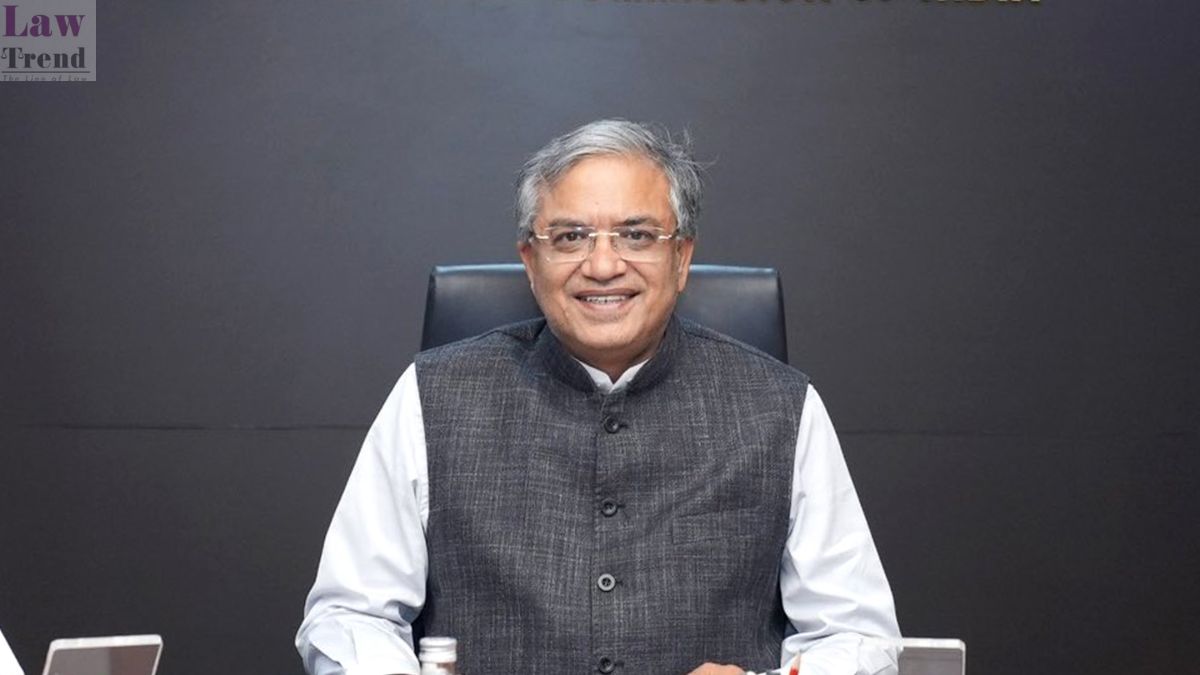
The Supreme Court has declined to pass an ex-parte interim order suspending Chief Election Commissioner Gyanesh Kumar over allegations that key decisions concerning the Special Intensive Revision (SIR) of electoral rolls were taken without the concurrence of the other Election Commissioners.
A bench comprising Chief Justice of India Surya Kant and Justices Joymalya Bagchi and V Mohana said the Election Commission of India (ECI) and other respondents must first be heard before any interim action is considered.
The Court issued notices to the Centre, the ECI, CEC Gyanesh Kumar, Election Commissioners Sukhbir Singh Sandhu and Vivek Joshi, Deputy Election Commissioner Maneesh Garg and DG (IT) Seema Khanna.
The bench indicated that it would examine the official record before deciding whether any of the questioned decisions required interference. It observed that any decision found to have been taken contrary to law could subsequently be annulled.
Court Questions Immediate Suspension of CEC
Senior advocate Vikas Singh, appearing for petitioner Rakesh Kumar Singh, sought the immediate suspension of Gyanesh Kumar, arguing that the alleged unilateral exercise of powers posed a serious threat to electoral democracy.
The bench, however, questioned the practical consequences of such an order and asked who would conduct elections if the Chief Election Commissioner were restrained from functioning.
Singh responded that the other two Election Commissioners could discharge the Commission’s functions.
CJI Surya Kant said the statutory framework governing the Commission was mandatory and indicated that the Court could undo any decision found to have been taken in violation of the law.
Justice Joymalya Bagchi also questioned whether such relief could be granted without hearing the ECI. He observed that if the records ultimately established that decisions had not been taken unanimously or by majority as required, the Court could examine whether they were ultra vires.
The Chief Justice also cautioned against passing orders solely on the basis of newspaper reports.
Plea Alleges 14 Decisions Were Taken Despite Objections
The petition alleges that at least 14 important decisions connected with the SIR were taken in the name of the ECI despite recorded objections from Election Commissioners Sukhbir Singh Sandhu and Vivek Joshi.
According to the plea, the objections were recorded between October 2025 and August 2026.
The petition claims that communications were issued in the ECI’s name without approval of the Commission, agendas and minutes of meetings were not circulated for more than a year, and changes were made to electoral-roll systems without the participation or approval of the two Election Commissioners.
The petitioner argues that powers vested under Article 324 in the Election Commission as a multi-member constitutional body cannot be exercised individually by the Chief Election Commissioner in his capacity as Chairman.
Form 6 Changes Among Issues Raised
One of the issues raised concerns alleged changes to Form 6 during the SIR exercise.
The petition states that Election Commissioner Vivek Joshi objected to requiring SIR-linked disclosures through Form 6 without first amending the Registration of Electors Rules, 1960. According to the plea, Election Commissioner Sukhbir Singh Sandhu later supported that objection.
The petition also raises concerns over the alleged centralisation of the electoral-roll database and access to ERONet/ECINet by statutory field-level authorities.
It states that Joshi proposed an independent audit of database access credentials, while Sandhu questioned the authority of the ECI’s Director General (IT) to restrict access available to statutory electoral officers.
Another allegation relates to appeals filed in the ECI’s name before West Bengal Appellate Tribunals against voters whose inclusion had been directed by judicial officers. The petition claims Sandhu questioned who had authorised those appeals and under what authority.
Section 18 Cited on Collective Decision-Making
The plea relies on Section 18 of the Chief Election Commissioner and Other Election Commissioners Act, 2023.
According to the petitioner, the provision requires the Commission’s business to be conducted unanimously wherever possible and, where there is a difference of opinion, by majority.
Among the interim reliefs sought are preservation of electoral-roll data and audit trails, a restraint on further substantive alteration of Form 6 and protection against irreversible changes to electoral-roll data while the matter remains pending.
The petitioner has also sought an interim direction restraining Gyanesh Kumar from exercising the functions of Chief Election Commissioner and requiring the Commission’s business to be conducted by the other two Election Commissioners.




