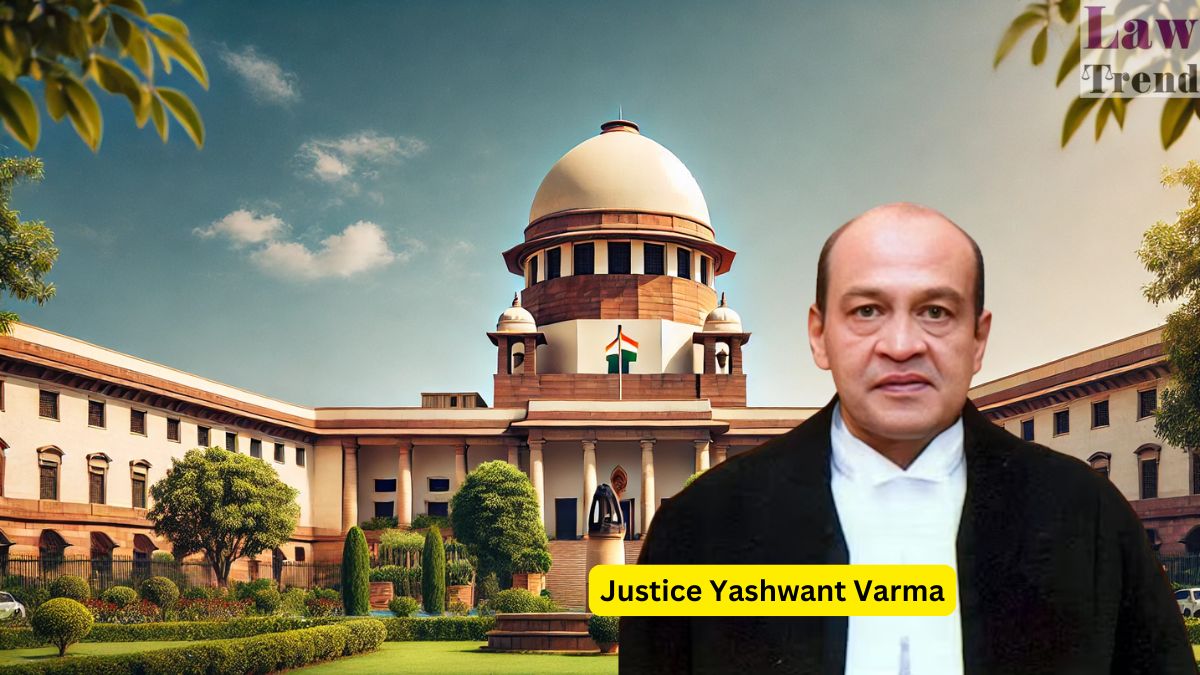
In a significant development, the Supreme Court has dismissed the writ petition filed by Allahabad High Court judge Justice Yashwant Varma, challenging the decision of the Lok Sabha Speaker to constitute an inquiry committee to probe the allegations of misconduct against him.
A Bench comprising Justice Dipankar Datta and Justice Satish Chandra Sharma pronounced the order, clearing the way for the three-member committee constituted under the Judges (Inquiry) Act, 1968 to proceed with the investigation into the allegations of “proven misbehaviour” following the recovery of burnt currency notes from his official residence in 2025.
The Legal Challenge: “Unilateral” Constitution of Committee
Justice Yashwant Varma had approached the Supreme Court under Article 32 of the Constitution, assailing the validity of the notification issued by the Lok Sabha Speaker on August 12, 2025. The Speaker had constituted a three-member Inquiry Committee comprising Supreme Court judge Justice Aravind Kumar, Madras High Court Chief Justice Manindra Mohan Shrivastava, and Senior Advocate B. Vasudeva Acharya.
The primary ground of challenge was based on the Proviso to Section 3(2) of the Judges (Inquiry) Act, 1968.
Senior Advocates Mukul Rohatgi and Siddharth Luthra, appearing for Justice Varma, argued that impeachment motions were moved in both Houses of Parliament (Lok Sabha and Rajya Sabha) on the same day (July 21, 2025). They contended that under the statutory scheme, when notices of motion are given in both Houses on the same day, a “Joint Committee” must be constituted by the Speaker of the Lok Sabha and the Chairman of the Rajya Sabha acting jointly.
The petitioner argued that the Lok Sabha Speaker acted unilaterally in constituting the committee without waiting for the decision of the Rajya Sabha Chairman, thereby violating the mandatory procedural safeguards prescribed under the Act.
Arguments of the Lok Sabha Secretariat
Solicitor General Tushar Mehta, appearing for the Lok Sabha Secretariat and the Union of India, vehemently opposed the petition. He submitted that the factual premise of the petitioner’s argument—that motions were “admitted” in both Houses—was incorrect.
The Solicitor General clarified that while a motion was indeed admitted by the Lok Sabha Speaker, the motion in the Rajya Sabha was never admitted. He informed the Court that the Rajya Sabha Deputy Chairman had rejected the motion on August 11, 2025, finding it to be “defective” and not in order.
Mr. Mehta argued that the proviso to Section 3(2) applies only when motions are admitted in both Houses. Since the Rajya Sabha motion was rejected at the threshold, the requirement for a joint committee did not arise, and the Lok Sabha Speaker was fully within his jurisdiction to constitute the committee independently under the main provision of Section 3(2).
Court’s Observations and Decision
The Supreme Court rejected the petitioner’s contentions, finding no illegality in the procedure adopted by the Lok Sabha Speaker.
The Bench observed that the mere introduction of a motion in both Houses does not automatically trigger the requirement for a joint committee. The statutory requirement for a joint decision by the Speaker and the Chairman arises only when the motions are found to be in order and are admitted by the presiding officers of both Houses.
Since the Rajya Sabha motion had failed to pass the scrutiny of admission, the Court held that the Lok Sabha Speaker was competent to proceed with the constitution of the Inquiry Committee based on the motion admitted in the Lower House. The Court refused to interfere with the ongoing parliamentary process, noting that the Judges (Inquiry) Act is a self-contained code.
Background of the Controversy
The impeachment proceedings stem from a sensational incident in March 2025, when a fire broke out at the official residence of Justice Varma (who was then a judge of the Delhi High Court). Firefighters and police personnel allegedly recovered substantial amounts of burnt and partially burnt currency notes from the storeroom of the residence.
Following the incident, the then Chief Justice of India, Justice Sanjiv Khanna, constituted an “In-House Inquiry Committee” to probe the matter. The in-house panel indicted Justice Varma, concluding that he had “covert or active control” over the cash and had failed to provide a plausible explanation for its source.
Based on the in-house report, the CJI recommended his removal to the Prime Minister and the President. Subsequently, 146 Members of Parliament in the Lok Sabha submitted a notice of motion for his removal, leading to the current proceedings.
Justice Varma had previously challenged the In-House Inquiry report as well, which was also dismissed by the Supreme Court in August 2025.