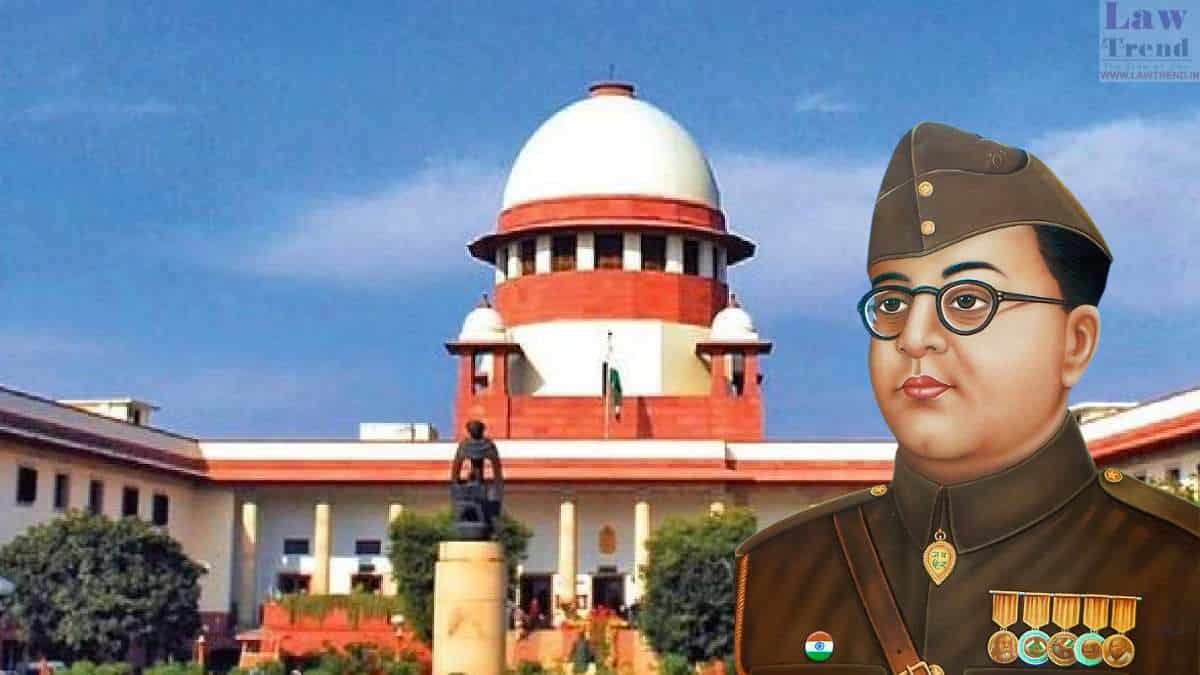
The Supreme Court on Thursday declined to entertain a petition seeking directions to bring to India the ashes believed to be those of freedom fighter Netaji Subhas Chandra Bose from Tokyo’s Renkoji Temple. After the bench indicated its unwillingness to examine the matter, the petitioner, Ashis Ray—Bose’s grand nephew—sought permission to withdraw the plea, which the court allowed.
The matter came up before a bench comprising Chief Justice Surya Kant and Justices Joymalya Bagchi and Vipul M. Pancholi. Senior advocate Abhishek Singhvi appeared on behalf of the petitioner.
At the outset of the hearing, Singhvi told the court that the plea had been filed on behalf of family members who wished to “give a decent quietus to the ashes.” The petition sought directions for bringing back to India the remains believed to belong to Bose, which are kept at the Renkoji Temple in Tokyo.
During the hearing, the bench questioned the basis of the claim regarding the ashes. The Chief Justice asked, “First of all, where are the ashes? What is that proof?” while noting that Bose was “one of the greatest leaders of our nation” whose sacrifice commands respect across the country.
The court also observed that the issue had previously come before it. The bench pointed out that a similar petition had been dismissed by the Supreme Court last year.
Responding to this, Singhvi argued that the earlier case dealt with a different issue—whether Bose had died or not. He also submitted that it was recorded that every Indian head of state visiting Japan had paid obeisance at the Renkoji Temple.
The bench, however, remarked, “That is inference. Until and unless he dies, there can’t be ashes.”
The judges further sought clarity on whether the request had the support of Bose’s immediate family members. The bench asked how many family members supported the plea.
Singhvi told the court that Bose had only one heir—his 84-year-old daughter—and that the petitioner was his grand nephew. He added that the daughter was present virtually during the proceedings.
The bench responded that if the legal heir wanted the ashes to be brought to India, she must come forward before the court. “We respect her sentiments, and we would ensure that her sentiments are translated into legal action. But she must step forward,” the court said.
The judges also noted that, to their knowledge, there were differences within Bose’s family regarding the issue surrounding the incident and the alleged ashes.
After the court expressed its disinclination to examine the plea, Singhvi sought permission to withdraw the petition. The bench permitted the withdrawal, bringing the proceedings to a close.