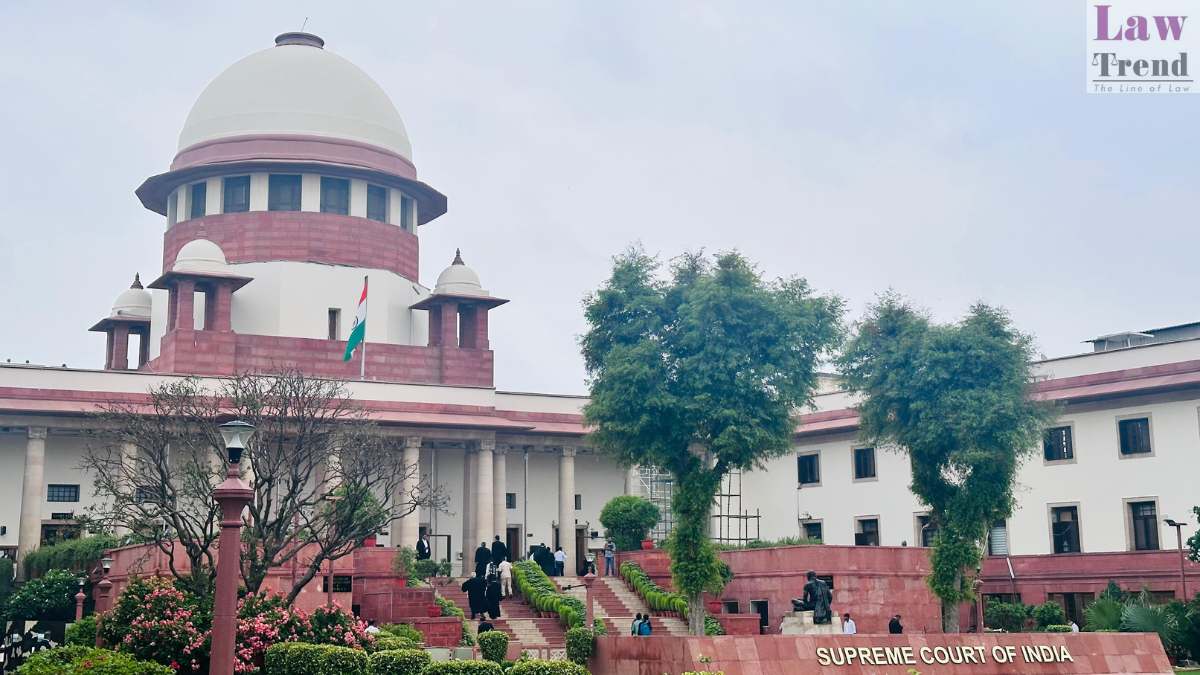
The Supreme Court of India has set aside the conviction of an accused in a 2004 murder case, holding that the prosecution failed to prove its case beyond reasonable doubt. The Bench, comprising Justice Manoj Misra and Justice Joymalya Bagchi, observed that the testimony of the solitary supporting eyewitness was “not of such a stellar quality” to form the sole basis of conviction, particularly when contradicted by other injured witnesses regarding the visibility at the crime scene.
The Court allowed the appeal filed by Anjani Singh, acquitting him of charges under Sections 302, 307, and 504 of the Indian Penal Code (IPC), overturning the judgment of the Allahabad High Court dated July 5, 2019.
Background of the Case
The case dates back to October 20, 2004, when a function for the establishment of a Durga idol was held at a village, followed by a drama play. The prosecution alleged that during the play, the appellant, Anjani Singh, beat the son of the informant, Anugrah Narain Singh (PW-1). When PW-1 objected, Anjani allegedly left the scene in anger.
It was alleged that around 9:00 PM, Anjani returned with a country-made pistol, accompanied by his brother Ravindra Singh (armed with a licensed rifle) and their father Rishabh Dev Singh (armed with a lathi). The accused allegedly exhorted each other to kill PW-1. Ravindra and Anjani reportedly opened fire, causing injuries to PW-1 and several others, including Harendra Kumar Yadav, Mritunjay Kumar Yadav, Vimlesh Dubey, and Umesh Kumar Thakur. Two individuals, Krishna Kant Verma and Banarasi, died at the spot.
The Trial Court convicted all three accused. On appeal, the Allahabad High Court acquitted Rishabh Dev Singh but affirmed the conviction of Anjani Singh and Ravindra Singh. Ravindra Singh passed away during the pendency of the appeal before the Supreme Court, causing his appeal to abate. The present appeal survived qua Anjani Singh alone.
Arguments of the Parties
The counsel for the appellant argued that the prosecution’s case rested entirely on the ocular account of PW-1, whose testimony was unreliable. It was submitted that other injured witnesses testified that the lights were off at the time of the incident, making identification impossible. The defence highlighted discrepancies regarding the seizure of the rifle, noting that the magazine recovered from the spot did not match the seized rifle. Furthermore, it was argued that PW-1 had a criminal history and his injuries appeared superficial.
Per contra, the State contended that the FIR was prompt and named all accused. The counsel for the State argued that the testimony of PW-1, an injured witness, was consistent regarding the time and place of occurrence and the participation of the appellant. It was submitted that hostile witnesses did not damage the substratum of the prosecution’s case.
Court’s Analysis and Observations
The Supreme Court conducted a detailed scrutiny of the evidence, noting that apart from PW-1, no other eyewitness supported the prosecution’s case. The Court observed that other injured witnesses consistently deposed that the “lights went off” at the time of the indiscriminate firing.
On the Reliability of the Solitary Eyewitness (PW-1): The Bench found PW-1’s testimony to be “wavering” and inconsistent. The Court noted contradictions regarding the location of the firing and the specific role of the appellant. Justice Misra, writing for the Bench, observed:
“PW-1’s wavering testimony does not inspire our confidence for several reasons… though firing by Ravindra from rifle is specifically alleged, firing of shots from pistol by Anjani to target any particular person is not specifically alleged, rather the testimony is to the effect that Anjani did not fire any shot at those who were trying to snatch his brother’s rifle.”
The Court further remarked that it was inexplicable why the accused would resort to indiscriminate firing killing two innocent persons against whom no motive was shown, especially if PW-1 was the sole target.
On the Absence of Light: The Court placed significant weight on the testimony of other witnesses who stated that darkness prevailed during the incident. The judgment noted:
“Notably, witnesses other than PW-1 are consistent that lights went off at the time of firing… The best way to ensure darkness is to switch off lights, and where supply of electricity is from a generator to switch it off. Interestingly, the generator operator got killed in the incident.”
Discrepancies in Forensic Evidence: The Court highlighted a critical flaw in the prosecution’s evidence regarding the weapon. A magazine recovered from the spot did not match the rifle seized from co-accused Ravindra. The Court observed:
“The magazine recovered from the spot, could not be forensically connected with the seized rifle… This throws doubt on the theory propounded by the prosecution that gunshots were aimed at someone else but by chance they hit the two deceased.”
Decision
The Supreme Court held that the prosecution failed to prove the case beyond reasonable doubt. The Court ruled that the benefit of doubt ought to have been extended to the appellant by the lower courts.
“In such circumstances, taking a conspectus of the entire evidence as also the fact that all eye witnesses, except PW-1, have not supported the prosecution case and have consistently deposed about there being no light at the time of occurrence, in our view, it was a fit case where the benefit of doubt ought to have been extended to the appellant.”
Accordingly, the appeal was allowed, and the conviction of Anjani Singh was set aside. The Court directed that his bail bonds be discharged.
Case Details:
- Case Title: Anjani Singh v. The State of Uttar Pradesh
- Case Number: Criminal Appeal No. 591 of 2020 (2026 INSC 3)
- Coram: Justice Manoj Misra and Justice Joymalya Bagchi