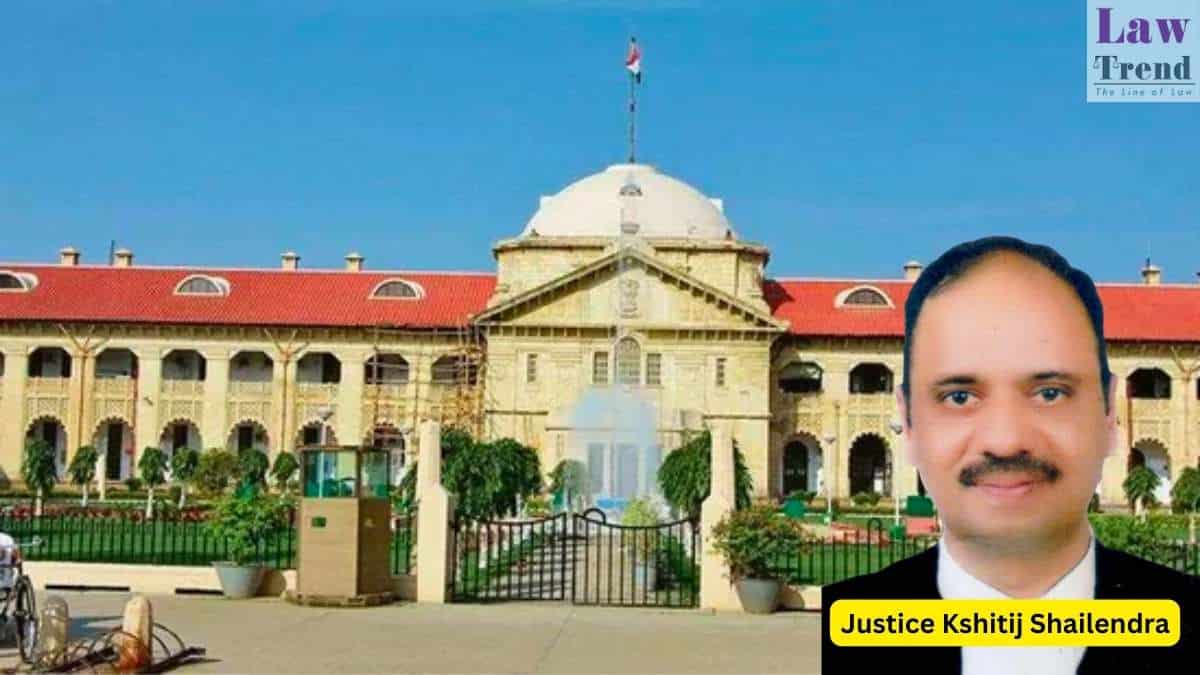
The Allahabad High Court has dismissed a criminal revision petition challenging the framing of charges under Section 306 of the Indian Penal Code (IPC) (Abetment of suicide), reiterating that at the stage of framing charges, the court is not required to record detailed reasons. Justice Kshitij Shailendra held that if there is a ground for “presuming” that the accused has committed the offence, it is sufficient to proceed, and a roving inquiry into the evidence is not warranted at this initial stage.
The High Court was hearing a revision petition filed by Ashok Singh @ Kali Singh challenging two orders: the order dated January 24, 2024, by the Additional District and Sessions Judge/Special Judge (P.C. Act), Gorakhpur, framing charges under Section 306 IPC, and the order dated October 22, 2021, by the Additional Chief Judicial Magistrate-I, Gorakhpur, taking cognizance of the offence. The Court dismissed the revision, vacating the interim order and paving the way for the trial to proceed.
Background of the Case
The prosecution’s case originated from an incident reported on March 2, 2020. A ward boy at District Hospital, Gorakhpur, informed the police about a body in the mortuary. A suicide note was discovered in the pocket of the deceased, Deen Dayal Singh, the brother of the revisionist, Ashok Singh.
The First Information Report (FIR) was registered on the same day, alleging that the suicide note indicated harassment by the applicant as the reason for the deceased’s death, which was caused by ante-mortem injuries from a train. Following the investigation, a charge sheet was submitted, and the Magistrate took cognizance in October 2021. Subsequently, in January 2024, the Sessions Court framed charges under Section 306 IPC.
Arguments of the Parties
The Revisionist’s Contentions: Counsel for the revisionist, Shri Rajeev Chaddha, raised several grounds challenging the proceedings:
- Ingredients of Abetment: It was argued that the ingredients of abetment under Section 107 IPC were not attracted.
- Reliability of Suicide Note: The counsel contended the suicide note was “planted.” He pointed out that signatures allegedly made by the deceased appeared after just two lines of the first paragraph, followed by further writing. He argued that the first paragraph implicated the father of the deceased, who had already passed away four months prior to the incident.
- Forensic Evidence: Reliance was placed on a Forensic Science Laboratory (FSL) report dated August 3, 2021, which stated that for a satisfactory examination, 10-15 signatures were required, which had not been provided.
- Contradictory Statements: The counsel highlighted that the deceased’s widow initially declined to give a statement and later gave a statement regarding property disputes and harassment. He also noted her initial application to the police stated the suicide was due to business loss and no family member was responsible.
- Procedural Irregularity: A technical objection was raised regarding the dates; the charge sheet bore an endorsement dated October 23, 2021, while the Magistrate took cognizance a day prior, on October 22, 2021.
The State’s Arguments: The learned Additional Government Advocate (A.G.A.) opposed the revision, submitting:
- The suicide note, coupled with witness statements collected during the investigation, provided sufficient evidence of instigation.
- At the stage of framing charges, the court is not required to record detailed reasoning and can proceed even on “grave suspicion.”
Court’s Analysis and Observations
On the Order Taking Cognizance The Court first addressed the discrepancy regarding the dates of the charge sheet and the cognizance order. The revisionist argued that cognizance (22.10.2021) could not be taken before the submission of the charge sheet (endorsed 23.10.2021). Justice Shailendra dismissed this as a “human error in writing the date,” observing that the Court “cannot be too wild in its vision” to assume cognizance was taken without the charge sheet. The Court held that such a discrepancy does not vitiate the proceedings.
On Framing of Charge (Section 227 vs. 228 Cr.P.C.) The Court undertook a detailed analysis of Sections 227 (Discharge) and 228 (Framing of Charge) of the Cr.P.C. The Judge observed:
“The language used in Sections 227 and 228 is clear and unambiguous. Whereas reasons are required to be recorded while discharging the accused under Section 227; Section 228 does not require the Judge to record his reasons for framing charge, rather what is sufficient for him at that stage is that there is ground for ‘presuming that an offence has been committed’.”
Citing the Supreme Court in Amit Kapoor v. Ramesh Chander (2012) and Dinesh Tiwari v. State of U.P. (2014), the Court reiterated that at the framing of charge stage, the court is concerned with “strong suspicion” rather than proof.
On the Suicide Note and Forensic Reports Regarding the contentions about the suicide note’s genuineness and the placement of signatures, the Court held that these are matters for trial. The Court noted:
“The Court cannot presume, at this stage, that after putting signatures at the end of first paragraph, no further writing could be made by the deceased… Death of the father of the deceased occurred on 15.12.2019 also, at this stage, cannot be sufficient to discard the suicide note.”
The Court also addressed the conflicting reports regarding handwriting—an FSL report indicating signatures were disputed but handwriting tallied, and a private report by an advocate/forensic scientist claiming discrepancies. Justice Shailendra stated, “no definite opinion, at this stage, can be expressed regarding validity of the suicide note… It is for the trial court to record a finding based upon the documentary and oral evidence.”
Distinguishing Precedents The Court distinguished the present case from the Supreme Court’s recent judgment in Jayedeepsinh Pravinsinh Chavda v. State of Gujarat (2025), noting that the Apex Court in that matter was dealing with a discharge application where ingredients of the offence were absent. In contrast, the present case involved a challenge to framing charges where “suspicion/grave suspicion/presumption did exist.”
Reliance was placed on Satish Mehra v. Delhi Administration (1996) to hold that a roving inquiry into the evidence is not warranted at this stage.
Decision
The High Court dismissed the Criminal Revision No. 1352 of 2024, upholding the orders of the lower courts.
“In view of the above observations made by the Hon’ble Supreme Court, this Court is of the view that suspicion/grave suspicion/presumption did exist which obliged the Court to frame charge U/S 306 I.P.C.”
The Court clarified that its observations are confined to the stage of framing charges and do not express an opinion on the merits of the case.
Case Details:
- Case Title: Ashok Singh @ Kali Singh Versus State of U.P. and another
- Case Number: Criminal Revision No. 1352 of 2024
- Judge: Justice Kshitij Shailendra.
- Citation: 2026:AHC:2274