

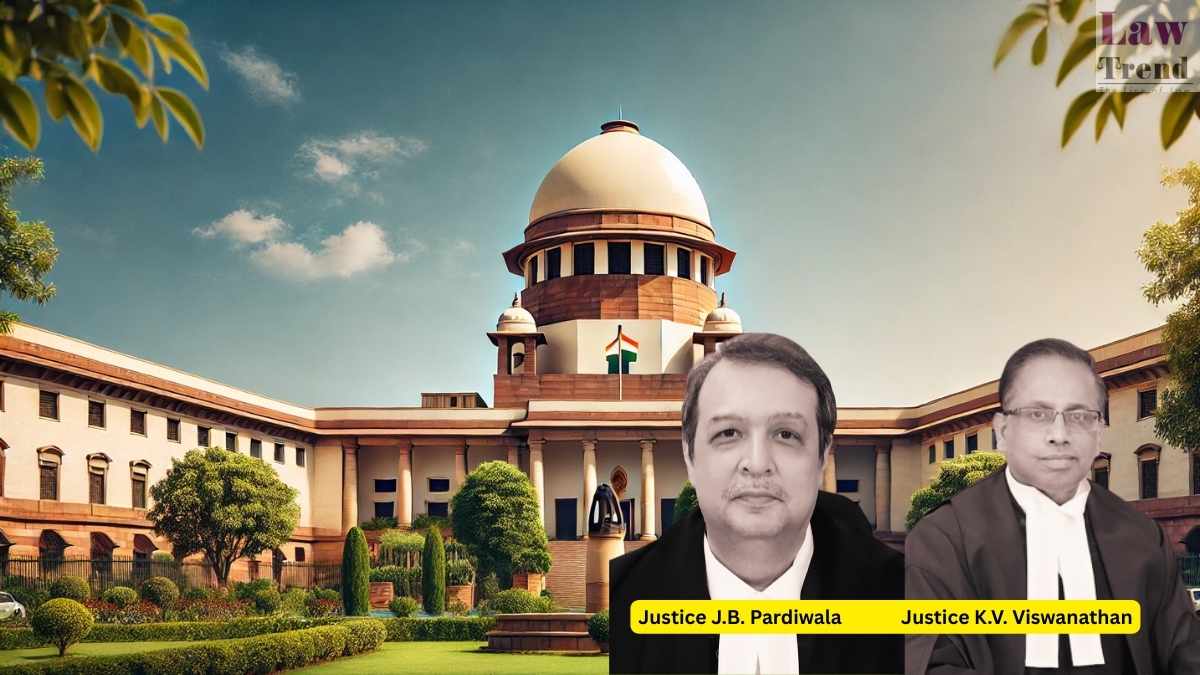
The Supreme Court of India has held that the non-negotiable principles of the Rule of Law are central to the interpretation of contractual clauses, especially when the State or its instrumentalities are parties. A Bench comprising Justice J.B. Pardiwala and Justice K.V. Viswanathan set aside a High Court judgment that had nullified an arbitral award on the grounds of a restrictive “default” clause in a Manning Agreement.
The Court emphasized that “one party to a contract cannot decide whether the other party was in wilful breach or has committed neglect, when liability by the other party is disputed.”
Background of the Case
On December 26, 2008, a “Manning Agreement” was entered into between M/s ABS Marine Services (the appellant) and the Andaman and Nicobar Administration (the respondent) for manning 17 vessels. On July 6, 2009, a vessel named M.V. Long Island struck a submerged rock while drifting in rough seas. In February 2013, the Administration issued a show-cause notice, and subsequently, on September 25, 2014, unilaterally recovered Rs. 2,87,84,305/- from the appellant’s pending bills as a penalty for the grounding.
The matter was referred to arbitration by the Supreme Court in 2015. The Arbitrator, Hon’ble Mr. Justice S.S. Nijjar (Retd.), ruled that Clause 3.20 of the agreement—which claimed the Administration’s decision was final and could not be challenged in court or arbitration—was void under Section 28 of the Indian Contract Act, 1872. The Arbitrator awarded the appellant the recovered amount with interest.
While the District Judge upheld the award, the High Court at Calcutta (Circuit Bench at Port Blair) set it aside, holding that the dispute fell under “excepted matters” as per Clause 3.20 and was beyond the arbitrator’s jurisdiction.
Key Arguments
Appellant: Senior Advocate Mr. S. Niranjan Reddy argued that the arbitrator has jurisdiction to decide breaches and negligence. He contended that Clause 3.20, by excluding both courts and arbitration, would render the appellant remediless, and that the Administration had already acquiesced to the arbitration process.
Respondent: Additional Solicitor General Mr. Vikramjit Banerjee argued that the arbitrator, being a “creature of the agreement,” could not judge the validity of a clause within that same agreement. He maintained that Clause 3.20 and 3.22 (the arbitration clause) together demarcated the boundaries of jurisdiction, explicitly excluding “excepted matters” like the Administration’s final decision on defaults.
Court’s Analysis and Observations
The Supreme Court examined the interplay between Clause 3.20 (Default) and Clause 3.22 (Arbitration). The Court identified several fatal flaws in the Administration’s interpretation:
1. No Party Can Be a Judge in Its Own Cause: The Court noted that the Administration’s stand violated the fundamental principle that no party can be a judge in its own cause. Citing State of Karnataka v. Shree Rameshwara Rice Mills (1987) and J. G. Engineers Private Limited v. Union of India (2011), the Bench observed:
“A contract cannot provide that one party will be the arbiter to decide whether he committed breach or the other party committed breach. That question can only be decided by only an adjudicatory forum, that is, a court or an Arbitral Tribunal.”
2. Violation of Section 28 of the Contract Act: The Court held that any clause barring any action in both a court of law and before an arbitrator is void.
“There is a fundamental rule of interpretation that no construction shall be placed which would lead to a vacuum in legal remedies.”
3. Concept of ‘Excepted Matters’: The Court clarified that “excepted matters” are generally those where liability is admitted and only quantification remains. Since the appellant disputed the “wilful act or negligence,” the Administration could not unilaterally decide the liability.
“Matters may be ‘excepted’ from arbitration… but a vacuum in legal remedies cannot result. ‘Except’ matters one may but ‘Exclude’ justice, one cannot.”
4. Observations on State Contracts: The Bench expressed “shock” at the Administration’s contention that its decision was immune from challenge. Justice Viswanathan remarked that such clauses harken back to “times when might was right.” The Court advised the State to stop incorporating clauses that foreclose redress through courts.
Decision
The Supreme Court concluded that the dispute regarding liability was fully arbitrable under the widely worded Clause 3.22. The Court found the High Court’s reasoning “seriously flawed” and restored the Arbitrator’s award dated May 8, 2017.
The appeals were allowed, and the recovery of Rs. 2.87 crore from the appellant was held to be improper in the absence of an independent adjudication of negligence.
Case Details:
- Case Name: M/s ABS Marine Services v. The Andaman and Nicobar Administration
- Case No.: Civil Appeal Nos. 3658-3659 of 2022
- Bench: Justice J.B. Pardiwala and Justice K.V. Viswanathan
- Date: March 23, 2026




