

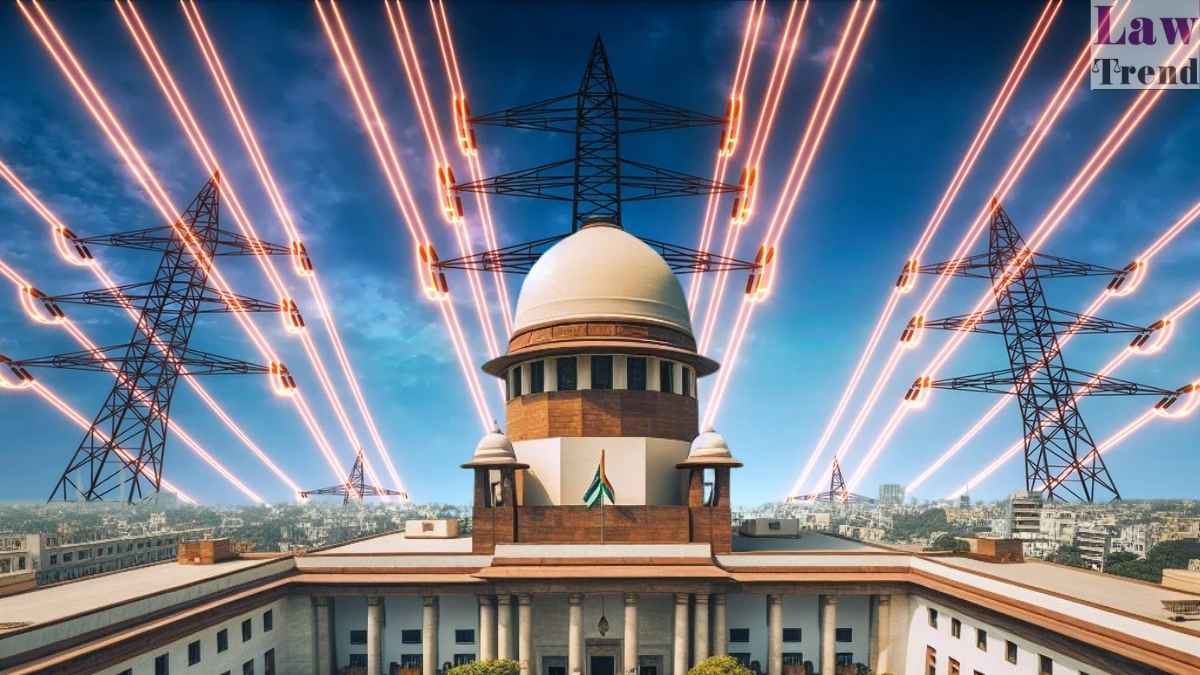
The Supreme Court of India has upheld the statutory power of the State of Maharashtra to withdraw or modify electricity duty exemptions previously granted to captive power generators. However, in a significant observation on the principles of fairness, the Court ruled that such withdrawals cannot be abrupt and must follow a reasonable notice period to allow industries to reorganize their affairs.
A Bench comprising Justice Pamidighantam Sri Narasimha and Justice Alok Aradhe delivered the judgment in a batch of appeals filed by the State of Maharashtra against a High Court order that had struck down notifications issued in 2000 and 2001.
Background of the Case
The dispute originated from the Bombay Electricity Duty Act, 1958, which provides for the levy and collection of duty on electrical energy consumption. Section 5A of the Act empowers the State Government to exempt certain classes of premises or purposes from this duty in the “public interest.”
Beginning in 1994, the State issued notifications granting exemptions to industries consuming energy generated through captive power plants. This policy was aimed at encouraging industrial self-sufficiency. However, on April 1, 2000, and April 4, 2001, the State issued new notifications that effectively withdrew or reduced these exemptions.
The 2001 notification specifically limited the exemption to energy generated through non-conventional sources or imposed a duty of fifteen paise per unit on others. Although the State restored the full exemption in 2005, it refused to grant relief for the intervening period (2000–2005). The High Court subsequently quashed the 2000 and 2001 notifications, labeling them as “discriminatory, arbitrary, and suffering from vice of non-application of mind,” prompting the State’s appeal to the Apex Court.
Arguments of the Parties
The State of Maharashtra argued that the power to grant a statutory exemption inherently includes the power to withdraw it. They contended that “augmentation of revenue is in public interest” and that a “budgetary deficit is a valid ground to withdraw the exemption.” The State further argued that captive power producers have no fundamental right to a permanent tax holiday.
Conversely, Reliance Industries Ltd. and other respondents argued that the State was bound by the doctrines of promissory estoppel and legitimate expectation. They submitted that acting on the State’s earlier representation, they had made “huge investments” to set up captive power plants. They contended that any withdrawal must be “reasonable, non-arbitrary, just and fair” and compliant with Article 14 of the Constitution.
Court’s Analysis
The Court began by clarifying the nature of a tax exemption, stating: “An exemption is by definition a freedom from an obligation which the exemptee is otherwise liable to discharge. It is a privilege granting an advantage not available to others.”
The Bench held that a recipient of such a concession has no “legally enforceable right” against the government to continue receiving it indefinitely. The Court noted that the right to enjoy an exemption is a defeasible one, meaning it can be taken away using the same power that granted it.
Addressing the challenge under Article 14, the Court observed:
“The justification advanced by the State namely, augmentation of public revenue and addressing the fiscal constraints cannot be regarded as extraneous or unreasonable.”
The Court emphasized that judicial review in economic policy matters is limited. It noted that the government must retain flexibility to “recalibrate such policy when circumstances so demand.” Consequently, it found that the doctrines of legitimate expectation and promissory estoppel did not apply because the withdrawal was done in the “public interest.”
However, the Court identified a flaw in the manner of withdrawal. It held that principles of “fair play” require the State to provide reasonable notice before reversing a long-standing concession.
The Court observed:
“The sudden withdrawal of the exemption without providing a reasonable transitional period to the industries had the effect of placing the captive power generators in a position to immediately bear an additional fiscal burden.”
The Decision
The Supreme Court quashed the High Court’s judgments dated October 5, 2009, and November 7, 2009. While it upheld the State’s authority to withdraw the exemptions, it modified the effective dates of the impugned notifications.
The Court held that the notifications dated April 1, 2000, and April 4, 2001, would operate only after the expiry of one year from their respective dates.
“We are of the view that a period of one year would constitute a reasonable notice, enabling the captive power generators to adjust their operations and financial planning,” the Bench concluded.
Case Details:
- Case Title: The State of Maharashtra & Others v. Reliance Industries Ltd. & Others
- Case Numbers: Civil Appeal Nos. 3012-3026 of 2010 (with Civil Appeal Nos. 3027-3029 of 2010)
- Coram: Justice Pamidighantam Sri Narasimha and Justice Alok Aradhe
- Date: March 25, 2026




