The Supreme Court has set aside a Delhi High Court judgment which held that in cases of mass cheating involving large numbers of investors, a separate First Information Report (FIR) must be registered for each investor’s deposit. The Apex Court ruled that where a criminal conspiracy is alleged to dupe multiple persons, registering a single FIR and treating subsequent complaints as statements under Section 161 of the Code of Criminal Procedure (CrPC) is a permissible course of action.
The core legal issue before the Supreme Court was whether multiple complaints from 1,852 investors, who were allegedly cheated in a Ponzi scheme, constituted separate and individual transactions requiring separate FIRs, or if they could be amalgamated into a single FIR given the allegation of a common criminal conspiracy.
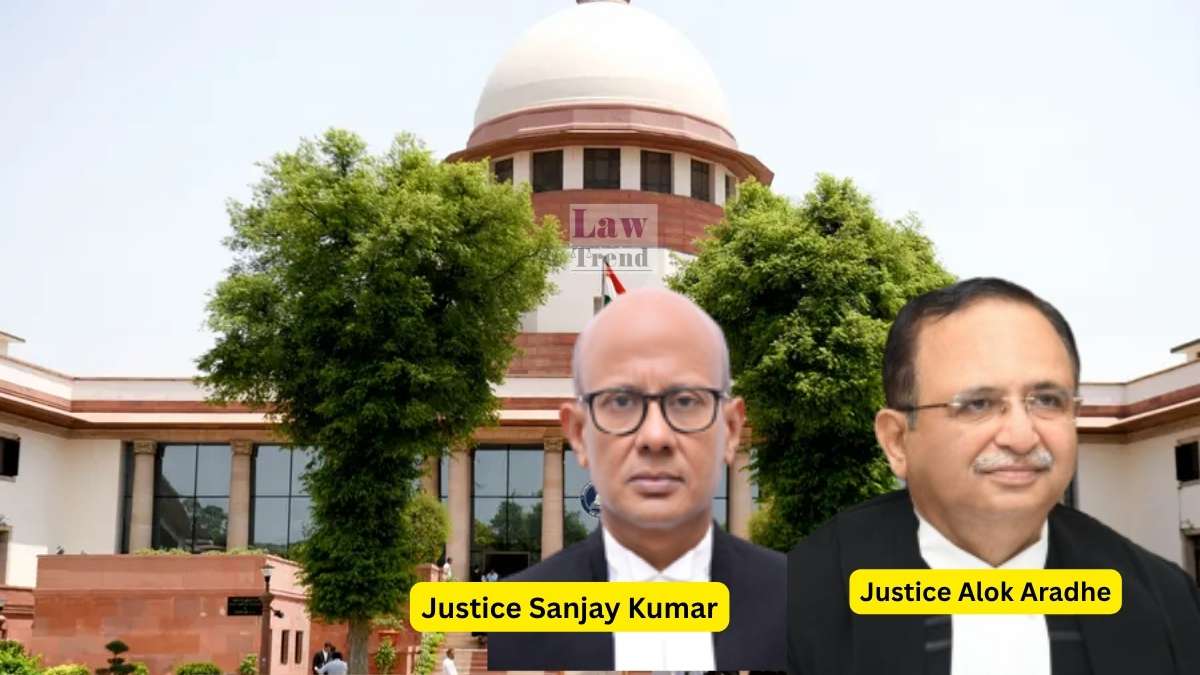
A Bench comprising Justice Sanjay Kumar and Justice Alok Aradhe allowed the appeal filed by the State (NCT of Delhi), holding that the reference made by the Trial Court to the High Court was premature. The Court observed that “as a conspiracy is alleged, leading to multiple acts of cheating against different individuals, the course adopted by the Delhi Police in registering one FIR and treating the complaints received from 1851 other complainants as statements under Section 161 CrPC, was the correct course of action to have been adopted at that stage.”
Background of the Case
The case originated from FIR No. 89 of 2009 registered by the Economic Offences Wing of the Delhi Police under Sections 420 (Cheating) and 120B (Criminal Conspiracy) of the Indian Penal Code (IPC). The complainant, Rajesh Kumar, alleged that the accused, Ashok Jadeja, and his accomplices, including the respondent Khimji Bhai Jadeja, had induced people to invest money by falsely claiming that Ashok Jadeja possessed “divine power of Sikotar Mata to triple money in a few days.”
During the investigation, it was revealed that 1,852 victims had been cheated of approximately ₹46.40 crores. The police clubbed the remaining 1,851 complaints with the initial FIR, treating those complainants as witnesses. A charge sheet was filed against 15 persons in 2014, followed by six supplementary charge sheets.
During bail proceedings for the respondent in 2014, the Additional District & Sessions Judge referred three questions of law to the Delhi High Court under Section 395(2) of the CrPC regarding the amalgamation of complaints.
By a judgment dated July 8, 2019, the Division Bench of the Delhi High Court answered the reference, holding that “each deposit by an investor constitutes a separate and individual transaction” and that “all such transactions cannot be amalgamated and clubbed into a single FIR.” The High Court directed that a separate FIR must be registered for each transaction. The State appealed this decision to the Supreme Court.
Arguments of the Parties
The learned Additional Solicitor General, appearing for the State, contended that a conspiracy to procure deposits from several persons to dupe them constitutes a ‘single transaction’, irrespective of the number of victims. She argued that requiring individual FIRs would be “cumbersome and wholly unnecessary” and contrary to public policy, as it would lead to a multiplicity of proceedings. The State relied on Section 223 of the CrPC, arguing that the law allows for consolidated charges if offences form part of the same transaction.
Senior Advocate Mr. R. Basant, appointed as amicus curiae, submitted that the reference by the Trial Court was premature as the investigation was still pending. He argued that the allegations in the FIR manifested a single conspiracy. He submitted that if the offences formed part of the ‘same transaction’ under Section 220(1) CrPC, consolidation is permissible.
Court’s Analysis
The Supreme Court examined the legal concept of the ‘same transaction’ and the consolidation of FIRs. The Bench referred to the precedent in S. Swamirathnam vs. State of Madras, where a 3-Judge Bench had held that a single conspiracy to cheat members of the public, even if spread over several years, constitutes one transaction.
The Court reiterated the tests to decide when separate actions can be treated as part of the ‘same transaction’:
- Unity of purpose and design.
- Proximity of time and place.
- Continuity of action.
The Bench observed, “If several acts committed by a person show a unity of purpose or design, then it may be a strong circumstance to indicate that those acts form part of the same transaction.”
Referring to the decision in Amish Devgan vs. Union of India and T.T. Antony vs. State of Kerala, the Court noted that multiple FIRs for the same incident or transaction are generally not permissible and can be clubbed to avoid multiplicity of proceedings. The Court distinguished the case of Narinderjit Singh Sahni vs. Union of India, which the High Court had relied upon, noting that the development of law in later 3-Judge Bench decisions indicated a different legal position favoring consolidation to prevent multiplicity.
Decision
The Supreme Court set aside the answers given by the Delhi High Court to questions (a) and (b) of the reference. The Court held:
“We agree with the learned amicus that the reference by the learned Additional Sessions Judge was premature, as the stage had not arisen for her to have entertained any doubt so as to raise the questions of law that she did for the decision of the High Court.”
The Court ruled that the Magistrate concerned must decide at the stage of framing charges whether the acts constitute the ‘same transaction’.
“The inference to be drawn from the chargesheets, as filed, is left to the Magistrate concerned to consider, so as to ascertain whether the various acts of cheating attributed to the accused persons constitute part of the ‘same transaction’, thereby bringing them within the ambit of Section 220(1) CrPC and Section 223 (a) & (d) CrPC. If the offences formed part of the same transaction, the Magistrate would be entitled to charge and try them together… as it would be in the larger public interest to do so.”
Addressing the High Court’s concern about the rights of the victims, the Supreme Court clarified that complainants treated as witnesses would still be entitled to file protest petitions if a closure report is filed or if the accused is discharged.
“Further, in such an event, as pointed out in Amish Devgan (supra), the complainants, who would then be treated as witnesses in relation to the FIR which was first registered, would be entitled to file protest petitions in the event of a closure report being filed or if the Magistrate is inclined to discharge the accused, and the Magistrate concerned is bound to consider the same on merits.”
Consequently, the appeal was allowed.
Case Details:
Case Title: The State (NCT) of Delhi v. Khimji Bhai Jadeja
Case No.: Criminal Appeal No. [Number to be assigned] of 2026 (@ SLP (Crl.) No. 9198 of 2019)
Bench: Justice Sanjay Kumar and Justice Alok Aradhe