

Sessions Courts Lack Power to Impose Life Imprisonment ‘Till Natural Death’ Without Remission: Supreme Court
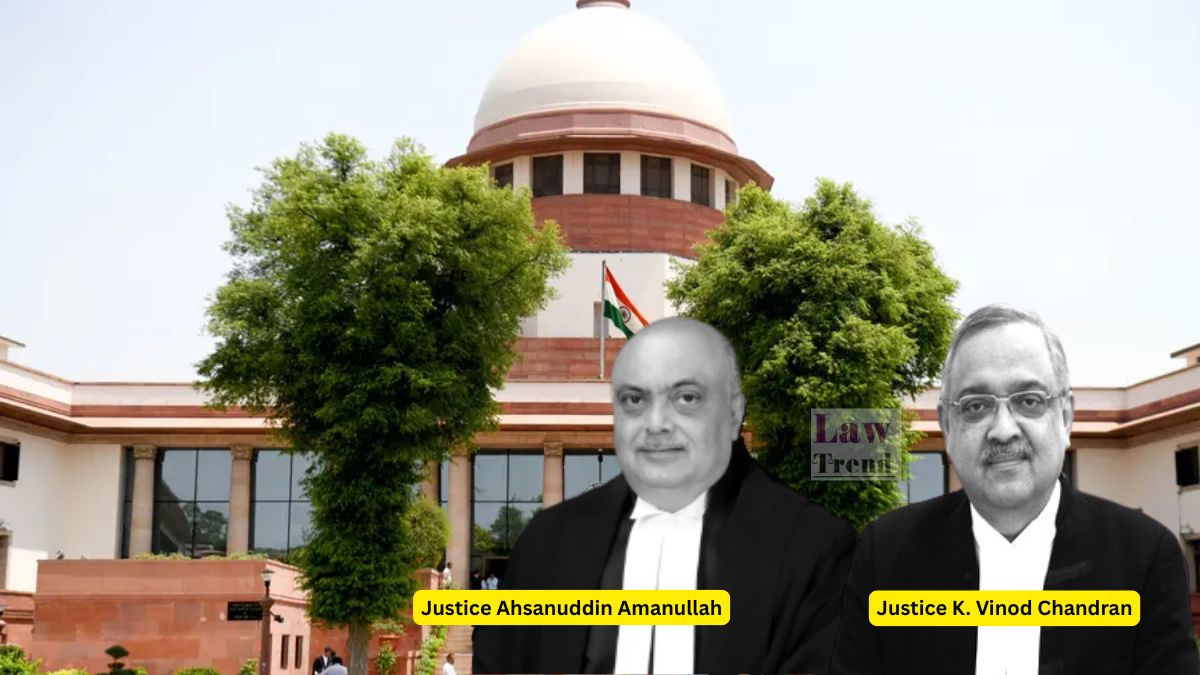

The Supreme Court has ruled that Sessions Courts do not have the competence to award a sentence of life imprisonment “till the end of natural life” without the benefit of remission. The Court clarified that the power to impose a special category of sentence that excludes remission is vested solely in the Constitutional Courts (the Supreme Court and High Courts) and cannot be exercised by trial courts.

The Division Bench comprising Justice Ahsanuddin Amanullah and Justice K. Vinod Chandran delivered the judgment in the case of Kiran v. The State of Karnataka, partly allowing the appeal filed by a convict who had been sentenced to life imprisonment with a direction that he would not be entitled to set-off under Section 428 of the Code of Criminal Procedure (CrPC).

Background of the Case

The case pertains to the brutal murder of a widow and mother of five children on January 1, 2014. According to the prosecution, the accused, a relative by marriage, entered the victim’s shanty at 11:30 PM. When the victim resisted his “lustful advances,” which had been continuing for some time, the accused poured kerosene on her and set her ablaze.

The victim sustained 60% burns and succumbed to her injuries ten days later. The trial court convicted the accused under Section 302 of the Indian Penal Code (IPC) and sentenced him to life imprisonment, directing that the imprisonment be till the end of his natural life and denying him the benefit of set-off under Section 428 CrPC.

READ ALSO  धारा 368 IPC के तहत दोषसिद्धि के लिए अपहरण की जानकारी होना आवश्यक: छत्तीसगढ़ हाईकोर्ट

Arguments and Evidence

The Supreme Court noted that despite the limited notice issued on the question of sentencing, it examined the evidence to ensure the conviction was sound. The Court observed that crucial witnesses, including the victim’s father (PW-1) and daughter (PW-7), had turned hostile. However, independent witnesses, including neighbors (PW-8 and PW-24), established the presence of the accused and his flight from the scene.

The prosecution heavily relied on the dying declarations of the deceased. While the declaration recorded by the police (Exhibit P-27) clearly implicated the accused, a request submitted to the Chief Metropolitan Magistrate (Exhibit D-1) initially mentioned suicide. The Station House Officer (PW-25) explained this discrepancy as a result of a language barrier, stating he could not communicate effectively in Telugu with the Hyderabad police.

Crucially, the dying declaration recorded by the Magistrate (PW-21) in the presence of the duty doctor (PW-22) categorically implicated the accused and detailed his prior conduct.

Court’s Observations and Analysis

On Conviction

The Supreme Court upheld the conviction, stating, “In the totality of circumstances, as coming out from the case records, we are convinced that the conviction was entered into properly.” The Bench found that the medical evidence and the dying declarations, corroborated by independent witnesses, established the guilt of the accused beyond doubt.

READ ALSO  Supreme Court Considers to Extend Tribunal Members' Tenure Amid Appointment Delays

On the Power of Sessions Courts

The primary legal issue addressed was whether a Sessions Court could impose a life sentence “till the remainder of life” and prohibit the benefit of set-off.

Referencing the Constitution Bench decision in Union of India v. V. Sriharan alias Murugan and Others (2016) and Swamy Shraddananda (2) v. State of Karnataka (2008), the Court observed that the power to create a special category of sentence—substituting the death penalty with imprisonment for life beyond remission—is reserved for superior courts.

The Bench observed:

“The power to impose punishment of imprisonment for life without remission was conferred only on the Constitutional Courts and not on the Sessions Courts.”

The Court held that a Sessions Court cannot curtail the statutory power of remission and commutation provided under Sections 432 to 435 of the CrPC or the constitutional powers under Articles 72 and 161.

“The sentence of life imprisonment no doubt means the entire life… which cannot be curtailed by a Sessions Court. Nor can the Sessions Court, a creation of the Cr.PC curtail the provision under Section 428, Cr.PC, available in the Code which created it.”

On Set-Off under Section 428 CrPC Regarding the trial court’s direction to deny set-off for the period the accused spent in detention during the trial, the Supreme Court termed it legally unsustainable.

“The statutory imprimatur in Section 428, Cr. PC is that the period of detention undergone by an accused during the investigation, inquiry or trial… shall be set-off against the term of imprisonment… The direction of the Sessions Court not to grant set-off under Section 428, Cr. PC will stand deleted, as there is no escape from it.”

Decision

The Supreme Court partly allowed the appeal by modifying the sentence. While the conviction under Section 302 IPC was confirmed, the direction that the imprisonment be “till the end of natural life” was set aside.

READ ALSO  Courts Must Support, Not Obstruct Arbitration: Justice Manmohan Urges Govt to Revisit ₹10 Crore Cap on Dispute Referrals

The Court ordered:

  • The sentence is modified to imprisonment for life.
  • The appellant is permitted set-off as provided under Section 428 CrPC.
  • The accused is entitled to avail of remission or commutation in due course, subject to the government’s decision as per its policy.

The Bench concluded that the offence did not fall into the category requiring the special treatment of a fixed term without remission, unlike the precedent in Ravinder Singh v. State (NCT of Delhi) cited by the State.

Case Details:

  • Case Title: Kiran v. The State of Karnataka
  • Case No: Criminal Appeal No. of 2025 (@Special Leave Petition (Crl.) No.15786 of 2024)
  • Citation: 2025 INSC 1453
  • Coram: Justice Ahsanuddin Amanullah and Justice K. Vinod Chandran

Law Trend
Law Trendhttps://lawtrend.in/
Legal News Website Providing Latest Judgments of Supreme Court and High Court

Related Articles

Latest Articles

