Section 44C Ceiling Applies to Both Common and Exclusive Head Office Expenditure of Non-Resident Assessees: Supreme Court
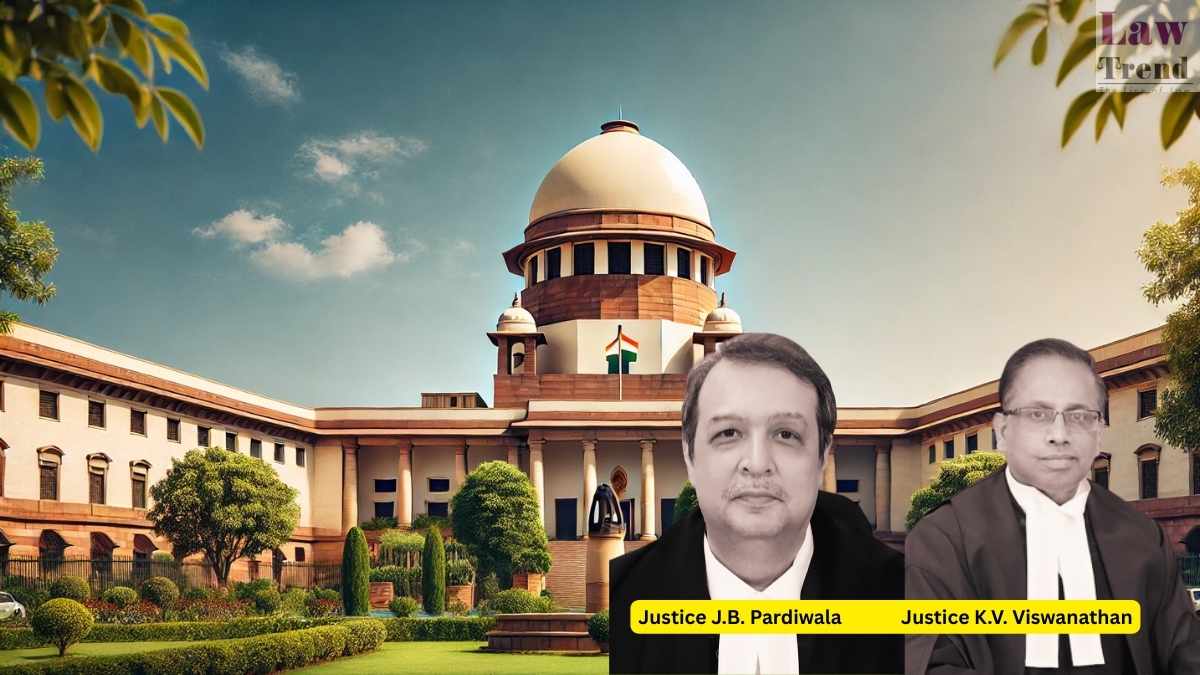

The Supreme Court has held that the ceiling limit prescribed under Section 44C of the Income Tax Act, 1961, applies to “head office expenditure” incurred by a non-resident assessee, regardless of whether such expenditure is “common” to multiple branches or incurred “exclusively” for the Indian branch.

A Bench comprising Justice J.B. Pardiwala and Justice K.V. Viswanathan set aside the view taken by the Bombay High Court in Commissioner of Income Tax v. Emirates Commercial Bank Ltd., which had held that exclusive expenses incurred by a head office for an Indian branch fall outside the purview of Section 44C.

The central issue before the Court was whether the deduction for expenditure incurred by the head office of a non-resident assessee exclusively for its Indian branches is governed by the ceiling limit under Section 44C or is allowable in full under Section 37(1) of the Act. The Court ruled in favor of the Revenue, holding that Section 44C does not distinguish between common and exclusive expenditure. However, the Court remanded the matter to the Income Tax Appellate Tribunal (ITAT) for the limited purpose of verifying whether the disputed expenses technically qualify as “head office expenditure” under the statutory definition.

Background of the Case

The judgment dealt with two civil appeals involving M/s. American Express Bank Ltd. and M/s. Oman International Bank.

In the case of American Express Bank, the assessee, a non-resident banking company, claimed deductions for the Assessment Year (AY) 1997-1998 under Section 37(1) for expenses incurred by its head office directly in relation to Indian branches. The Assessing Officer (AO) limited the deduction to 5% of the gross total income, applying Section 44C. The ITAT later allowed the assessee’s appeal, relying on the Bombay High Court’s decision in Emirates Commercial Bank, reasoning that exclusive expenses are outside the purview of Section 44C. The High Court subsequently dismissed the Revenue’s appeal.

READ ALSO  Atrocious Game by State: Madras HC Slams State in Delaying Professors' Salaries, Imposes Exemplary Costs

Similarly, Oman International Bank claimed a deduction for AY 2003-04 for travelling expenses and certification fees incurred by its head office specifically for Indian branches. The AO applied the Section 44C ceiling. The CIT(A) and ITAT ruled in favor of the assessee, and the Bombay High Court dismissed the Revenue’s appeal, again relying on Emirates Commercial Bank.

Arguments of the Parties

The Additional Solicitor General, appearing for the Revenue, argued that Section 44C begins with a non-obstante clause (“Notwithstanding anything to the contrary contained in Sections 28 to 43A”), giving it overriding effect over Section 37. The Revenue contended that the legislative intent was to curb inflated claims by foreign companies where books are maintained abroad, making verification difficult. It was argued that the definition of “head office expenditure” is clear and includes all executive and general administration expenses incurred outside India, without distinguishing between common and exclusive expenses.

The respondents contended that Section 44C applies only to “common” head office expenses that require allocation or attribution to the Indian business. They argued that expenditure incurred exclusively for Indian operations is fully deductible under Section 37(1) as it is directly attributable to the Indian business and does not require the normative attribution formula of Section 44C. Reliance was placed on the Bombay High Court’s decision in Emirates Commercial Bank and the Calcutta High Court’s decision in Rupenjuli Tea Co. Ltd.

Court’s Analysis

The Supreme Court undertook a strict interpretation of the taxing statute. The Bench observed that Section 44C applies when two conditions are met: the assessee is a non-resident, and the expenditure is in the nature of “head office expenditure” as defined in the Explanation to the section.

READ ALSO  आपराधिक मामले में बरी होने पर मृतक की मां को प्राकृतिक उत्तराधिकारी के रूप में दहेज की वस्तुएं लौटाने पर कोई रोक नहीं: सुप्रीम कोर्ट

Interpretation of “Head Office Expenditure” The Court rejected the distinction between “common” and “exclusive” expenditure. Justice Pardiwala, writing for the Bench, observed:

“The text provides no indication that the expenditure must be of a common or shared nature. Therefore, the meaning of the Explanation is clear, straightforward, and unambiguous. If we were to accept the respondents’ contention, we would be forced to add words to the statute that simply do not exist.”

Interpretation of “Attributable to” Addressing the respondents’ argument regarding clause (c) of Section 44C, which refers to expenditure “attributable to the business… in India,” the Court held that “attributability” is a genus of which “exclusivity” is a species. The Court stated:

“Expenditure that is incurred exclusively for the business in India is, by its very nature, attributable to the business in India. In fact, exclusive expenditure represents the strongest form of attribution, as there is a direct and undivided nexus between the expense and the Indian operations.”

Disapproval of Emirates Commercial Bank The Court explicitly held that the view taken by the Bombay High Court in Emirates Commercial Bank—that Section 44C covers only common expenditure—was incorrect. The Court noted that the High Court provided no basis for concluding that the section only covers expenditure of a common nature.

Distinguishing Rupenjuli Tea The Court distinguished the Calcutta High Court’s decision in Rupenjuli Tea, noting that in that case, the assessee had no business operations outside India. Therefore, the concept of attribution under clause (c) could not apply. This was factually different from the present cases where the banks had global operations.

Legislative Intent The Court observed that the legislative history, including the Memorandum to the Finance Bill, 1976, supported the Revenue’s case. The object was to address the difficulty in verifying claims made by foreign head offices. Accepting the respondents’ view would defeat this purpose.

READ ALSO  Why Transgender and Sex Workers Cannot Donate Blood? Asks Supreme Court from Centre

Tripartite Test for Head Office Expenditure While ruling for the Revenue on the legal principle, the Court clarified that the definition of “head office expenditure” in the Explanation is not merely illustrative but exhaustive regarding the types of “executive and general administration” expenses. The Court laid down a “tripartite test” for an expense to qualify:

  1. The expenditure must be incurred outside India.
  2. The expenditure must be in the nature of “executive and general administration” (the genus).
  3. The expenditure must fall within the specific species enumerated in clauses (a), (b), and (c) of the Explanation, or be expressly prescribed under clause (d).

Decision

The Supreme Court allowed the appeals, holding that Section 44C applies to head office expenditure regardless of whether it is common or exclusive.

However, observing that the lower authorities had not factually verified whether the specific expenses claimed satisfied the “tripartite test” to technically qualify as head office expenditure, the Court remanded the matters to the Income Tax Appellate Tribunal (ITAT), Mumbai.

The Court directed:

“Consequently, we remand the matters to the Income Tax Appellate Tribunal, Mumbai, for the limited purpose of verifying whether the disputed expenditures satisfy the tripartite test necessary to qualify as ‘head office expenditure’ under the Explanation to Section 44C of the Act, 1961.”

Case Details:

  • Case Title: Director of Income Tax (IT)-I, Mumbai v. M/s. American Express Bank Ltd. (with connected matter)
  • Citation: 2025 INSC 1431
  • Coram: Justice J.B. Pardiwala and Justice K.V. Viswanathan
  • Appeal Nos: Civil Appeal No. 8291 of 2015 & Civil Appeal No. 4451 of 2016

Law Trend
Law Trendhttps://lawtrend.in/
Legal News Website Providing Latest Judgments of Supreme Court and High Court

Related Articles

Latest Articles