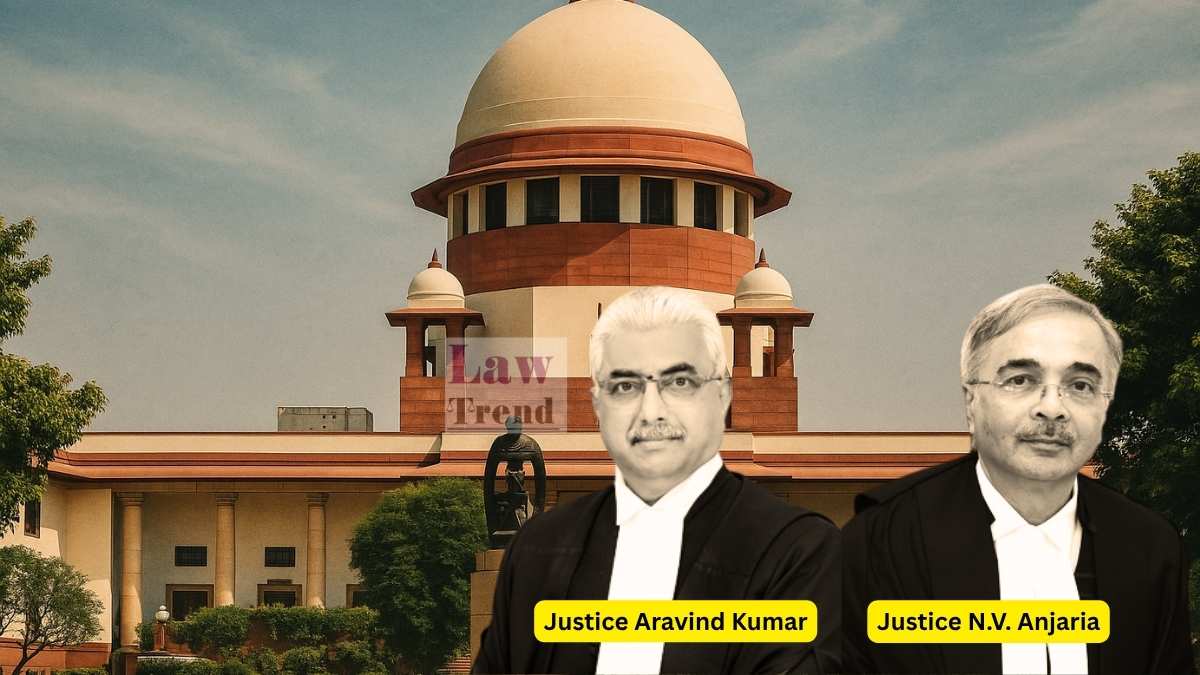
The Supreme Court has referred a significant question of law to a Larger Bench regarding the liability of a director to deposit 20% of the compensation amount under Section 148 of the Negotiable Instruments Act, 1881 (NI Act) during an appeal, specifically in cases where the accused company itself could not be prosecuted due to a “legal snag” like winding up.
A Division Bench comprising Justice Aravind Kumar and Justice N.V. Anjaria expressed its inability to concur with the earlier Coordinate Bench decisions in Bijay Agarwal v. Medilines and Shri Gurudatta Sugars Marketing P. Ltd. v. Prithviraj Sayajirao Deshmukh, which had held that the term “drawer” in Sections 143A and 148 refers strictly to the company and not its authorized signatories or directors.
The Court was adjudicating an appeal filed by a director who was convicted under Section 138 of the NI Act after the company he represented was wound up and thus not prosecuted. The Appellate Court had suspended his sentence subject to the condition of depositing 20% of the compensation amount under Section 148. The Supreme Court observed that granting a blanket exemption to directors from such deposits on the technical ground that they are not the “juridical drawer” would defeat the legislative intent of the 2018 Amendment to the NI Act. Consequently, the Bench referred the matter to the Chief Justice of India for the constitution of a Larger Bench to resolve the interpretive conflict.
Background of the Case
The case arose from a business transaction between the Respondent, Steel Authority of India (SAIL), and the accused company, Shiv Mahima Ispat Private Limited. In 2012-13, the accused company purchased Hot Rolled coils from SAIL and issued a cheque for Rs. 4,82,72,269/-, signed by the appellant, Bharat Mittal, as a director. The cheque was dishonoured with the remarks “Exceeds Arrangement.”
SAIL filed a complaint under Section 138 of the NI Act. During the pendency of the trial, the accused company was ordered to be wound up by the High Court on December 1, 2016. Consequently, the prosecution continued solely against the appellant-director. The Trial Court convicted the appellant and sentenced him to two years of simple imprisonment and directed him to pay a compensation of Rs. 8,10,00,000/-.
When the appellant challenged this conviction, the Appellate Court suspended the sentence on November 27, 2024, subject to the condition that he deposit 20% of the compensation amount (approx. Rs. 1.62 Crores) under Section 148 of the NI Act. The appellant’s plea for exemption from this deposit was rejected by the High Court, leading to the present appeal before the Supreme Court.
Arguments of the Parties
The Appellant’s Contentions: Senior Advocate R. Basant, appearing for the appellant, relied heavily on the Supreme Court’s recent judgments in Bijay Agarwal and Shri Gurudatta Sugars. He argued that:
- The appellant is merely a signatory and not the “drawer” of the cheque; the company is the drawer.
- Under Section 148, the power to order a deposit applies only to an appeal by the “drawer.”
- Since the company is in liquidation and the appellant is only vicariously liable, he cannot be compelled to deposit the 20% amount.
- The appellant is unemployed and in financial distress, making the condition impossible to fulfill.
The Respondent’s Contentions: Senior Advocate Nagamuthu, appearing for SAIL, argued that:
- The appellant was the director actively managing the company and had signed the cheque.
- Since the company could not be prosecuted due to the liquidation order (a legal snag), the appellant cannot escape liability.
- Exempting the director from the deposit requirement would defeat the purpose of Section 148, which is to provide interim relief to the complainant.
Court’s Analysis and Observations
On Vicarious Liability and “Legal Snags” The Court reiterated the law laid down in Aneeta Hada v. Godfather Travels & Tours Pvt. Ltd., noting that while a company must ordinarily be arraigned as an accused to prosecute its directors, an exception exists where the company cannot be prosecuted due to a “legal hurdle” or “legal snag.” In such cases, the prosecution may validly continue against the directors alone.
On Section 148 and Legislative Intent The Bench analyzed the Statement of Objects and Reasons of the Negotiable Instruments (Amendment) Act, 2018. The Judges observed that Section 148 was introduced to address “undue delay in final resolution of cheque dishonour cases” and to discourage frivolous appeals. The provision empowers the Appellate Court to direct the deposit of a minimum of 20% of the fine or compensation.
Disagreement with Bijay Agarwal and Gurudatta Sugars The Court examined the ratio in Shri Gurudatta Sugars (dealing with Section 143A) and Bijay Agarwal (dealing with Section 148), which held that the expression “drawer” must be construed strictly to mean only the principal offender (the company) and not the authorized signatories.
Justices Kumar and Anjaria expressed their disagreement with this “overly literal interpretation.” The Bench noted:
“In a factual scenario where the company is non-existent and proceedings under Section 138 read with Section 141 of the Act are instituted against the persons responsible for its affairs, a strict construction of the definition of ‘drawer’ under Section 7 so as to confine it exclusively to the company would amount to an unduly narrow interpretation, running contrary to the legislative intent underlying Sections 143A and 148.”
The Court emphasized that proceedings under Section 138 are “quasi-criminal” and “compensatory” in nature. Therefore, a purposive interpretation is preferred over a literal one.
“To deny the complainant the benefit of the remedial framework introduced by the amendment, merely by relying on a definition framed at the time of the original enactment and without construing it in the light of the purpose sought to be achieved by the legislature, would, in our considered view, amount to a misinterpretation of the statute.”
The Bench further reasoned that if the strict interpretation were applied, directors of wound-up companies would escape the deposit requirement while controlling the litigation, rendering the 2018 amendment “nugatory” and “devoid of practical efficacy.”
Decision
The Court held that a director cannot be granted a “blanket exemption” from the deposit under Section 148 merely because the company is not the appellant. However, being a Bench of co-equal strength to those that decided Bijay Agarwal and Gurudatta Sugars, the Judges stated they could not unilaterally overrule those decisions.
Accordingly, the Court referred the following question for authoritative pronouncement by a Larger Bench:
“Whether, upon a conviction under Section 138 read with Section 141, the appellate deposit contemplated by Section 148 may be directed against a convicted director/authorized signatory, or whether such deposit is confined to the juristic ‘drawer/company’ alone in all scenarios?”
The papers have been directed to be placed before the Chief Justice of India for the constitution of a Larger Bench.
Case Details:
- Case Title: Bharat Mittal v. State of Rajasthan and Ors.
- Case Number: Criminal Appeal No. [ ] of 2025 (@ SLP (Crl.) No. 12327 of 2025)
- Citation: 2025 INSC 1459
- Bench: Justice Aravind Kumar and Justice N.V. Anjaria