

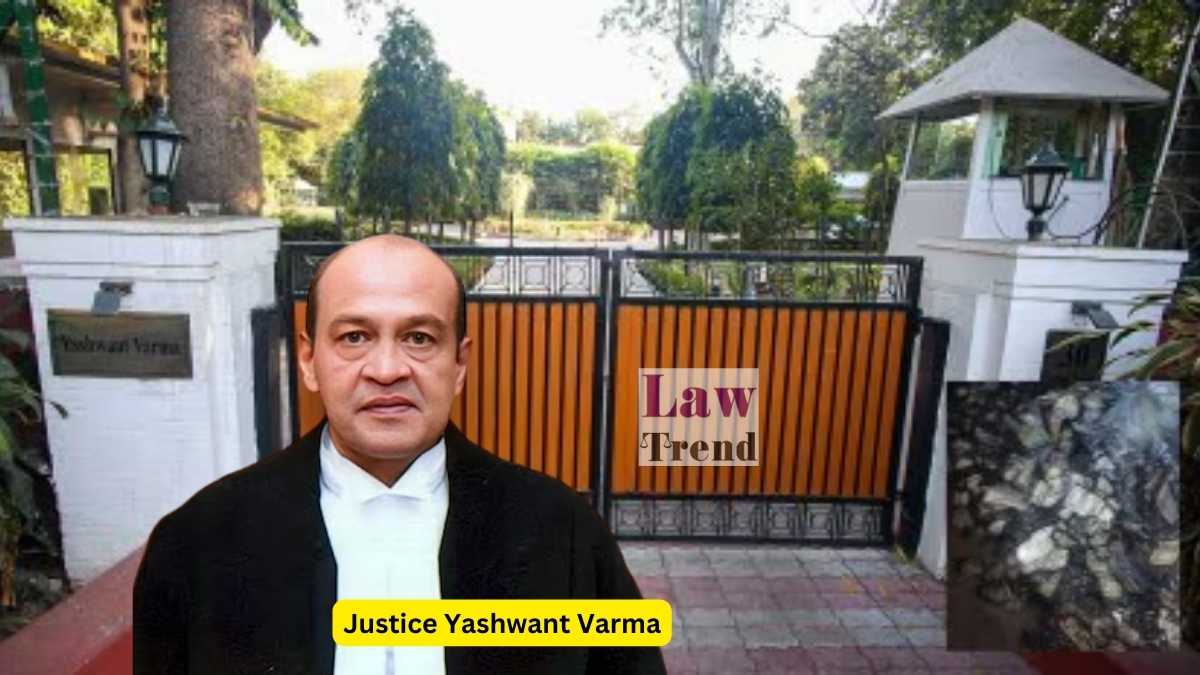
The Supreme Court on Thursday reserved its decision on a petition filed by Allahabad High Court Judge, Justice Yashwant Varma, challenging the validity of a parliamentary committee constituted to probe corruption allegations against him. The case stems from the recovery of a substantial amount of cash from his official residence last year.
In a significant development, the Apex Court also declined Justice Varma’s interim prayer seeking additional time to file his response before the inquiry committee.
A Division Bench comprising Justice Dipankar Datta and Justice Satish Chandra Sharma heard the challenge brought by Justice Varma regarding the legality of the inquiry panel set up by the Lok Sabha Speaker. The petitioner contended that the constitution of the committee was unsustainable under the Judges (Inquiry) Act, citing procedural irregularities involving the admission of removal motions in Parliament. While the Court reserved its judgment on the legal validity of the panel, it refused to extend the deadline for Justice Varma to submit his reply to the committee, which is scheduled to receive responses by January 12.
Background of the Case
The controversy dates back to March 14 of the previous year, when a large sum of currency was reportedly recovered from Justice Varma’s official residence in Delhi, where he was posted as a High Court judge at the time. Following the incident, he was transferred to the Allahabad High Court.
Subsequent to the recovery, then Chief Justice of India Sanjiv Khanna directed an in-house inquiry into the matter. A three-member panel constituted for this purpose submitted its report on May 4, finding Justice Varma guilty of misconduct. Based on these findings, the then CJI advised Justice Varma to resign or face impeachment proceedings. Upon his refusal to step down, the inquiry report was forwarded to the President of India, Droupadi Murmu, and Prime Minister Narendra Modi.
Justice Varma had previously moved the Supreme Court challenging the in-house inquiry report, but his plea was dismissed on August 7. Shortly thereafter, on August 12, Lok Sabha Speaker Om Birla constituted a separate three-member parliamentary committee to investigate the charges.
Legal Arguments: The Validity of the Parliamentary Panel
The core legal issue raised by Justice Varma pertains to the procedure adopted for constituting the parliamentary inquiry committee.
Senior Advocate Mukul Rohatgi, appearing for Justice Varma, argued that the committee’s formation was “contrary to law.” He submitted that when notices for a motion seeking the removal of a judge are given in both Houses of Parliament on the same day, a committee can only be constituted if the motion is admitted in both Houses.
Rohatgi highlighted that while the motion was admitted in the Lok Sabha, a similar motion was rejected by the Deputy Chairman of the Rajya Sabha. He contended that this rejection rendered the unilateral formation of the committee by the Lok Sabha Speaker invalid.
“Where the notices of the motion are ‘given’ to the Houses on the same date, no committee will be constituted, unless the motion is being admitted in both Houses,” Rohatgi argued. He further submitted that under such circumstances, the Judges (Inquiry) Act requires the committee to be constituted jointly by the Speaker of the Lok Sabha and the Chairman of the Rajya Sabha.
Court’s Observations and Outcome
The Supreme Court had agreed to examine this procedural challenge during an earlier hearing on December 16. On Thursday, after hearing the submissions, the Bench of Justices Datta and Sharma reserved its judgment on the petition.
Regarding the petitioner’s request for an extension of time to reply to the parliamentary panel, the Court declined to intervene, maintaining the current schedule which requires a response by January 12.




