

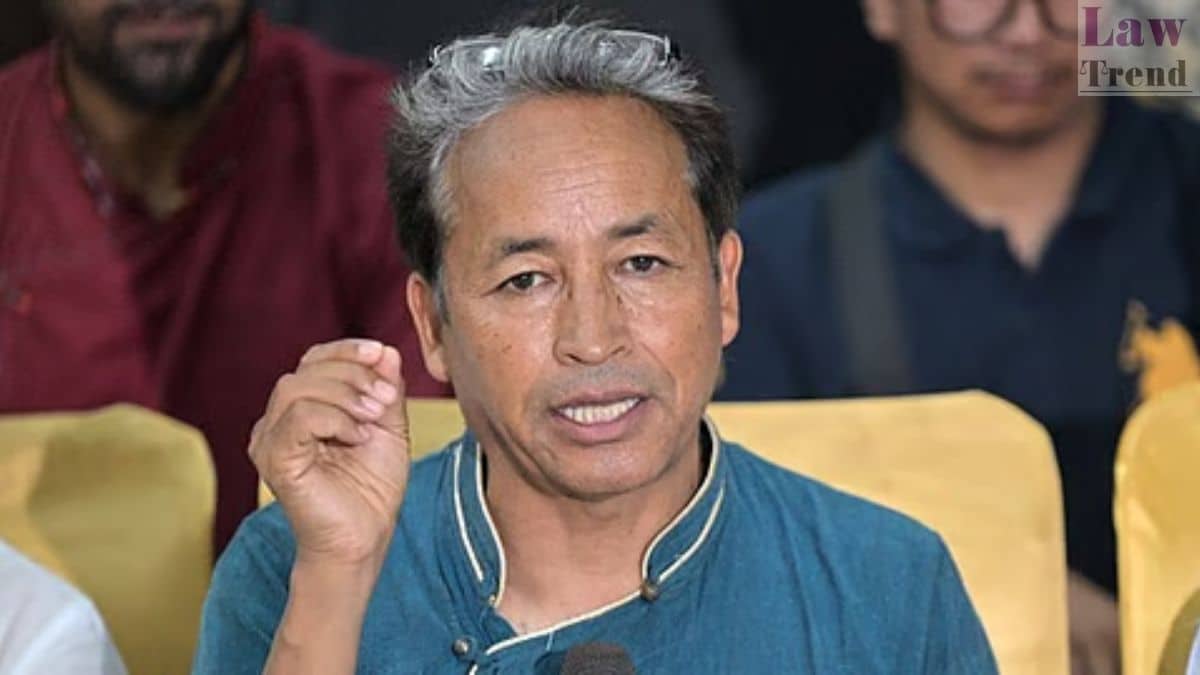
The Supreme Court on Wednesday heard arguments in a habeas corpus petition filed by Gitanjali Angmo, wife of renowned Ladakhi climate activist Sonam Wangchuk, challenging his detention under the National Security Act (NSA). During the hearing, the Centre defended its decision, asserting that Wangchuk remains in good health and that the grounds for his preventive detention continue to exist.
A bench of Justices Aravind Kumar and P B Varale was informed by Solicitor General Tushar Mehta that Wangchuk had undergone 24 medical checkups during his custody and was “fit, hale and hearty.”
“He had some digestive issue, he is being treated. There is nothing to worry, nothing alarming,” Mehta submitted, opposing the plea for release on health grounds. “We can’t make exceptions like this… It will not be possible to release him on health grounds. It may not be desirable also.”
Mehta said the authorities had given the matter “utmost consideration” and reiterated that the original reasons for his detention under NSA remain valid.
Additional Solicitor General K M Nataraj, appearing alongside the SG, argued that Wangchuk was a “chief provocateur” in the September 24, 2023 violence in Leh and had allegedly instigated youth by referencing political uprisings in other countries.
“He instigated youth by giving examples of Nepal and the Arab Spring,” Nataraj claimed, adding that Wangchuk’s speeches amounted to a warning that similar unrest could erupt in India.
However, the bench pushed back on the Centre’s interpretation of Wangchuk’s statements.
“Where does he say that? He is saying they [the youth] have taken it. He himself is surprised,” the bench observed, asking the ASG to read the entire sentence.
The judges noted that Wangchuk appeared to be quoting the views of disillusioned youth rather than endorsing violence himself.
“He is saying that the youth is saying that. Read the complete sentence. He is saying this is something worrying. If somebody expresses that violent method is not the proper way… You are doing too much of reading,” the bench remarked.
Gitanjali Angmo’s plea categorically denied any role of her husband in the violence, asserting that Wangchuk had consistently condemned any unrest in Ladakh.
She cited his public statements and social media posts in which he had described the September 24 violence as the “saddest day of his life,” and warned that violence would jeopardize the “tapasya” and peaceful struggle of the Ladakhi people.
The petition urged the court to declare the detention illegal, arguing that the NSA was wrongly invoked as Wangchuk’s actions did not meet the statutory threshold of being “prejudicial to the defence of India.”
The National Security Act, 1980 empowers the Centre and state governments to detain individuals for up to 12 months to prevent them from acting in ways deemed a threat to national security, public order, or essential services. The Act, however, has often been criticised for enabling preventive detention without charge or trial.
The bench has not passed any orders yet and is expected to continue hearing the matter.




