

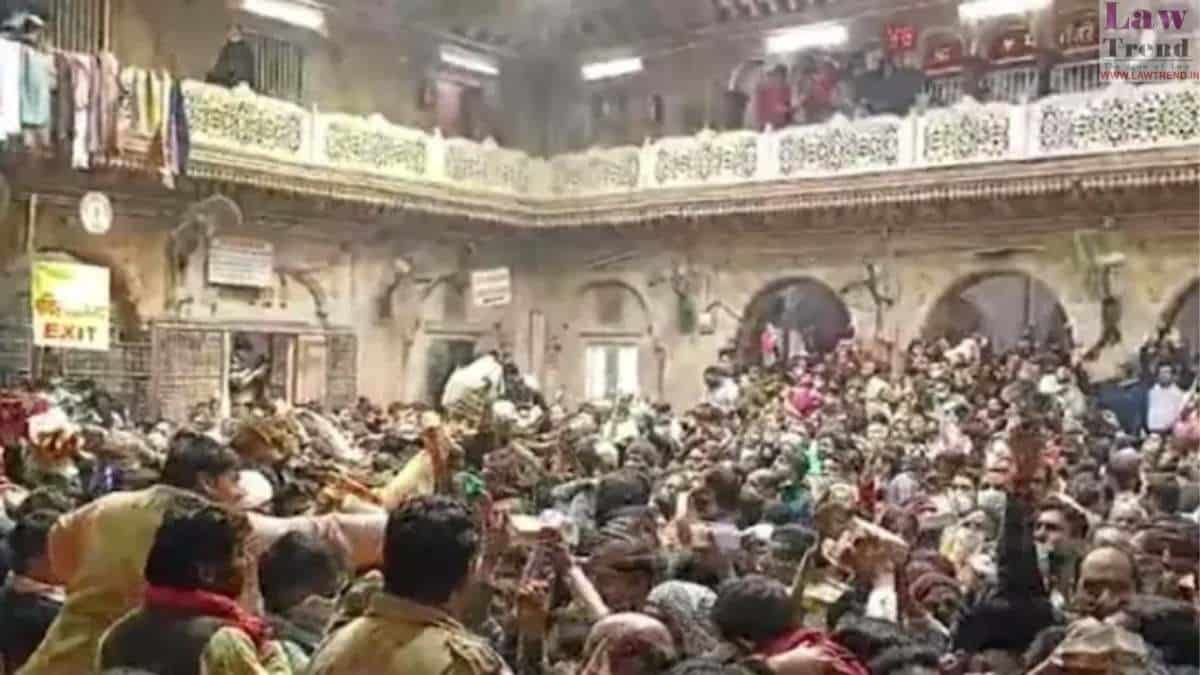
The Supreme Court on Monday expressed strong reservations over the practice of permitting “special pujas” in temples in return for money, observing that such practices disrupt the deity’s prescribed resting time and privilege those who can afford to pay. The court was hearing a plea challenging recent changes in darshan timings and temple practices at the Bankey Bihari Ji Temple in Vrindavan.
A bench comprising Chief Justice of India Surya Kant and Justices Joymalya Bagchi and Vipul M Pamcholi issued notice to the Supreme Court-appointed high-powered temple management committee as well as the Uttar Pradesh government, and listed the matter for further consideration in the first week of January.
During the hearing, senior advocate Shyam Divan and advocate Tanvi Dubey, appearing for the temple sevayats, assailed the alteration of darshan timings and the discontinuation of certain essential religious practices, including the age-old Dehri Pooja. Divan submitted that the darshan timings were an integral part of the temple’s traditions and rituals and had been strictly followed for generations.
“These darshan timings are part of tradition and rituals. The timings during which the temple is open to the public are a part of a long tradition,” Divan told the court, adding that the recent changes had disturbed the internal ritual schedule of the temple, including the times when the deity wakes up in the morning and retires at night.
Taking note of these submissions, the CJI orally remarked, “What they do is, after closing the temple at 12 noon, they do not allow the deity to rest even for a second and they exploit the deity like anything. The so-called affluent people, those who can afford to pay hefty amounts, are allowed to do special pujas.”
When Divan responded that such practices ought to be strictly proscribed, stressing that the resting period of the deity is sacrosanct, the CJI observed that this was precisely the concern troubling the court. “This is the time when they indulge in all kinds of these practices that they invite people who can pay, and special pujas are done,” the Chief Justice said.
The petitioners argued that the temple has historically followed strict seasonal timings, with distinct schedules for summer and winter, which were closely intertwined with internal rituals, including the deity’s waking and resting periods. According to Divan, recent changes effected through office memoranda issued in September 2025 have disrupted these essential religious practices.
They also highlighted the suspension of the Dehri Pooja, an age-old ritual performed exclusively by the Goswamis as part of the Guru–Shishya parampara. The petitioners contended that crowd management could not be a valid ground for stopping the ritual, as it is performed when the temple is closed to the public and at a limited, specific location.
After hearing the submissions, the bench directed that notice be served on all relevant parties, including the temple management committee.
The dispute has arisen amid major changes to the temple’s governance framework. For decades, the administration, rituals, and financial affairs of the Bankey Bihari Temple were governed by the 1939 Scheme of Management. However, the Uttar Pradesh Shri Bankey Bihari Ji Temple Trust Ordinance, 2025 seeks to replace this arrangement with a state-controlled trust, triggering wider debate on governmental involvement in religious institutions and its impact on long-established traditions.
In August 2025, while hearing a challenge to the ordinance, the Supreme Court declined to examine its constitutional validity, leaving that issue to be decided by the Allahabad High Court. The top court, however, stayed the operation of the ordinance, which vests administrative control of the shrine with the state, until the High Court rules on its validity.
At the same time, the Supreme Court constituted a high-powered committee, headed by former Allahabad High Court judge Justice Ashok Kumar, to manage the temple’s day-to-day affairs. The committee was tasked with ensuring basic amenities for devotees, including clean drinking water, functional washrooms, shelters, dedicated crowd corridors, and facilities for elderly and vulnerable pilgrims. It was also empowered to plan the overall development of the temple and its surrounding areas, including land acquisition, if required.




