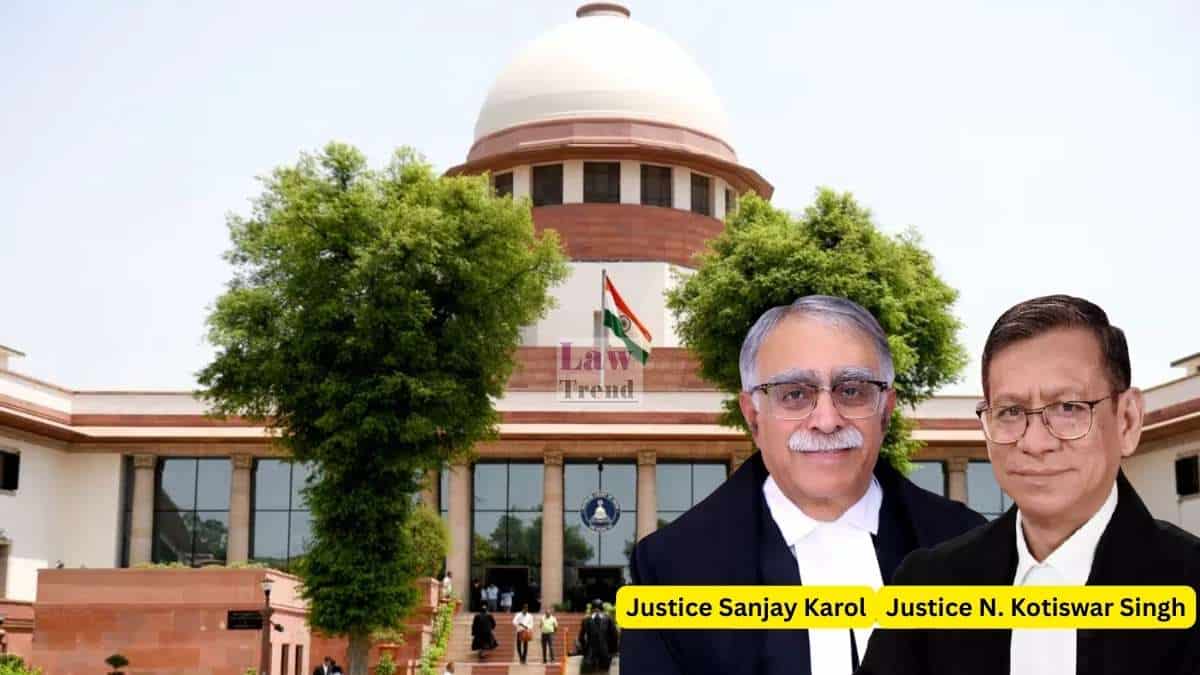
The Supreme Court of India has delivered a significant judgment clarifying the applicability of Section 436-A of the Code of Criminal Procedure (CrPC) and the principles of bail under Article 21 in cases involving heinous offences and reverse burden of proof.
The Bench, comprising Justice Sanjay Karol and Justice N. Kotiswar Singh, held that Section 436-A CrPC is not applicable to offences for which death is a specified punishment. However, emphasizing the rights of undertrials under Article 21, the Court refused to interfere with the bail granted to the accused in the 2010 Jnaneshwari Express derailment case, citing their incarceration of over 12 years and the “glacial pace” of the trial.
Furthermore, the Court expounded on the duties of the State in cases where the burden of proof is reversed (such as under UAPA), asserting that the State must “create pathways through which the accused can reclaim their innocence.”
Legal Issue and Background
The judgment arose from appeals filed by the Central Bureau of Investigation (CBI) challenging the grant of bail to several accused persons involved in the derailment of Train No. 2102, Jnaneshwari Express, on May 28, 2010. The incident resulted in the death of 148 persons and injuries to 170 others.
The accused were charged under various sections, including Section 302 (Murder) of the IPC and Sections 16/18 of the Unlawful Activities (Prevention) Act (UAPA). The Calcutta High Court had granted them bail in 2022 and 2023, primarily due to the delay in trial. The CBI contended that the High Court erroneously interpreted Section 436-A CrPC and failed to consider the heinous nature of the crime.
Key Legal Clarifications
The Supreme Court addressed four vital aspects of law in its analysis:
1. Applicability of Section 436-A CrPC
The Court clarified the scope of Section 436-A CrPC (and the corresponding Section 479 of the Bharatiya Nagarik Suraksha Sanhita, 2023), which allows for the release of undertrials who have served half the maximum sentence.
The Bench explicitly held that this provision does not apply to capital offences. Since the accused were charged under Section 302 IPC and Section 16 UAPA, where death is a possible punishment, the Court observed:
“That, in and of itself, excludes these offences from the ambit of Section 436A-IPC. On that count, the impugned judgments requires interference and are set aside to that extent.”
2. Article 21 vs. National Security
The Court examined whether the prolonged incarceration warranted release under Article 21, despite the inapplicability of Section 436-A. While acknowledging that “individual liberty is not absolute” and must be balanced against national interest, the Court held that Article 21 rights cover “speedy trial, timely completion of investigation, fair trial etc.”
“The scales of Lady Justice must balance on the one hand-the constitutionally consecrated and jealously guarded right under Article 21 and on the other, the recognition that individual liberty is not absolute and is subject to just exceptions i.e. the paramount considerations of national interest, sovereignty and integrity of the nation.”
However, citing precedents like Union of India v. K.A. Najeeb (2021) and Javed Gulam Nabi Shaikh v. State of Maharashtra (2024), the Court concluded that unduly long incarceration without the conclusion of trial violates the right to life and liberty.
3. Reverse Burden of Proof and State’s Duty
A significant portion of the judgment focused on statutes like the UAPA that impose a “reverse burden of proof,” where the accused must prove their innocence after foundational facts are established.
The Court observed that prolonged incarceration makes it “exceedingly difficult” for an accused to rebut this presumption due to limited access to resources. The Bench laid down a profound principle:
“If the State, in spite of all its might presumes guilt, then the same State must also, with the employment of all the resources at its command, create pathways through which the accused can reclaim their innocence.”
The Court emphasized that procedural formalities are insufficient:
“For if the system imposes an extraordinary burden yet denies the tools to discharge it, the promise of constitutionalism fades into symbolism.”
4. Curtailing Liberty at an Advanced Stage
Despite the severity of the crime—which the Court noted resulted in “immense” loss of life and was intended to “strike fear in the society”—the Bench declined to send the accused back to custody.
The Court noted that the trial, pending since 2010, still had 28 witnesses left to be examined.
“We may note the glacial pace at which the trial has proceeded cannot justify the incarceration of the accused, particularly when they have already been in prison for a dozen years…”
Directions Issued
To ensure that trials involving reverse burden of proof are not indefinitely delayed, the Supreme Court issued the following directions:
Directions In Personam:
- The Trial Court must take up the matter on a day-to-day basis.
- Adjournments are to be eschewed unless exceptional circumstances are shown.
- The Administrative Judge of the High Court is requested to seek a compliance report every four weeks.
Directions In Rem (To all High Courts and State Legal Services Authorities):
- Legal Aid: The State Legal Services Authority must ensure every undertrial is aware of their right to representation and assign counsel expeditiously.
- High Courts: The Chief Justices are requested to:
- Examine pending cases under laws with reverse burden of proof (e.g., UAPA).
- Ascertain if the number of designated special courts and staffing is sufficient.
- Organize case lists from “earliest to latest.”
- For cases pending over five years, refrain from routine adjournments and ensure day-to-day hearings.
Decision
The Supreme Court disposed of the appeals by refusing to cancel the bail, upholding the liberty of the accused due to the delay in trial, while simultaneously setting aside the High Court’s reasoning regarding Section 436-A CrPC.
Case Details
Case Title: Central Bureau Of Investigation V. Dayamoy Mahato Etc.
Case No.: Criminal Appeal Nos. of 2025 (Arising out of SLP(Crl) Nos. 12376-12377/2023)
Bench: Justice Sanjay Karol and Justice N. Kotiswar Singh