

‘Rooh Afza’ is a Fruit Drink, Not an Unclassified Item; Subject to Lower VAT Rate: Supreme Court
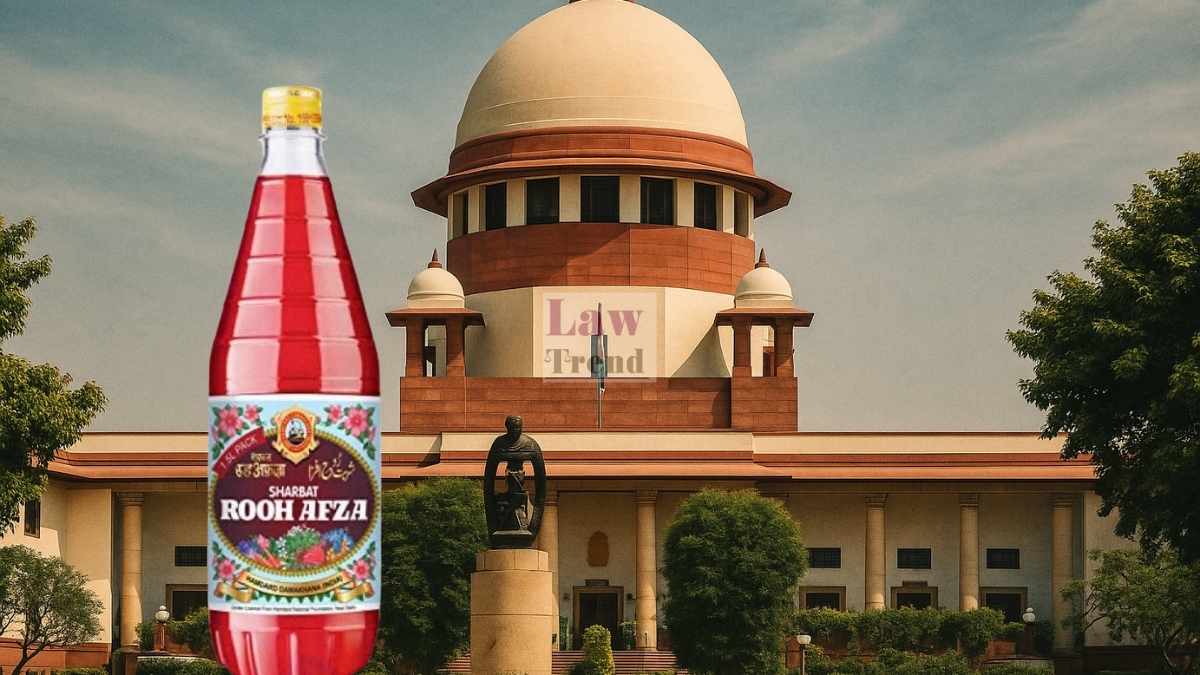
In a significant ruling for the food and beverage industry, the Supreme Court of India has held that the popular summer beverage “Sharbat Rooh Afza” qualifies as a “fruit drink” under the Uttar Pradesh Value Added Tax Act, 2008 (UPVAT Act). A Bench comprising Justice B.V. Nagarathna and Justice R. Mahadevan set aside the orders of the Allahabad High Court, the Commercial Tax Tribunal, and taxing authorities that had classified the product under the residuary entry at a higher tax rate of 12.5%.

The Court ruled that the product is exigible to VAT at the concessional rate of 4% under Entry 103 of Part A of Schedule II of the UPVAT Act.

Background of the Case

The appellant, M/s Hamdard (Wakf) Laboratories, manufactures “Sharbat Rooh Afza,” a non-alcoholic sweetened beverage. During the assessment years 2008 to 2012, Hamdard paid VAT at 4%, classifying the product as a “Fruit Drink” or “Processed Fruit” under Entry 103.

However, the Joint Commissioner (Corporate Circle), Commercial Tax, Ghaziabad, issued provisional assessments treating Rooh Afza as an “unclassified item” taxable at 12.5% under the residuary entry (Schedule V). This view was upheld by the Additional Commissioner (Appeals), the Commercial Tax Tribunal, and eventually by the Allahabad High Court in a common judgment dated July 2, 2018. The High Court had primarily relied on the fact that the product was essentially a “sugar-based concentrate” and did not find the word “sharbat” within Entry 103.

Arguments of the Parties

For the Appellant (Hamdard): The learned senior counsel for Hamdard argued that Rooh Afza is a fruit-based beverage containing not less than 10% fruit juice (primarily pineapple and orange) blended with herbal extracts. They contended that Entry 103 is an “inclusive and umbrella entry” meant to cover all products with a substantial fruit nexus.

READ ALSO  Ministerial Duties Under SARFAESI Act Must Not Brook Delay: Allahabad High Court

The appellant emphasized the “essential character test,” arguing that while sugar syrup constitutes 80% of the volume, it acts merely as a preservative and carrier. The fruit content, they argued, imparts the product’s distinctive identity. They also highlighted that almost all other States (Delhi, Gujarat, West Bengal, etc.) classify Rooh Afza as a fruit drink at a lower tax rate.

For the Respondent (Revenue): The Revenue contended that Entry 103 does not expressly include “Sharbat.” They relied heavily on the Fruit Products Order (FPO), 1955, noting that under Clause 11, any beverage containing less than 25% fruit juice must be described as “Non-Fruit Syrup.” Since Rooh Afza contains only 10% fruit juice, the Revenue argued it could not be a “Fruit Drink.” They further applied the “common parlance test,” asserting that consumers and traders would not regard a product labeled as a non-fruit syrup as a fruit drink.

Court’s Analysis and Observations

The Supreme Court rejected the Revenue’s reliance on regulatory standards for fiscal classification. The Court noted:

“The contention of the appellant that regulatory classification under food safety legislation cannot solely govern interpretation of an undefined fiscal entry under the UPVAT Act merits acceptance.”

Key points from the Court’s analysis include:

  1. Burden of Proof: The Court reiterated that the burden of proving a product falls under a residuary entry lies on the Revenue. “The Revenue has produced no trade enquiry, consumer survey, market evidence or documentary material to demonstrate that the product is not understood in commercial circles as a fruit-based beverage preparation.”
  2. Common Parlance & Essential Character Test: The Court observed that technical definitions should not override commercial understanding. On the composition, the Court noted: “The flavour, aroma and beverage character are derived from the fruit juice component and allied distillates, which together impart to the product its distinctive character… Mechanical reliance upon the quantitative predominance of invert sugar syrup would therefore be misplaced.”
  3. Inclusive Nature of Entry 103: The Court pointed out that Entry 103 uses the word “including,” which expands its scope. It does not prescribe a minimum fruit content threshold.
  4. Avoidance of Residuary Entry: Referring to Dunlop India Ltd v. Union of India, the Court warned against consigning goods to the “orphanage of the residuary clause” when they have a reasonable claim to a specific entry.
  5. Uniformity Across States: The Court found it relevant that multiple other states treated the product as a fruit-based beverage. “Where similarly worded entries across multiple jurisdictions have been construed in a particular manner, such uniformity assumes evidentiary value in determining commercial understanding.”

The Decision

The Supreme Court concluded that the High Court and lower authorities had misdirected themselves in law.

READ ALSO  [Section 138 NI Act] Complainant Need Not Prove Financial Capacity at Threshold; Onus Shifts Only If Accused Raises Specific Objection: Supreme Court

“Accordingly, it is held that ‘Sharbat Rooh Afza’ is classifiable under Entry 103 of Schedule II, Part A of the UPVAT Act as a fruit drink / processed fruit product and is exigible to VAT at the concessional rate of 4% during the relevant assessment years.”

The Court allowed the appeals and directed the respondent authorities to grant consequential relief, including the refund or adjustment of excess tax paid by the appellant.

Case Details:

  • Case Name: M/S Hamdard (Wakf) Laboratories v. Commissioner, Commercial Tax, U.P. Commercial
  • Case No: Civil Appeal No(s). 2557-2578 of 2026
  • Bench: Justice B.V. Nagarathna and Justice R. Mahadevan
  • Appearance for Appellant: Senior Advocate Arvind P. Datar, assisted by Advocates Aditya Bhattacharya, Abhishek Kumar Singh (AOR), Ritwik Tyagi, Simran Tandon, Akriti Sharma, and Vipin Upadhyay.
  • Appearance for Respondent: Advocates Bhakti Vardhan Singh (AOR), Vikas Singh Jangra, Samar Vijay Singh, Pawan Kishore Singh, J. Tarun Kumar, and Sandeep Singh Somaria.

READ ALSO  Supreme Court Rejects Pavithra Gowda’s Review Plea in Renukaswamy Murder Case; Confirms Cancellation of Bail for Actor Darshan and Others
Ad 20- WhatsApp Banner

Law Trend
Law Trendhttps://lawtrend.in/
Legal News Website Providing Latest Judgments of Supreme Court and High Court

Related Articles

Latest Articles


