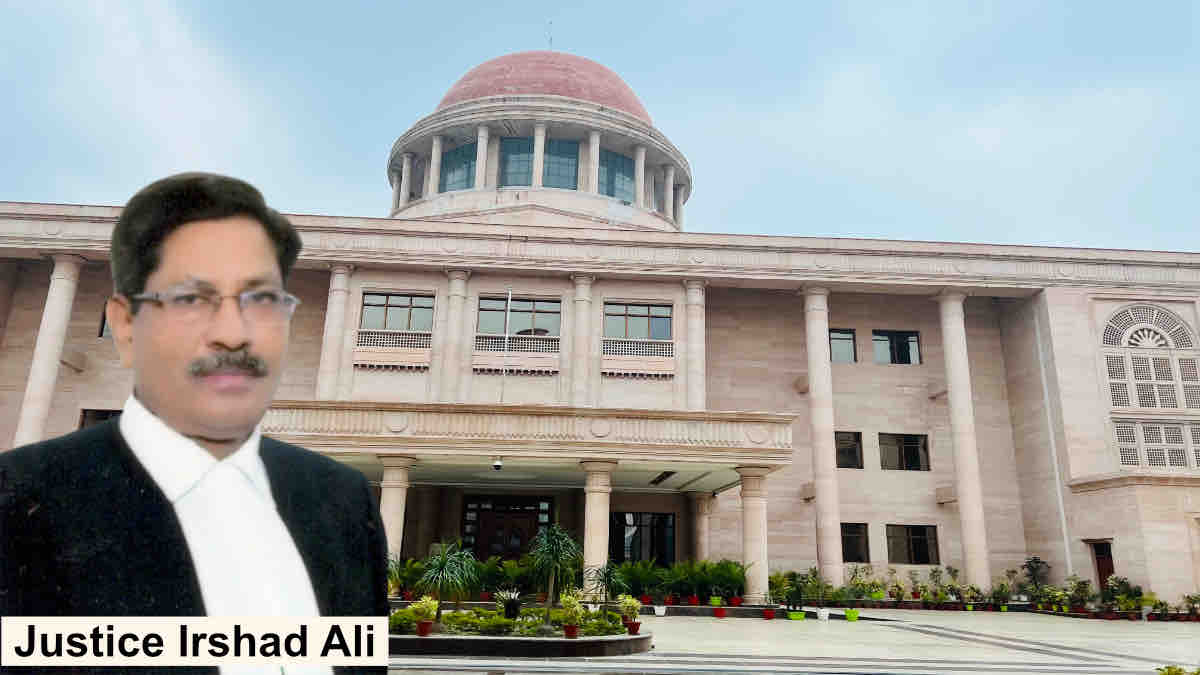
The Lucknow Bench of the Allahabad High Court has quashed an order passed by the Additional Commissioner (Judicial), Lucknow Division, which had set aside a restoration order in favor of a landless agricultural labourer belonging to the Scheduled Caste. Justice Irshad Ali held that the revisional authority lacked jurisdiction and committed a manifest illegality by restoring an ex-parte order passed without notice to the affected party.
Legal Issue
The primary legal issue was whether a revisional authority is justified in interfering with a procedural order that merely restores a matter to be heard on merits to uphold the principles of natural justice. Additionally, the court examined whether orders passed under Section 122-B (4-F) of the U.P. Zamindari Abolition and Land Reforms (Z.A. & L.R.) Act are subject to revisional jurisdiction.
Background of the Case
The petitioner, Sahab Das, a member of the Chamar community and a landless agricultural labourer, claimed possession of Plot No. 147/2 (area 0.400 hectares) in Village Laglesra, District Unnao, since before June 3, 1995. On January 9, 1998, following an inquiry, the Pargana Adhikari, Hasanganj, granted him benefit under Section 122-B (4-F) of the U.P. Z.A. & L.R. Act, declaring him a Bhumidhar with non-transferable rights.
Subsequently, Respondent No. 2 (an ex-Pradhan) moved an application to recall the order. On July 18, 1998, the Pargana Adhikari set aside the regularization order. The petitioner, asserting he was never notified of the recall proceedings, applied for the restoration of the original order on April 19, 1999. On September 25, 2003, after hearing both parties, the Pargana Adhikari recalled the July 1998 ex-parte order. This restoration was challenged by the ex-Pradhan through a revision, which the Additional Commissioner allowed on August 10, 2004, leading to the present writ petition.
Arguments of the Parties
Counsel for the Petitioner: Sri Abhisht Saran argued that the revisional authority acted in excess of jurisdiction. He contended that the order dated September 25, 2003, was a procedural restoration to ensure natural justice and did not adjudicate the merits of the land rights. He further argued that under Section 122-B (4-F), the petitioner enjoyed a statutory deeming status as a Bhumidhar which cannot be disturbed through revisional proceedings.
Counsel for the State: The Additional CSC argued that the initial regularization was based on a “forged and concocted report” and that the land had been reserved for a public purpose (a school) since 1995. He further contended that the petitioner’s restoration application was significantly time-barred and that the petitioner should have approached the Board of Revenue instead of the High Court.
Court’s Analysis
The Court observed that the order dated September 25, 2003, did not decide the rights of the parties on merits but only restored the proceedings so that the ex-Pradhan’s recall application could be adjudicated after hearing the petitioner.
Regarding natural justice, the Court noted:
“It is a settled principle of law that any order passed without providing opportunity of hearing to an affected party is violative of the principles of natural justice and cannot be sustained. By restoring such an ex-parte order, the revisional authority has virtually deprived the petitioner of his valuable right to contest the proceedings and defend the order dated 09.01.1998.”
The Court relied heavily on the Supreme Court’s decision in Manorey @ Manohar Vs. Board of Revenue, U.P. and others (2003), stating:
“Sub-section (4-F) not only protects the possession of an eligible agricultural labourer belonging to Scheduled Caste or Scheduled Tribe but also confers upon such person the status of Bhumidhar with non-transferable rights by virtue of a statutory deeming provision.”
Critically, on the point of jurisdiction, the Court cited Sushila and others Vs. State of U.P. and others (2015) and Ganga Raman Sharma Vs. State of U.P. (2016), holding:
“Since an order under Section 122-B (4-F) itself is not revisable, any order passed in proceedings arising out of such order, including an order allowing restoration application, is also not revisable and any interference by the revisional court in such matters would be wholly without jurisdiction.”
Decision
The Court concluded that the revisional authority’s order suffered from manifest illegality and jurisdictional error. Consequently, the High Court allowed the writ petition, quashed the order dated August 10, 2004, and restored the Pargana Adhikari’s order dated September 25, 2003. The concerned authority was directed to decide the matter afresh after providing a due opportunity of hearing to all parties.
Case Details:
- Case Title: Sahab Das Vs. Additional Commissioner (Judicial) Lucknow Division and another
- Case No: WRIT-C No. 1000273 of 2005
- Bench: Justice Irshad Ali
- Date: March 12, 2026