

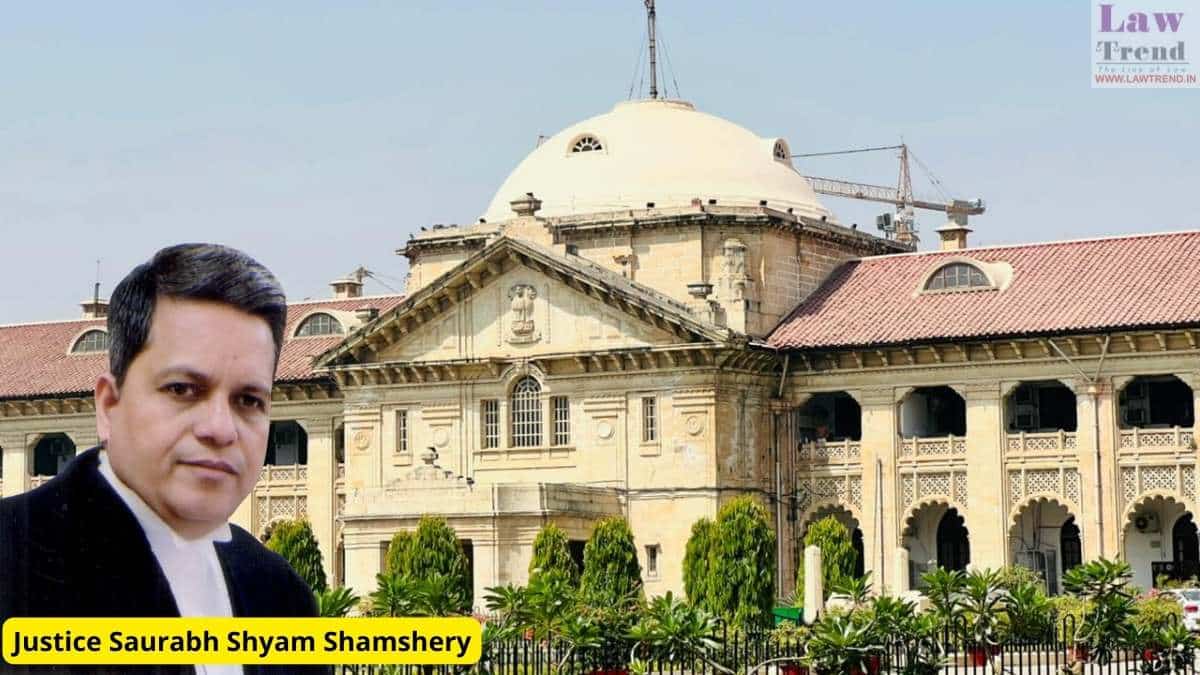
The High Court of Judicature at Allahabad, in a judgment delivered on April 02, 2026, has set aside an order by the Deputy Director of Consolidation (D.D.C.) that granted Sirdari rights to a claimant based on sporadic and disputed revenue entries. The Court held that the revisional authority erred in interfering with concurrent findings of fact without establishing the core ingredients of adverse possession.
Justice Saurabh Shyam Shamshery, presiding over a writ petition pending for over four decades, ruled that the D.D.C. had “very lightly interfered” with the well-reasoned orders of the Consolidation Officer (C.O.) and the Settlement Officer of Consolidation (S.O.C.).
Background of the Case
The dispute concerned plot numbers 1100, 4643, 1072, 3275, and 883 in village Haraiya, District Azamgarh. In the basic year, these plots were recorded in the names of Radhey Kishun Upadhyay and Shridhar Upadhyay, the predecessors of the petitioner, D.B. Upadhyaya.
The contesting respondent (Kharbhan) filed objections under Section 9A(2) of the U.P. Consolidation of Holdings Act, 1953, claiming Adhivasi and later Sirdar rights. He based his claim on revenue entries from 1356-F and 1359-F. The Consolidation Officer rejected these objections in 1971, a decision upheld by the Settlement Officer of Consolidation. However, the D.D.C. partly allowed the respondent’s revision in October 1971, leading to the present writ petition filed in 1982.
Arguments of the Parties
The petitioner, represented by Senior Advocate Sri Durgesh Kumar Singh and Sri Vishnu Singh, argued that:
- The D.D.C. exceeded its revisional jurisdiction by disturbing concurrent findings of fact.
- The revenue entries relied upon by the respondent were recorded as a ‘sikmi tenant’ (sub-tenant) with a note of ‘Batai Nisfi’, which indicates permissive, not hostile, possession.
- The respondent’s name was absent from revenue records for at least ten years prior to the start of consolidation proceedings.
The contesting respondents, represented by S/Sri ChandraJeet Yadav and Upendra Nath Yadav, contended that:
- The long-standing entries in their name established hostile possession.
- The petitioners never took steps for eviction.
- The respondent became Adhivasi and Sirdar by virtue of being recorded in 1356-F and 1359-F.
The Court’s Analysis
The Court emphasized that for a plea of adverse possession to succeed, the claimant must establish possession that is “peaceful, open and continuous” and meets the requirement of being nec vi, nec clam, and nec precario.
Justice Shamshery observed:
“In view of above, one of basic ingredients to prove adverse possession is that hostile possession be continued for more than 12 years before it was raised but on basis of undisputed revenue record, it was absolutely missing.”
The Court found that the D.D.C. ignored vital evidence:
- Nature of Entry: The entries were of ‘sikmi tenant’ with Batai Nisfi, which the Court termed “permissive possession and not an adverse possession.”
- Continuity: Revenue records showed the respondent’s name was “struck off” or missing in 1365-F and subsequent years.
- Jurisdictional Error: The D.D.C. failed to deliberate on the “manner of entries” and based findings on assumptions rather than records.
Citing the Supreme Court in Bachan vs. Kankar (1972), the Court noted that “entries which are not genuine cannot confer adhivasi rights.” The Court also referred to Vishwa Vijay Bharati vs. Fakhrul Hassan (1976), noting that while revenue records are generally accepted at face value, “the presumption of correctness can apply only to genuine, not forged or fraudulent, entries.”
Decision of the Court
The Court concluded that the D.D.C.’s interference was “legally unsustainable.” It upheld the detailed reasons assigned by the Consolidation Officer, who found no evidence of the respondent’s possession for ten years before consolidation.
The High Court set aside the impugned orders of the Deputy Director of Consolidation dated October 26, 1971, and September 17, 1982. The judgments of the Consolidation Officer and Settlement Officer of Consolidation were upheld, and the writ petition was allowed.
Case Details
Case Title: D.B.Upadhyaya Versus D.D.C. and others
Case Number: WRIT B No. 12565 of 1982
Bench: Justice Saurabh Shyam Shamshery
Date: April 02, 2026




