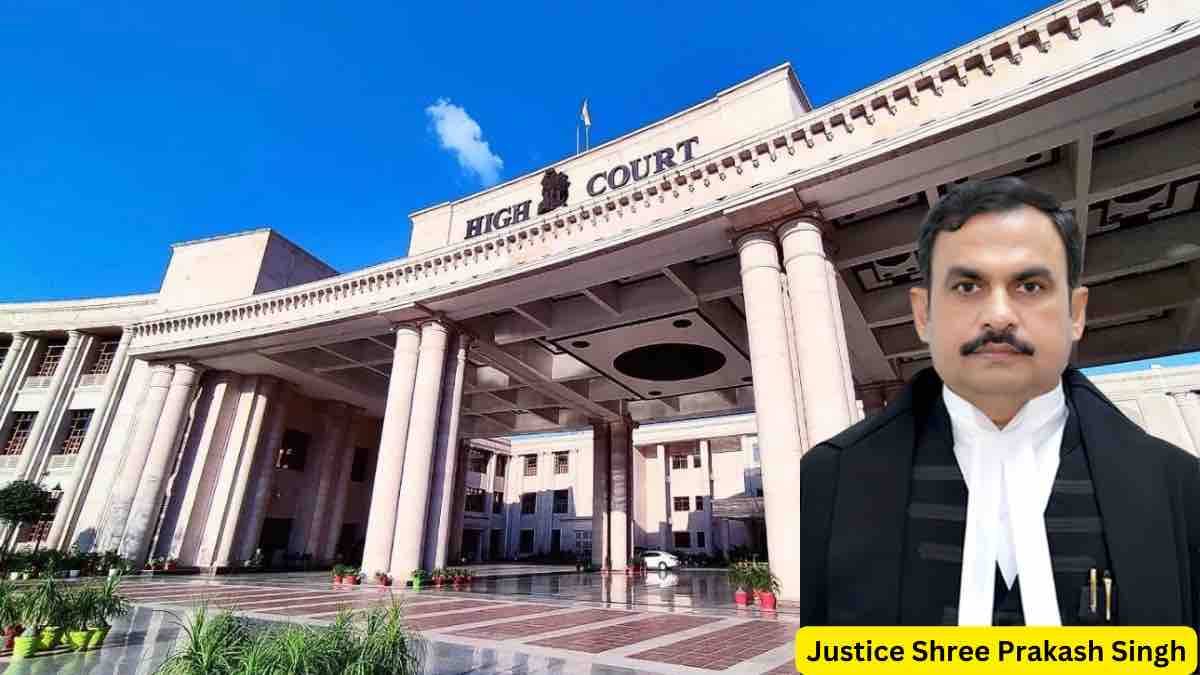
The Lucknow Bench of the Allahabad High Court has ruled that retiral benefits are valuable rights and property of retired employees, not a bounty to be distributed at the government’s discretion. The court partially allowed a writ petition, quashing a corporation’s order that denied interest on delayed retiral dues, and directed the payment of 7% interest per annum on the delayed gratuity and leave encashment.
Background
The petitioner, Mishri Lal, was appointed as a Sub Engineer in the U.P. State Bridge Corporation Ltd. (the ‘Corporation’) on January 9, 1979. Over the course of his unblemished career, he was promoted to Deputy Project Manager in 1997 and later to Project Manager in May 2003. He retired upon reaching the age of superannuation on July 31, 2007.
Despite his retirement in 2007, the petitioner’s retiral dues were not paid for approximately seven years, eventually being settled in 2014. The petitioner approached the court seeking interest on this delayed payment and the actual benefits of the Sixth Pay Commission recommendations from January 1, 2006. On March 2, 2016, the Managing Director of the Corporation rejected these claims, prompting the current writ petition.
Arguments of the Parties
Counsel for the Petitioner: The petitioner argued that while the retiral dues were paid in 2014, the seven-year delay entitled him to interest on gratuity and leave encashment. Furthermore, it was contended that the Sixth Pay Commission benefits should have been granted from its commencement date of January 1, 2006, rather than the date of the Government Order (G.O.) dated March 26, 2010. The petitioner relied on the Supreme Court judgment in Union of India Vs. Balbir Singh Turn (AIR 2018 SC 206) to argue that administrative instructions cannot override legislative or cabinet decisions regarding pay structures.
Counsel for the Respondent (Corporation): The Corporation contended that the petitioner failed to submit the mandatory ‘Form I’ prescribed under the Payment of Gratuity Act, 1972, for claiming gratuity. They maintained that as soon as formalities were completed in 2014, payments were made. Regarding the Sixth Pay Commission, the respondent argued that the G.O. dated March 26, 2010, explicitly stated that actual benefits would be provided with immediate effect, while benefits from 2006 would only be notional.
Court’s Analysis and Observations
Hon’ble Shree Prakash Singh, J., examined two primary issues: the entitlement to interest on delayed dues and the claim for retrospective Sixth Pay Commission benefits.
On the issue of gratuity, the Court analyzed Section 7 of the Payment of Gratuity Act, 1972. While the Corporation argued the petitioner hadn’t filed Form ‘I’, Justice Shree Prakash Singh noted that Section 7(2) fastens a mandatory liability on the employer to determine the amount of gratuity and give written notice to the employee, regardless of whether an application has been made. The Court found the Corporation failed to provide this mandatory notice.
The Court emphasized the nature of retiral benefits:
“It is trite law that retiral benefits are not a bounty to be distributed by the Government to its employees after their retirement, but these are valuable rights and property in the hands of the retired employees. In fact, non-payment of retiral dues is the harassment of the retired employee… if the retiral dues are paid with inordinate delay, suitable interest in a compensatory nature shall suffice the purpose so as to solace harassed employee.”
Citing the Supreme Court in State of Kerala Vs. M. Padmanabhan Nair (1985), Hon’ble Shree Prakash Singh, J. reiterated that culpable delay in settlement must be visited with the penalty of interest. He also referred to D.D. Tewari Vs. Uttar Haryana Bijli Vitran Nigam Limited (2014), affirming that retiral dues are a valuable right.
Regarding the Sixth Pay Commission, the Court observed that the G.O. dated March 26, 2010, was not challenged in the petition. The Court noted that the government consciously decided to provide notional benefits from 2006 and actual benefits from the date of the G.O. Since the G.O. remained intact and was not declared a nullity, the petitioner was not entitled to actual arrears from 2006.
Decision
The High Court partly allowed the writ petition. It quashed the impugned order dated March 2, 2016, to the extent that it denied interest on delayed payments.
The Court directed:
- The competent authority to pay interest at the rate of 7% per annum on the delayed post-terminal dues (gratuity and leave encashment).
- Such payment must be made to the petitioner within a period of eight weeks.
- The claim for actual benefits of the Sixth Pay Commission from January 1, 2006, was denied.
Case Title: Mishri Lal Versus State Of U.P. Thru Prin.Secy. P.W.D. Civil Sectt. Lko. And Ors
Case No.: WRITA No. 9735 of 2016