

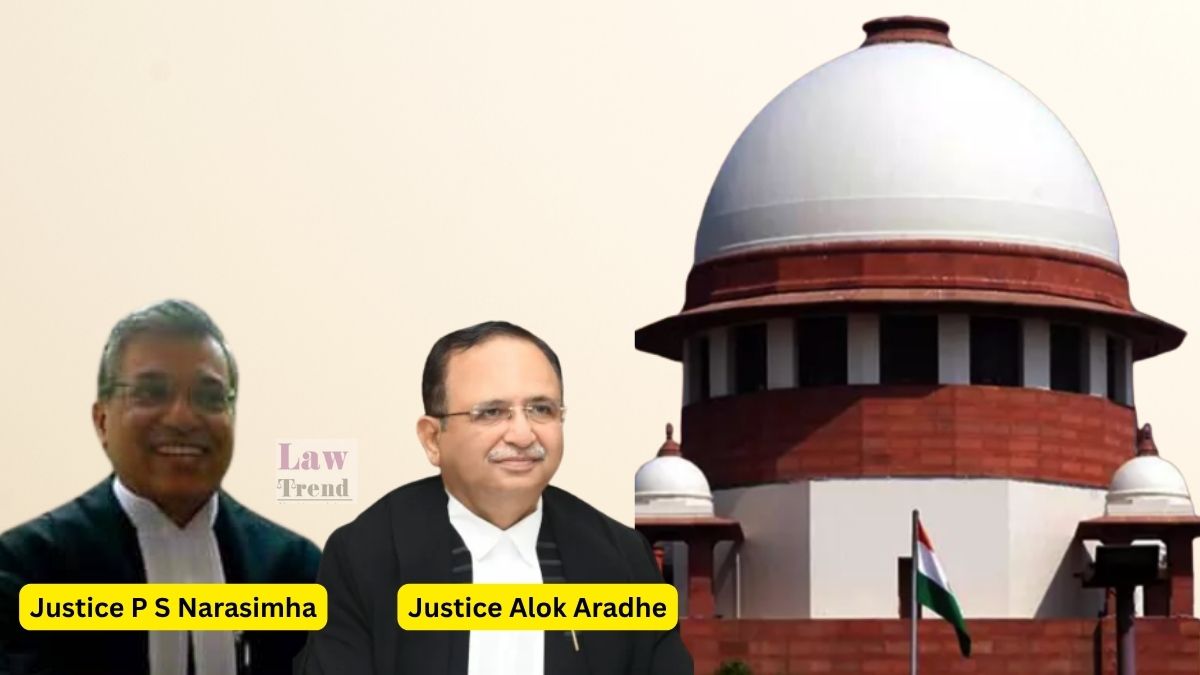
The Supreme Court of India has held that candidates belonging to reserved categories who avail of relaxation in qualifying marks for an eligibility test are entitled to migrate to the open or unreserved category if they secure higher merit in the main selection examination.
A Bench comprising Justice Pamidighantam Sri Narasimha and Justice Alok Aradhe quashed a judgment of the Bombay High Court which had previously barred such migration. The Court clarified that relaxation in a qualifying examination merely enables entry into the “zone of consideration” and does not affect the determination of inter se merit in the final selection process.
Background of the Case
The controversy arose during the recruitment of teachers in Maharashtra following the Teachers Aptitude and Intelligence Test, 2022 (TAIT). The recruitment process required candidates to have passed the Teachers Eligibility Test (TET), as mandated by the National Council for Teacher Education (NCTE).
Under the statutory scheme, general category candidates required 60% to pass the TET, while reserved category candidates were granted a 5% relaxation, requiring only 55%. The appellants, belonging to reserved categories, had qualified the TET using this relaxation but secured higher marks in the subsequent TAIT (the main selection exam) than the last selected general category candidate. Despite their higher merit, they were excluded from the open category merit list dated February 25, 2024.
The Bombay High Court (Aurangabad Bench) dismissed their writ petitions on February 14, 2025, relying on the Supreme Court’s decision in Government of (NCT of Delhi) v. Pradeep Kumar, holding that availing relaxation in TET made them ineligible for the open category.
Arguments of the Parties
The appellants argued that the open category is a “merit category” and not a quota for general candidates. They contended that relaxation in eligibility is intended to create a level playing field and should not penalize merit in the main selection.
The respondents (State of Maharashtra) maintained that TET is a mandatory eligibility requirement. They argued that candidates who qualified under relaxed standards could not claim migration to the open category, as doing so would result in a “double benefit” of reservation.
The Court’s Analysis
The Supreme Court identified the principal issue as whether candidates using relaxation in a qualifying exam can migrate to the open category based on merit in the main exam.
The Court observed that while the NCTE guidelines fix 60% as the passing mark for TET, they expressly permit State Governments to grant concessions to reserved categories. In this case, the Maharashtra Government had provided a 5% relaxation.
Distinction Between Eligibility and Selection Merit
Referring to its previous rulings in Jitendra Kumar Singh v. State of U.P. and Vikas Sankhala v. Vikas Kumar Agarwal, the Court noted:
“A concession/relaxation in a qualifying examination merely enables entry of a candidate into the zone of consideration and cannot be treated as relaxation in the standard prescribed for qualifying the written examination if such relaxation does not affect the merit which has to be determined solely on the basis of performance in the main examination.”
The Court emphasized that no relaxation was granted in the TAIT examination itself. Therefore, all candidates were evaluated on par during the selection stage.
Misapplication of Precedents
The Court held that the High Court and the Commissioner (Education) erred in relying on Pradeep Kumar (2019). In that case, candidates were denied open category seats because they did not possess the required OBC certificates from the NCT of Delhi and failed to meet the basic eligibility of 60% marks without having a valid local reservation claim.
In contrast, the Court noted:
“In the instant case, the requirement of obtaining 60% marks in TET is not an essential eligibility condition as the guidelines issued by the NCTE itself permits such relaxation… Such relaxation only enables a candidate belonging to reserved category to participate in TAIT.”
The Bench further clarified that migration is permissible if the Recruitment Rules are silent or do not expressly prohibit it.
The Decision
The Supreme Court quashed the Bombay High Court’s judgment dated February 14, 2025.
The Court directed:
“The respondents shall include in the merit list, those appellants who have secured marks higher than the last selected candidate in the general category.”
The Court concluded that the relaxation in qualifying criteria affects only eligibility, not merit. Consequently, the appeals were allowed with no order as to costs.
Case Details:
- Case Title: Chaya & Ors. etc. v. The State of Maharashtra & Anr. etc.
- Case Number: Civil Appeal Nos. ___ of 2026 (@SLP (C) Nos. 14517-14539 of 2025)
- Bench: Justice Pamidighantam Sri Narasimha and Justice Alok Aradhe
- Date of Judgment: March 23, 2026




