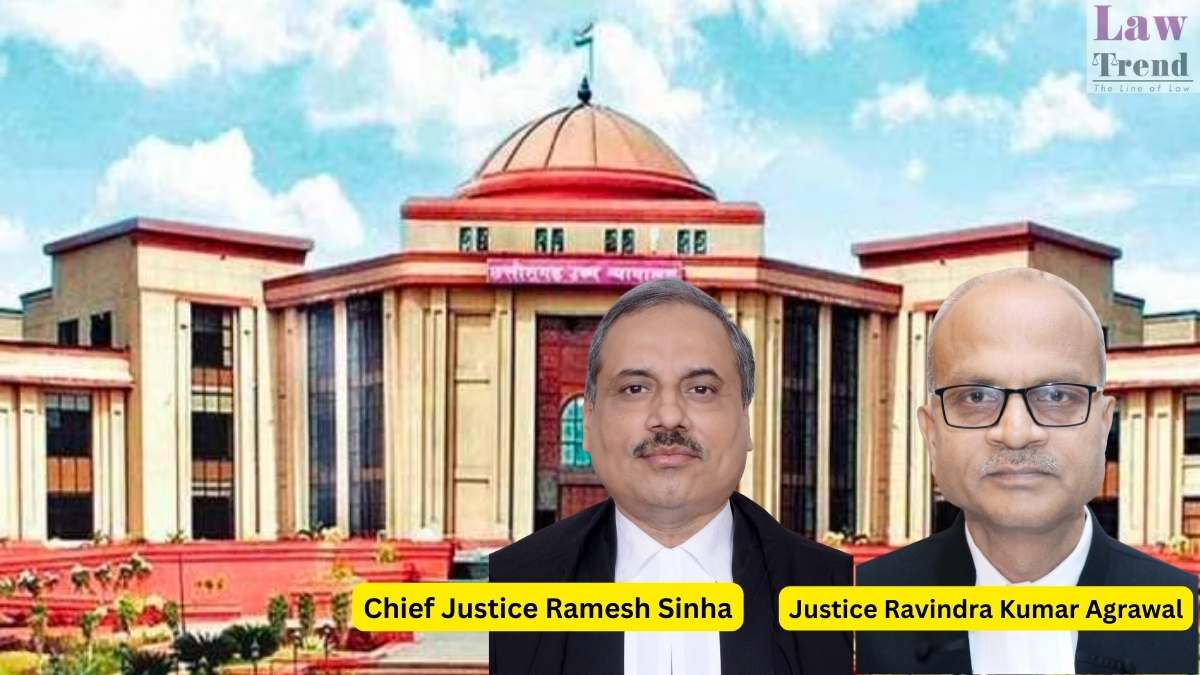
Ruling on the sanctity of personal liberty and the limits of police power, the Chhattisgarh High Court has held that preventive arrest under the Bharatiya Nagarik Suraksha Sanhita (BNSS), 2023, must strictly conform to statutory safeguards and constitutional requirements. The Division Bench of Chief Justice Ramesh Sinha and Justice Ravindra Kumar Agrawal declared that an arrest made without the registration of a cognizable offence, without informing the arrestee of the grounds of arrest, and followed by a mechanical remand without application of mind, is a violation of Articles 21 and 22(1) of the Constitution of India.
Holding that such illegal detention justifies the quashment of proceedings and the award of compensation as a public law remedy, the Court directed the State of Chhattisgarh to pay Rs. 1,00,000/- (Rupees One Lakh) to the petitioner.
Legal Issue and Decision
The central legal question before the Court was whether the police can effect a preventive arrest under Section 170 of the BNSS (corresponding to Section 151 of the CrPC) without disclosing the grounds of arrest and whether a Magistrate can remand such a person to custody without satisfying himself of the necessity of detention.
The High Court answered in the negative, observing that Section 35 of the BNSS confers power of arrest as a “preventive measure and not as a punitive one.” The Court ruled that the failure to issue a notice of appearance under Section 35(3) and the failure to supply grounds of arrest in writing rendered the arrest illegal. Consequently, the Court quashed the order dated September 8, 2025, the Istagasha, and all subsequent proceedings in Criminal Case No. 1379/2025.
Background of the Case
The petitioner, Akash Kumar Sahu, a law student and hotel owner in Bhilai, filed the writ petition challenging his arrest and subsequent detention.
- The Incident: On September 8, 2025, police officials from Police Outpost Smriti Nagar visited the petitioner’s hotel regarding a missing person inquiry. Later, alleging theft by hotel staff, the police returned.
- The Arrest: The petitioner alleged that upon his arrival at the hotel, he was verbally abused, humiliated, and forcibly taken to the police station where he was beaten. He was arrested under Section 170 of the BNSS and proceedings under Sections 126 and 135 of the BNSS were initiated.
- The Remand: He was produced before the Sub-Divisional Magistrate (SDM), Durg, who remanded him to judicial custody. He was released on bail the next day. The petitioner contended he was never informed of the grounds of his arrest.
Arguments of the Parties
Petitioner’s Contentions: Advocate Mr. Dhiraj Kumar Wankhede argued that the entire action was arbitrary and illegal:
- No Substantive Offence: No FIR was registered against the petitioner for any cognizable offence. The arrest was based merely on a suspected altercation.
- Violation of BNSS: The police ignored the mandatory proviso of Section 35(3) of the BNSS regarding the issuance of a notice of appearance.
- Constitutional Violation: The petitioner was not informed of the grounds of arrest, violating Articles 21 and 22(1). Counsel relied on the Supreme Court’s decision in Mihir Rajesh Shah vs. State of Maharashtra (2025), arguing that grounds of arrest must be communicated in writing.
- Mechanical Remand: The Magistrate exercised power under Section 187 of the BNSS (remand) mechanically without verifying the legality of the arrest.
State’s Defense: Advocate General Mr. Vivek Sharma submitted that the police acted to prevent a breach of peace:
- Obstruction of Duty: The State alleged that the petitioner argued with the police, snatched vehicle keys, and assaulted a driver during an inquiry into a missing person.
- Preventive Action: The situation necessitated preventive arrest under Section 170 BNSS.
- Intimation: The State claimed the petitioner’s father was informed of the arrest via mobile.
- Bail: It was argued that the petitioner was sent to jail only because he failed to furnish a bail bond on the date of arrest.
Court’s Analysis and Observations
The Court scrutinized the Istagasha and the affidavit filed by the Senior Superintendent of Police, Durg.
1. On Preventive Arrest and Statutory Safeguards: The Bench observed that Section 35 of the BNSS is circumscribed by strict safeguards.
“The provision is … not intended to authorize routine or mechanical arrests. Further, Section 35(3) of the BNSS, 2023 mandatorily requires the police officer to issue a notice of appearance in cases where arrest is not necessary. … The failure to follow this statutory mandate vitiates the arrest itself.”
2. On Grounds of Arrest (Reliance on Mihir Rajesh Shah): The Court noted that the arrest memo contained the petitioner’s handwritten endorsement: “I don’t know the matter”.
“Merely informing a family member about the arrest does not amount to compliance with the constitutional and statutory requirement of informing the arrestee himself of the grounds of arrest… In the present case, there is not even a whisper in the State’s affidavit to show that the grounds of arrest were ever supplied to the petitioner in writing.”
3. On Mechanical Remand: The Court criticized the SDM for failing to discharge his duty as a “judicial sentinel.”
“In the present case, where no FIR was registered and no offence was disclosed, the remand of the petitioner to judicial custody reflects a mechanical exercise of power, in complete disregard of the constitutional mandate… The Magistrate was required to act as a judicial sentinel, which duty, unfortunately, was not discharged.”
4. On Compensation: Citing D.K. Basu v. State of West Bengal, the Court held that the petitioner suffered severe mental and financial hardship.
“The cumulative effect of the aforesaid facts unmistakably establishes that the petitioner was subjected to an illegal arrest, unlawful detention and unwarranted incarceration… Liberty with dignity is the essence of Article 21.”
Decision
The High Court allowed the writ petition and issued the following directions:
- Quashment: The order dated 08.09.2025 and all proceedings in Criminal Case No. 1379/2025 were quashed.
- Compensation: The State was directed to pay Rs. 1,00,000/- to the petitioner within four weeks.
- Interest: An interest of 9% per annum will apply if payment is delayed.
- Accountability: The State was granted liberty to recover the amount from the erring officials after an inquiry.
Case Details
- Case Title: Akash Kumar Sahu vs. State of Chhattisgarh & Others
- Case Number: WPCR No. 553 of 2025
- Bench: Chief Justice Ramesh Sinha and Justice Ravindra Kumar Agrawal