POSH Act | ICC of Aggrieved Woman’s Workplace Can Probe Employee of Different Department: Supreme Court
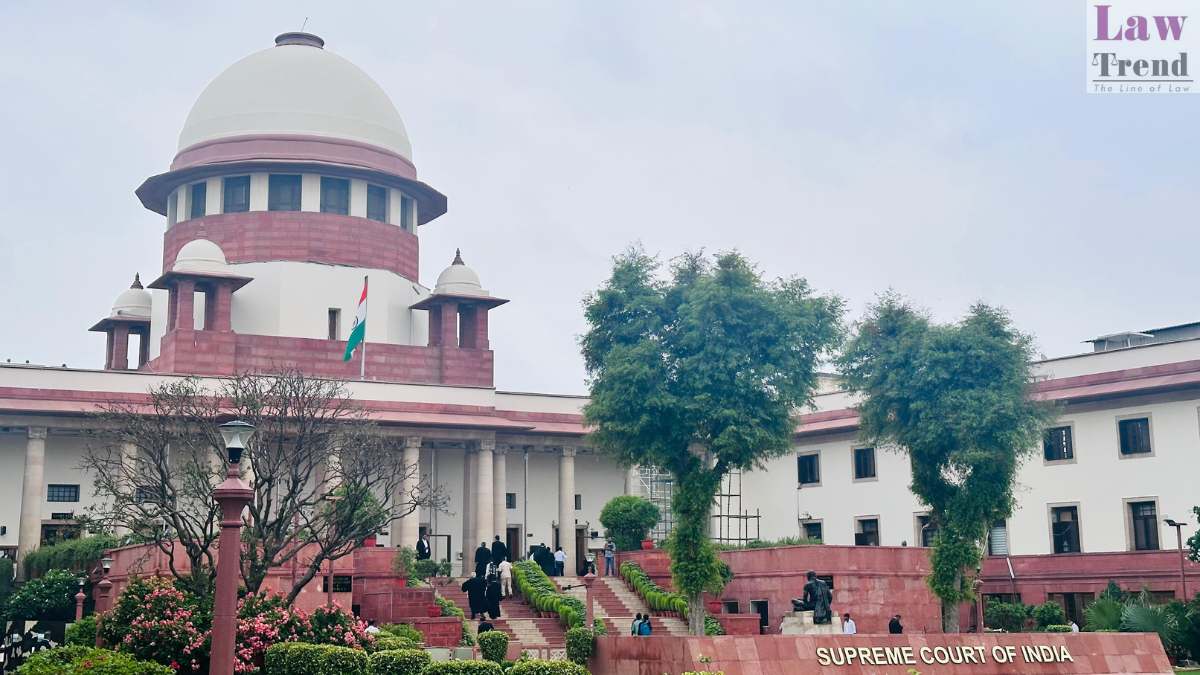

The Supreme Court has held that the Internal Complaints Committee (ICC) constituted at the workplace of an aggrieved woman has the jurisdiction to entertain a complaint under the Sexual Harassment of Women at Workplace (Prevention, Prohibition and Redressal) Act, 2013 (POSH Act) against an employee belonging to a different department of the Government of India.

A Bench comprising Justice J.K. Maheshwari and Justice Vijay Bishnoi, while dismissing an appeal filed by an Indian Revenue Service (IRS) officer, ruled that the definition of “workplace” under the POSH Act is broad and the Act must be interpreted to further its social welfare intent. The Court clarified that the phrase “where the respondent is an employee” in Section 11 of the Act is a procedural provision and not a jurisdictional bar.

Brief Summary and Outcome

The legal issue before the Apex Court was whether the ICC of one government department could inquire into sexual harassment allegations against an officer working in a separate department. The Appellant, an IRS officer, challenged the jurisdiction of the ICC of the Department of Food and Public Distribution (where the complainant worked) to investigate him, arguing that only the ICC of his own department (Department of Revenue) had the authority. The Supreme Court rejected this contention, upholding the decisions of the Delhi High Court and the Central Administrative Tribunal (CAT).

Background of the Case

The case arose from a complaint filed by a 2004 batch Indian Administrative Service (IAS) officer (the aggrieved woman), who was posted as Joint Secretary in the Department of Food and Public Distribution. She alleged that the Appellant, a 2010 batch IRS officer posted as OSD, Investigation, Central Board of Direct Taxes (CBDT), sexually harassed her on May 15, 2023, at her workplace in Krishi Bhawan, New Delhi.

READ ALSO  [BREAKING] Parambir Singh moves Supreme Court seeking Probe into the allegations raised by him in the letter to CM Thakrey

Following the incident, the officer registered an FIR and subsequently filed a complaint under the POSH Act with the ICC of her own department on May 24, 2023. The ICC issued a notice to the Appellant on June 13, 2023. The Appellant challenged this notice before the CAT, seeking to set aside the proceedings on the grounds of lack of jurisdiction. The CAT dismissed his plea on June 23, 2023, and the Delhi High Court subsequently upheld the CAT’s order on June 30, 2023. The Appellant then approached the Supreme Court.

Arguments of the Parties

Senior Advocate Vipin Sanghi, appearing for the Appellant, argued that for civil servants, the Central Civil Services (Conduct) Rules, 1964, constitute a complete code. He contended that under Section 11 of the POSH Act, which uses the phrase “where the respondent is an employee,” the inquiry must be conducted by the ICC of the workplace where the respondent is employed. He emphasized that since only his own department (Revenue) could take disciplinary action against him, the ICC of the Department of Food and Public Distribution lacked jurisdiction. He further argued that under Section 19(h) of the Act, if the perpetrator is not an employee of the complainant’s workplace, the only remedy is to initiate action under the Indian Penal Code (IPC).

Additional Solicitor General Aishwarya Bhati, appearing for the Union of India, argued that the Appellant’s interpretation would defeat the purpose of the POSH Act. She submitted that the wide definitions of “workplace” and “employer” in the Act indicate a legislative intent to ensure all complaints are addressed. She contended that under Section 13(3), the ICC can recommend action to the employer of the respondent, thus bridging any inter-departmental gap.

READ ALSO  Once Confirmatory Order of Detention Is Passed Under Section 12 (1) of National Security Act, 1980, the State Government Has No Authority to Review Its Order: Allahabad HC

Court’s Analysis

The Supreme Court undertook a detailed textual and contextual interpretation of the POSH Act.

Interpretation of Section 11 The Court rejected the Appellant’s reliance on the word “where” in Section 11(1). The Bench observed that “where” is used in the sense of a situation or condition (“in case”), not as a reference to a physical place.

“The use of the phrase ‘where the respondent is an employee’ is essentially a procedural trigger, directing the ICC to apply the service rules which are applicable to the ‘respondent’, it is not a jurisdictional constraint limiting a particular ICC to hear the complaint,” the Court observed.

Definition of Workplace The Court highlighted Section 2(o)(v) of the POSH Act, which expands the definition of “workplace” to include “any place visited by the employee arising out of or during the course of employment.”

“If we were to interpret the provisions of the POSH Act to hold that only the ICC constituted at the workplace of the ‘respondent’ has the jurisdiction to entertain complaints… it would defeat the purpose of such an expanded scope,” the Bench noted.

The Court reasoned that forcing an aggrieved woman to approach the ICC of the respondent’s workplace would create “procedural and psychological barriers.”

Two-Stage Inquiry Process Addressing the issue of disciplinary authority, the Court referred to the Department of Personnel and Training (DoPT) Office Memorandum dated July 16, 2015. The Court explained that the inquiry process for government employees involves two stages:

  1. Fact-Finding Inquiry: The ICC at the aggrieved woman’s workplace conducts a preliminary inquiry to verify the allegations.
  2. Formal Disciplinary Inquiry: If the allegations are substantiated, the report is sent to the respondent’s Disciplinary Authority. If the Authority decides to issue a charge sheet, the ICC of the respondent’s department acts as the Inquiring Authority for the formal proceedings under the CCS (CCA) Rules, 1965.
READ ALSO  HC Cannot Re-Appreciate Evidence in Judicial Review of Departmental Proceedings: SC

The Court held:

“It is merely the factual inquiry which is to be conducted by the ICC constituted at the workplace of the aggrieved woman… The fact that ultimately disciplinary action against the ‘respondent’ has to be taken by his employer and his department cannot be an impediment for the ICC constituted at the workplace of the aggrieved woman to take up the fact-finding inquiry.”

Decision

The Supreme Court dismissed the appeal, holding that the ICC of the aggrieved woman’s department was competent to conduct the fact-finding inquiry. The Court directed that the ICC’s report (which had been kept in a sealed cover) be transmitted to the Appellant’s department for further action in accordance with the service rules.

The Court concluded:

“The phrase ‘where the respondent is an employee’ as contained in Section 11 of the POSH Act, cannot be interpreted to mean that ICC proceedings against a ‘respondent’ may only be instituted before the ICC constituted at the workplace of the ‘respondent’.”

Case Details:

  • Case Title: Dr. Sohail Malik v. Union of India & Anr.
  • Case No.: Civil Appeal No. 404 of 2024
  • Coram: Justice J.K. Maheshwari and Justice Vijay Bishnoi
  • Citation: 2025 INSC 1415

Law Trend
Law Trendhttps://lawtrend.in/
Legal News Website Providing Latest Judgments of Supreme Court and High Court

Related Articles

Latest Articles