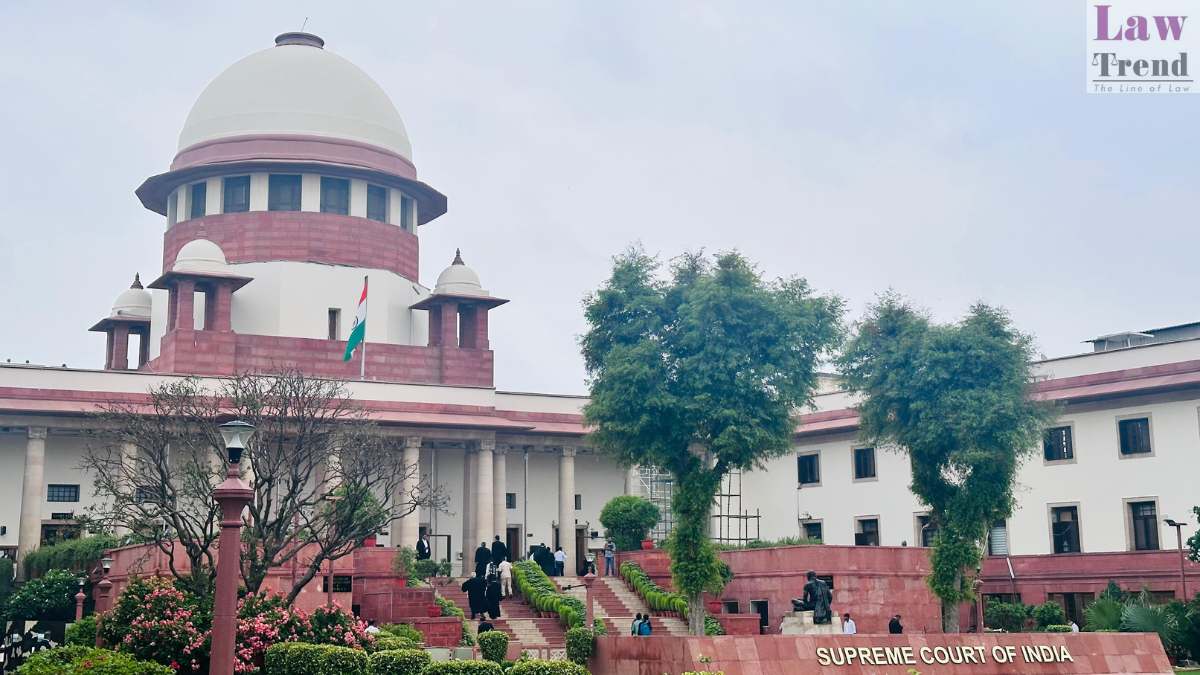
The Supreme Court has held that once a final report (closure report) submitted by the police is accepted by the competent court, the investigating agency cannot conduct a “further investigation” under Section 173(8) of the Code of Criminal Procedure (CrPC) without obtaining the leave of the Magistrate or the Court concerned.
A Bench comprising Justice Rajesh Bindal and Justice Vijay Bishnoi set aside a judgment of the Allahabad High Court which had refused to quash administrative orders directing further investigation into a rape case years after the closure report had been accepted by the Judicial Magistrate.
The Court observed that while the police have the power to conduct further investigation, the requirement of seeking the Court’s permission is a necessary implication of Section 173(8) CrPC to ensure the ends of justice.
Background of the Case
The case originated from an FIR registered on November 19, 2013, against the Appellants (Pramod Kumar and others) for offences under Sections 376D (gang rape), 352, 504, and 506 of the Indian Penal Code (IPC) at Mahila Police Station, District Firozabad.
Following an investigation, the police submitted a Final Report (Closure Report) on May 30, 2014, stating that no offence was made out. The report cited contradictions in the statements of the complainant and lack of supporting evidence. The Court of First Additional Civil Judge (J.D.)/Judicial Magistrate, Firozabad, accepted this closure report on September 14, 2015, noting that despite service of notice, the complainant did not file any protest petition.
Years later, acting on a complaint filed before the National Human Rights Commission (NHRC) alleging deficiencies in the investigation, the State of Uttar Pradesh, through a letter dated June 6, 2019, directed the CB-CID to investigate the matter. Subsequently, on April 26, 2021, the Superintendent of Police, Agra, directed the Investigating Officer (IO) to complete the investigation. The IO had applied to the Magistrate for permission to conduct further investigation, but the administrative orders directing the probe were issued without waiting for a judicial order.
The Appellants challenged these administrative orders before the Allahabad High Court, which dismissed their petition on November 20, 2023. Aggrieved, they approached the Supreme Court.
Submissions of the Parties
Arguments for the Appellants: Advocate Divyesh Pratap Singh, appearing for the Appellants, argued that the Superintendent of Police directed further investigation under Section 173(8) CrPC without obtaining prior permission from the competent Court, even though the closure report had already been accepted in 2015. He contended that once a final report is accepted, only the criminal court has the power to order further investigation. He characterized the new probe as an impermissible “de-novo” investigation initiated seven years later without new material.
The counsel also highlighted that a DNA Test Report dated September 21, 2022, concluded that the accused persons were not the biological fathers of the prosecutrix’s aborted fetus, which contradicted the allegations. Reliance was placed on the Supreme Court’s judgment in Vinay Tyagi v. Irshad Ali (2013).
Arguments for the State: Additional Advocate General Apoorva Agarwal, representing the State of Uttar Pradesh, argued that there is no statutory bar under Section 173(8) CrPC against conducting further investigation. He submitted that “further investigation” is merely a continuation of the earlier investigation. Relying on the judgment in Dharam Pal v. State of Haryana (2016), the State contended that a police officer has unrestricted power to conduct further investigation.
Court’s Analysis and Observations
The Supreme Court examined the scope of Section 173(8) of the CrPC (corresponding to Section 193(9) of the Bharatiya Nagarik Suraksha Sanhita, 2023).
Requirement of Court Permission Referring to the precedent set in Vinay Tyagi v. Irshad Ali (2013), the Bench reiterated that while Section 173(8) does not explicitly mandate seeking the Court’s leave, it has become a “procedure of propriety” and a legal practice that must be read into the provision.
The Court quoted:
“The requirement of seeking prior leave of the court to conduct ‘further investigation’ and/or to file a ‘supplementary report’ will have to be read into, and is a necessary implication of the provisions of Section 173(8) of the Code.”
Power Rests with the Magistrate The Bench also relied on the recent judgment in Peethambaran v. State of Kerala (2024), which held that a District Police Chief cannot order further investigation as that power rests either with the Magistrate or a higher court.
The Court observed:
“In light of the legal position as settled by this Court… it is safe to say that the power to direct further investigation in a case rests solely at the discretion of the Magistrate/Court concerned. In the event, the police/investigation agency is of the opinion that further investigation is necessary… it is binding upon them to file an appropriate application before the Magistrate/Court, without directing an order for further investigation by themselves.”
On the Conduct of the Superintendent of Police The Court strongly criticized the conduct of the Superintendent of Police, Agra, who had issued directions for the investigation to be completed without securing the Magistrate’s permission.
“Thus, it is amply clear that the Superintendent of Police acted in complete defiance of the procedure laid down under the law while passing orders directing further investigation without seeking leave of the Court. It is an unbecoming conduct from the officer of such a rank to exercise unfettered powers, in excess of its jurisdiction, thereby undermining the authority vested in the Court of law.”
Distinguishing Dharam Pal The Court distinguished the present case from Dharam Pal v. State of Haryana, noting that the facts in that case involved a request for transfer of investigation to the CBI where the Constitutional Court exercised its powers, which is distinct from a police officer unilaterally ordering further investigation after the acceptance of a closure report.
Decision
The Supreme Court allowed the appeal and set aside the impugned judgment of the Allahabad High Court dated November 20, 2023.
Consequently, the Court quashed the Order dated June 6, 2019, passed by the State Government, and the Order dated April 26, 2021, passed by the Superintendent of Police, which had directed further investigation.
However, the Bench clarified that this order would not prejudice the Criminal Revision petition filed by the original complainant against the acceptance of the closure report, which is pending before the District and Sessions Judge, Firozabad. The Trial Court was directed to decide the revision on its own merits.
Case Details:
- Case Title: Pramod Kumar & Ors. v. State of U.P. & Ors.
- Case No.: Civil Appeal No. of 2026 (Arising out of SLP (Criminal) No. 350 of 2024)
- Coram: Justice Rajesh Bindal and Justice Vijay Bishnoi
- Counsel for Appellants: Mr. Divyesh Pratap Singh
- Counsel for Respondents: Mr. Apoorva Agarwal, AAG