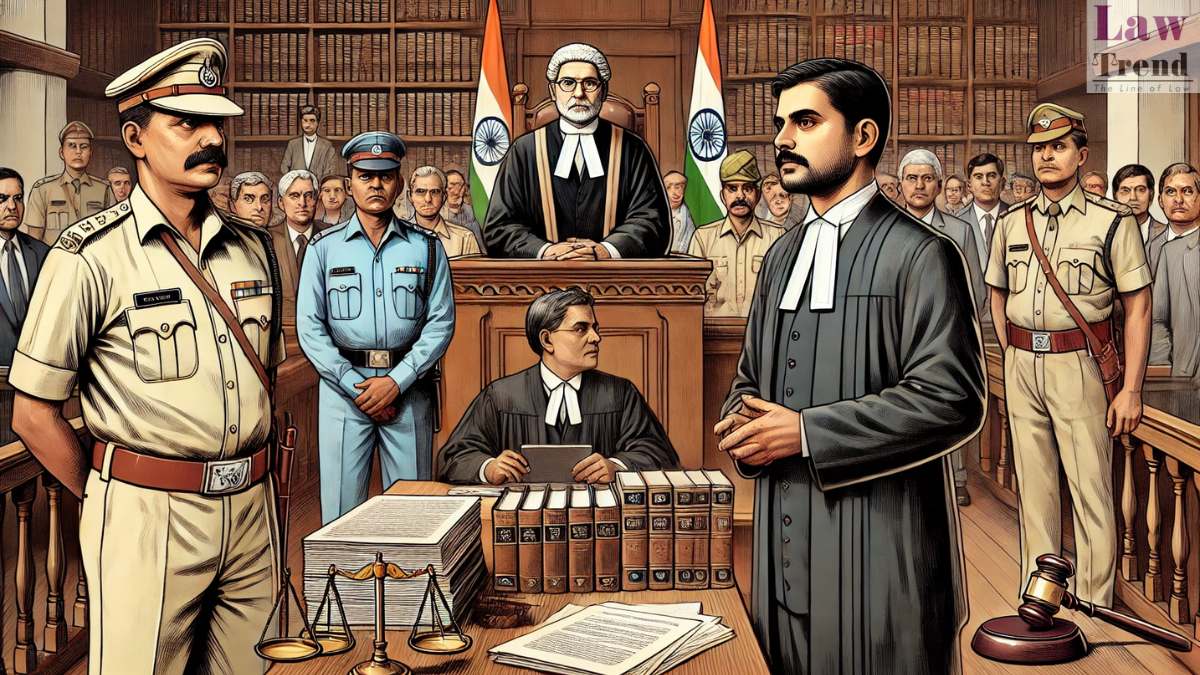
The Rajasthan High Court has taken suo motu cognizance of a viral incident involving the manhandling of a lawyer by a Station House Officer (SHO) in Jodhpur, directing the immediate formation of Coordination Committees at every district level to resolve friction between the bar and the police.
A Division Bench comprising Acting Chief Justice Sanjeev Prakash Sharma and Justice Baljinder Singh Sandhu, in the case of Rajasthan High Court Advocates’ Association, Jodhpur & Anr. v. State of Rajasthan & Anr. (D.B. Civil Writ Petition No. 23646/2025), observed that advocates and police personnel are “two limbs of the same justice delivery system” and must operate with “mutual respect and mutual cooperation.”
Background of the Incident
The proceedings were initiated after Senior Advocate Dr. Sachin Acharya, an elected Member of the Bar Council of Rajasthan, mentioned a news item published in Dainik Bhaskar regarding the “manhandling and misbehaviour” by the SHO of Police Station Kudi Bhagtasani, Jodhpur.
According to the details recorded in the order, Mr. Bharat Singh Rathore, a lawyer, accompanied by his wife—also a lawyer of the High Court—had visited the police station with a rape victim (prosecutrix). The lawyers observed that a person in civil clothes, not wearing a uniform, was recording the victim’s statement without following due procedure.
When Mr. Rathore complained to the SHO, the officer “misbehaved and manhandled the lawyer and shoved him in a room.” The situation escalated when the lawyer demanded that the victim not be summoned repeatedly to the station. The SHO allegedly restrained the lawyer. His wife, who insisted on the proper recording of the statement and protested against the manhandling, was also told to leave, with a lady constable attempting to remove her from the premises. A video of the incident was shown to the Court.
Court Proceedings and Admissions
Taking serious note of the event, the Bench summoned the Commissioner of Police, Jodhpur, Mr. Om Prakash, along with the Deputy Commissioner of Police (West) and the Additional Deputy Commissioner of Police.
Upon appearing before the Court, the Commissioner acknowledged the video evidence. The Court noted:
“The incident, which has been recorded in a video, has become viral, reflects that the concerned SHO has actually misbehaved and as suggested by the Commissioner, needs to be trained for soft skills.”
The Commissioner assured the Court that an inquiry would be conducted and, if required, departmental proceedings would be initiated against the officials responsible for misbehaving with the lawyers who were “representing a cause of victim.”
Court’s Observations and Analysis
The Bench expressed concern over the “unfortunate” incident and the lack of coordination between the two wings of the administration of justice.
The Court observed:
“We feel that so far as the advocates and police personnel are concerned, they both are two limbs of the same justice delivery system and are to act in tandem with each other and there should be mutual respect and mutual cooperation between the two. While the police is required to work in difficult situations and has to sometime act strongly with the accused, the same cannot be expected from them when they are dealing with the lawyers.”
The Court further added that lawyers are also expected to deal with police personnel “in a soft manner and with a polite attitude.”
Addressing the need for systemic reform, the Court emphasized that police officials require “thorough soft skill training.” It directed the Commissioner to inform the police academy about this requirement to ensure training is provided not only to officials in Jodhpur but across the state.
Reliance on Precedent
To prevent future occurrences, the Court referred to a 2019 order passed in the case of Bharat Yadav v. State of Rajasthan (2019 SCC OnLine Raj 782). The Court noted that in Bharat Yadav, similar issues were addressed, and directions were given for the constitution of a “Grievance Redressal Committee” or “Coordination Committee” at each district level.
Quoting from the Bharat Yadav judgment, the Court reiterated the structure of such committees:
“…a tentative constitution of such Committee which shall include at least one representative from the respective Bar Association of that district as well as one Member from the judiciary. Apart from the same, there should also be one Official from the concerned police department so that the matter can be examined impartially.”
Directives and Decision
Noting that the previously suggested Coordination Committees had not been “actively performing its work,” the High Court issued the following directions:
- Coordination Committees: The Court directed that a “Coordination Committee at each district shall be formed afresh,” and details must be communicated to the Court by the next hearing.
- Departmental Action: The Commissioner of Police assured the Court that action against the concerned officials would be taken immediately and reported to the Court “by today evening.”
- Future Directions: The Court stated that further directions regarding the functioning of the Committees would be passed subsequently.
The petition has been registered as a Public Interest Litigation (PIL) and is listed for further hearing on December 8, 2025. A copy of the order was directed to be sent to the Director General of Police.