The High Court of Chhattisgarh has dismissed a writ petition filed by Senior Personal Assistants (Stenographer Grade-I) working in the District Judiciary, who sought a direction to the State to amend the service rules to allow them to switch over to the Ministerial/Supervisory Cadre.
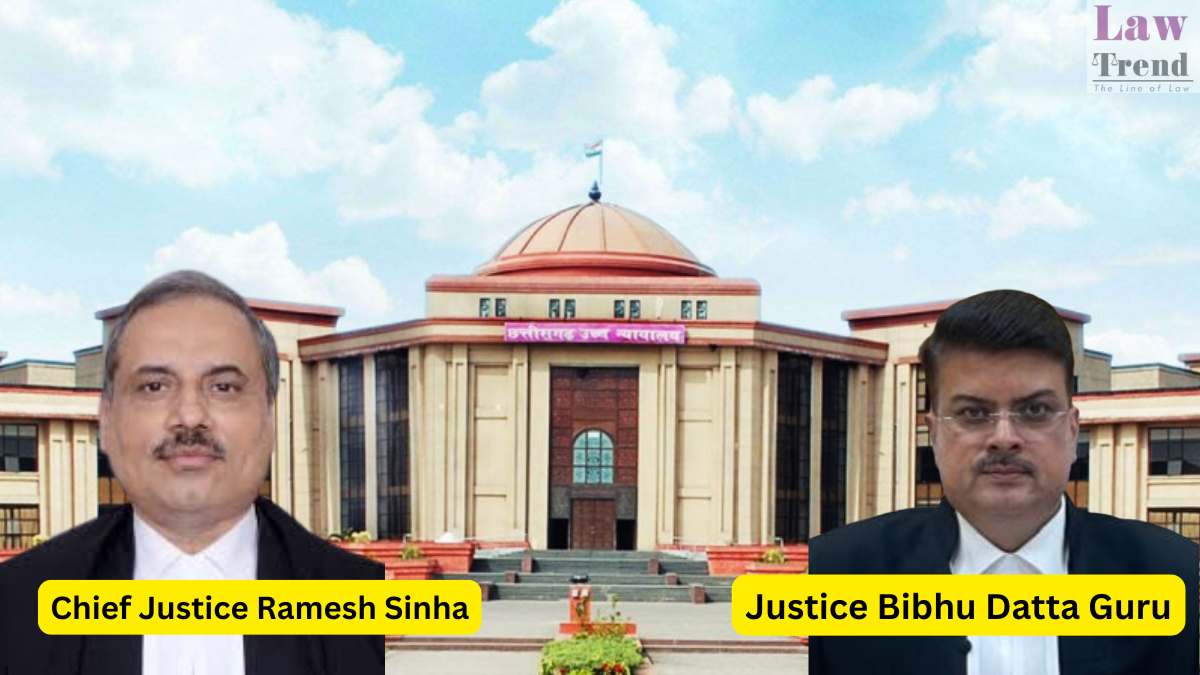
The Division Bench, comprising Chief Justice Ramesh Sinha and Justice Bibhu Datta Guru, upheld the validity of the Chhattisgarh District Judiciary Establishment (Recruitment and Conditions of Service) Employees Rules, 2023, observing that pay scales and cadre hierarchies fall within the exclusive domain of policy-making.
Background of the Case
The petitioners, serving as Senior Personal Assistants (Stenographer Grade-I) in various District and Sessions Courts across Chhattisgarh, approached the High Court challenging the Chhattisgarh District Judiciary Establishment (Recruitment and Conditions of Service) Employees Rules, 2023.
They contended that the Rules failed to incorporate the recommendations of the Justice Shetty Commission, specifically regarding the option for Stenographers to switch over to the Ministerial/Supervisory Cadre after completing a minimum period of service. The petitioners argued that the Commission had recommended that Stenographers should not be treated as “once a mortgage, always a mortgage” and that their experience should be utilized in other branches of administration.
The petitioners sought a declaration that the entry at Serial No. 1 Column No. 3 in Schedule II of the 2023 Rules is ultra vires the Constitution. They demanded inclusion in the cadre of Administrative Officers (Court Superintendents) or the creation of new promotional posts to address stagnation.
Arguments of the Parties
Petitioners’ Contentions: Represented by Advocate Mr. Samrath Singh Marhas, the petitioners argued that the omission of the switch-over option violated Articles 14 and 16 of the Constitution. They submitted that:
- The Justice Shetty Commission’s recommendations were binding on all States/Union Territories as per the Supreme Court’s directions in All India Judges’ Association v. Union of India.
- High Courts of Madhya Pradesh and Delhi have already implemented these recommendations, allowing Stenographers to switch to Ministerial cadres.
- The State of Chhattisgarh framed the 2023 Rules after a delay of 20 years but arbitrarily excluded this benefit, leaving the Stenographer cadre isolated and facing pay disparities compared to the Administrative Officer cadre.
State’s Defense: Deputy Advocate General Mr. Praveen Das, appearing for the State, opposed the petition, arguing:
- The 2023 Rules were framed under Article 309 read with Article 235 of the Constitution after consultation with the High Court and enjoy a presumption of constitutionality.
- The Supreme Court accepted the Shetty Commission’s recommendations subject to “feasibility and administrative suitability.” The recommendation regarding inter-cadre mobility was directory, not mandatory.
- The Stenographer cadre is a specialized cadre requiring technical competencies like shorthand and transcription, which are distinct from the functions of the Ministerial cadre.
- The 2023 Rules already provide a structured promotional pathway (Grade-III to Grade-II to Grade-I), ensuring career progression.
Court’s Analysis and Observations
The Court rejected the petitioners’ claim that the Shetty Commission’s recommendations on inter-cadre mobility were mandatory. The Bench referred to the Supreme Court’s judgment in All India Judges’ Association, noting that it “nowhere held that every recommendation—particularly those relating to cadre structure and inter-cadre mobility—must be incorporated verbatim by all States.”
On Policy Domain and Judicial Interference: The Court emphasized that structuring cadres and pay scales is an administrative prerogative.
“Pay scales and cadre hierarchies fall within the exclusive domain of policy, and unless shown to be arbitrary or discriminatory—which is not the case here—the Courts do not ordinarily interfere,” the Bench observed.
On the Distinction Between Cadres: The Court held that the functional differentiation between Stenographers and Ministerial staff is constitutionally permissible.
“The Stenographer Cadre is a specialised cadre requiring shorthand proficiency, accuracy of transcription, and continuous assistance to the Court. Ministerial and Supervisory Cadres involve financial, procedural, and establishment related responsibilities… The Court is satisfied that there exists an intelligible differentia and a rational nexus with the object sought to be achieved.”
On Uniformity Across States: Addressing the argument that other states like Madhya Pradesh had implemented the switch-over, the Court stated:
“The mere fact that Chhattisgarh has adopted a different model does not render its Rules unconstitutional. Implementation of Shetty Commission recommendations across the country has never been uniform and is dependent upon local administrative feasibility.”
Decision
The High Court dismissed the writ petition, holding that the petitioners failed to demonstrate any manifest arbitrariness or hostile discrimination in the 2023 Rules.
The Court concluded:
“Ultimately, what the petitioners seek is a direction compelling the State to restructure its cadres in a particular manner. Such an exercise falls squarely within the realm of policy, and judicial directions in this field… would amount to impermissible intervention in administrative prerogative.”
Case Details:
- Case Title: Om Prakash Ram & Others v. State of Chhattisgarh & Others (WPS No. 3976 of 2025)
- Coram: Chief Justice Ramesh Sinha and Justice Bibhu Datta Guru