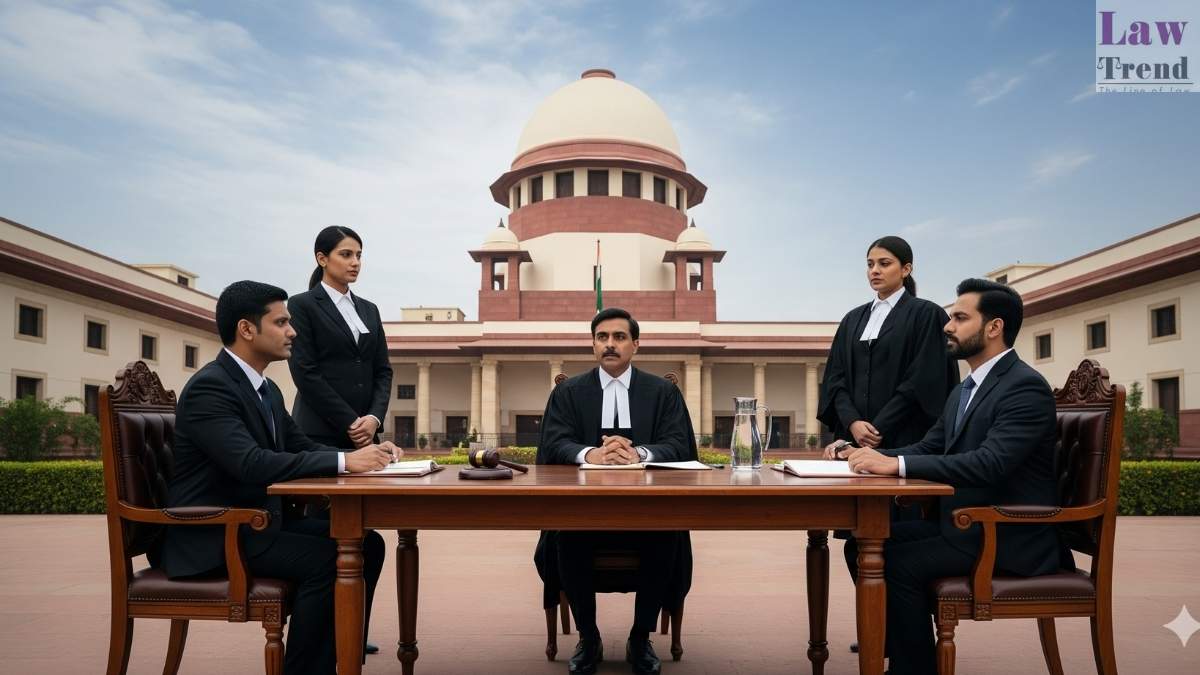
The Supreme Court of India has dismissed appeals filed by the Municipal Corporation of Greater Mumbai (MCGM), holding that a party cannot challenge the constitution of an arbitral tribunal after having participated in the proceedings and acquiesced to the appointment of the presiding arbitrator on multiple occasions.
A Bench comprising Justice J.K. Maheshwari and Justice Atul S. Chandurkar affirmed the decisions of the Bombay High Court, ruling that the MCGM’s conduct indicated it had understood and acted upon the arbitration clause as an enabling provision rather than a restrictive one.
Background of the Dispute
The case originated from a 1995 agreement between MCGM and M/s R.V. Anderson Associates Ltd., a Canadian engineering firm, for consultancy services to upgrade sewerage operations. Upon completion of the project in 2001, disputes arose regarding outstanding dues.
In August 2005, the Respondent invoked the arbitration clause. Both parties appointed their nominee arbitrators—Hon’ble Mr. Justice S.M. Jhunjhunwala (Retd.) for the Respondent and Mr. Sharad Upasani for MCGM. Although the parties initially explored conciliation, the process failed. Between 2007 and 2008, the nominee arbitrators attempted to appoint three different presiding arbitrators: Justice D.R. Dhanuka (Retd.), who resigned; Mr. John Savage, who also resigned; and finally, Mr. Anwarul Haque of Singapore.
It was only after participating in a preliminary meeting with Mr. Haque on January 9, 2009, that MCGM challenged the tribunal’s jurisdiction. They alleged that under Clause 8.3(b) of the Agreement, the nominee arbitrators lost their power to appoint a presiding arbitrator if they failed to do so within 30 days of the second nominee’s appointment (i.e., by November 2005).
Arguments of the Parties
For the Appellant (MCGM): Senior Counsel Mr. Siddharth Bhatnagar argued that the tribunal was coram non judice. He contended that Clause 8.3(b) used the word “shall,” making it mandatory that after the 30-day window, only the Secretary General of the International Centre for Settlement of Investment Disputes (ICSID), Washington D.C., could appoint the third arbitrator. He claimed this was a “foundational jurisdictional defect” that rendered the process “non-est” in law.
For the Respondent (M/s R.V. Anderson Associates): Senior Counsel Mr. Shyam Divan countered that Clause 8.3(b) was an enabling provision intended to resolve an impasse, not to oust the nominee arbitrators’ authority. He argued that since MCGM had participated in the appointment process and attended meetings without objection for years, it had waived its right to object under Section 4 of the Arbitration and Conciliation Act, 1996.
The Court’s Analysis
The Supreme Court focused on two primary aspects: the interpretation of Clause 8.3(b) and the conduct of the parties.
1. Interpretation of the Arbitration Clause: The Court held that the clause was “enabling in nature.” It noted that the contract did not specify that nominee arbitrators would lose their power after 30 days. The Bench observed:
“The intent of the clause appears to be that in case both Arbitrators cause a delay in appointment of the third arbitrator, the parties retain the authority to remedy the delay… the ICSID shall appoint the third Arbitrator [at the request of either party].”
The Court clarified that the word “shall” applied to the mandate of the ICSID Secretary General once a request was made, but did not extinguish the primary power of the nominee arbitrators.
2. Conduct, Acquiescence, and Waiver: The Bench scrutinized MCGM’s behavior between 2005 and 2009. It found that MCGM was “completely aware” of the timeline but “passively sat idle” while three different presiding arbitrators were appointed. The Court remarked:
“A party cannot keep a ‘jurisdictional ace’ up their sleeve and then claim that filing of the jurisdictional challenge under Section 16 would go back in time and wipe out the past conduct and acquiescence of the party… If the same is permitted, it will erode the basic principles of alternative dispute resolution and ethos of arbitration.”
The Court distinguished between statutory waiver under Section 4 and general acquiescence, noting that while MCGM filed its Section 16 application within the legal timeline (before the statement of defense), its prior conduct was a “relevant consideration to decipher its understanding of the contractual scheme.”
Final Decision
The Supreme Court concluded that the interpretation of the contract by the Arbitral Tribunal was “certainly a plausible view.” Citing Consolidated Construction Consortium Limited v. Software Technology Parks of India (2025) and SEPCO Electric Power Construction Corporation v. GMR Kamalanga Energy Ltd. (2025), the Court emphasized the principle of minimal judicial interference in arbitral awards.
The appeals were dismissed, and the arbitral award directing MCGM to pay specified amounts in USD and INR, along with 14% interest per annum, was upheld.
Case Details:
- Case Title: Municipal Corporation of Greater Mumbai v. M/s R.V. Anderson Associates Limited
- Citation: 2026 INSC 228
- Bench: Justice J.K. Maheshwari and Justice Atul S. Chandurkar
- Date of Judgment: March 11, 2026