The Allahabad High Court has set aside the termination order of a Lekhpal, holding that the failure of an Inquiry Officer to provide an opportunity for an oral hearing vitiates the entire disciplinary proceeding. The Court emphasized that even if a delinquent employee does not specifically request a personal hearing, it is an implicit duty of the Inquiry Officer to fix a date and time for such an inquiry under the Uttar Pradesh Government Servant (Discipline and Appeal) Rules, 1999.
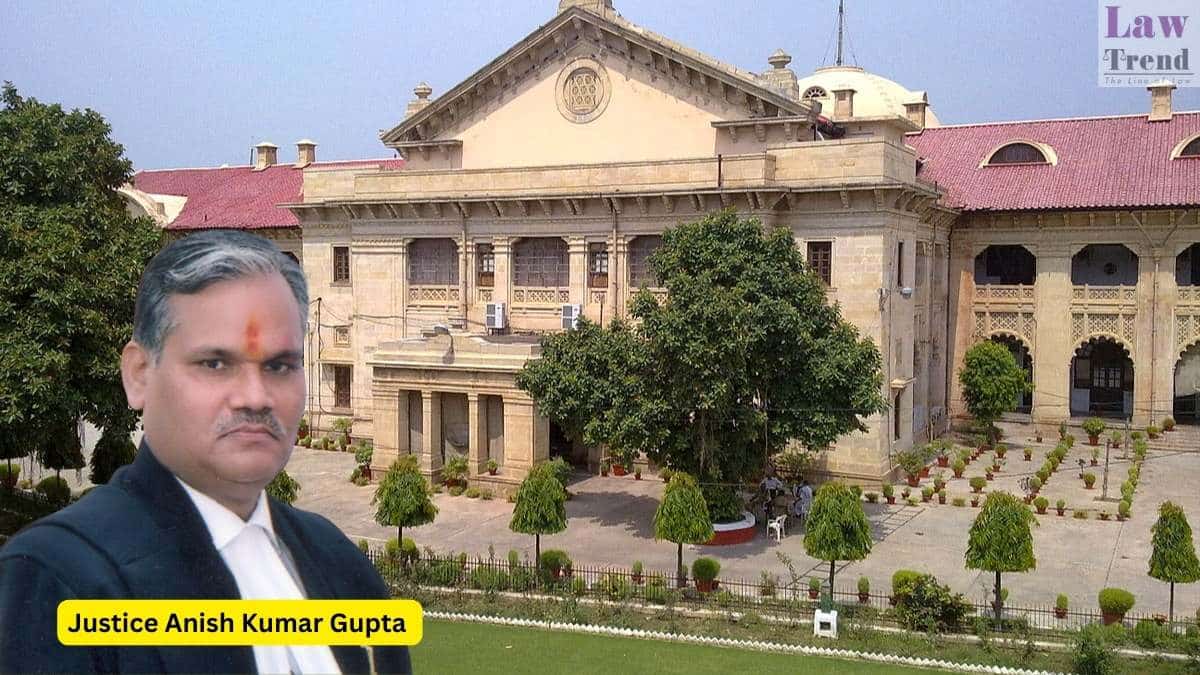
The petition was filed by Ram Swaroop Shukla, a Lekhpal appointed in 1980, challenging his termination order dated December 17, 2009, and the subsequent dismissal of his appeal on April 30, 2010. Justice Anish Kumar Gupta, presiding over the matter, allowed the petition, noting that the inquiry process was conducted in violation of the principles of natural justice and the settled interpretation of the 1999 Rules.
Background of the Dispute
The petitioner was posted in Domagor, Tehsil Jhansi, in 2008. Two FIRs were registered against him. The first alleged that he had wrongly declared a living person, Brij Kishore, as dead to facilitate a mutation order. However, a final report submitted by the police found no criminality, noting that Brij Kishore had renounced the world in 1988, and his family, believing him dead after years of searching, had performed his last rites before seeking mutation.
The second FIR alleged that the petitioner had torn a page (P.K.-11-ka) from the revenue records relating to the same matter. Consequently, he was suspended on November 11, 2008, and served a charge-sheet on March 21, 2009, containing three charges:
- Tearing and destroying revenue records.
- Possessing assets disproportionate to his known sources of income.
- Submitting a false report regarding the conversion of “Banjar” land into a “Road.”
The petitioner submitted his reply on June 23, 2009. However, the Inquiry Officer, without fixing any date for oral evidence or hearing, concluded the inquiry and found the charges proved (Charge 2 partially). Based on this report, the Disciplinary Authority terminated his services.
Arguments of the Parties
The counsel for the petitioner argued that the Inquiry Officer failed to follow the procedure prescribed under the 1999 Rules. It was contended that no witnesses were examined to prove the documents relied upon, and no opportunity for an oral hearing was granted to explain the charges. The petitioner asserted that the Disciplinary and Appellate authorities merely “relied upon the findings recorded by the Inquiry Officer” without independent application of mind.
Conversely, the Additional Chief Standing Counsel for the State argued that since neither the department nor the petitioner proposed any witnesses in the charge-sheet or the reply, there was “no occasion for the Inquiry Officer to examine any of the witnesses.” The State maintained that the 1999 Rules do not expressly require an oral hearing if no witnesses are proposed, and thus, there was no procedural infirmity.
Court’s Analysis and Legal Precedents
The Court examined Rule 7 of the 1999 Rules, which details the procedure for imposing major penalties. Justice Gupta observed that while the rules might appear silent on the necessity of an oral hearing when no witnesses are proposed, judicial interpretation has filled this gap.
The Court relied heavily on the Division Bench judgment in Kaptan Singh vs. State of U.P. and Another (2014), which held:
“Even if the delinquent does not demand personal hearing… the Inquiry Officer is not absolved from fixing a date of enquiry… Such oral enquiry is necessary as it gives an opportunity to the delinquent to explain his conduct and to the Inquiry Officer to have a better perspective of the controversy.”
The Court also cited the Supreme Court decision in Roop Singh Negi v. Punjab National Bank (2009), noting:
“The purported evidence collected during investigation by the investigating officer… by itself could not be treated to be evidence in the disciplinary proceeding. No witness was examined to prove the said documents.”
Furthermore, the Court referred to Satyendra Singh vs. State of U.P. (2024), reiterating that inquiry proceedings are “totally vitiated and non-est in the eyes of law” if no oral evidence is recorded in support of charges punishable with a major penalty.
The Decision
The Court concluded that after the petitioner submitted his reply, the Inquiry Officer was duty-bound to fix a date for a hearing.
“Since, such opportunity has never been granted in the instant case to the petitioner herein, thus, the inquiry report… cannot be relied upon for termination of service… Thus, the entire proceedings against the petitioner is vitiated.”
Consequently, the Court set aside the termination and appellate orders. While the Court noted that matters are typically remitted back to the stage where the error occurred, it declined to do so here as the petitioner had already reached the age of superannuation on January 9, 2018.
Case Details:
- Case Title: Ram Swaroop Shukla vs. State of U.P. and Others
- Case Number: WRIT A No. 27948 of 2010
- Bench: Justice Anish Kumar Gupta
- Date : February 27, 2026