

The High Court of Chhattisgarh has dismissed a criminal appeal filed by a man convicted of murdering his wife by setting her ablaze, affirming the legal principle that an authentic dying declaration which inspires the confidence of the Court can serve as the sole basis for conviction without further corroboration.
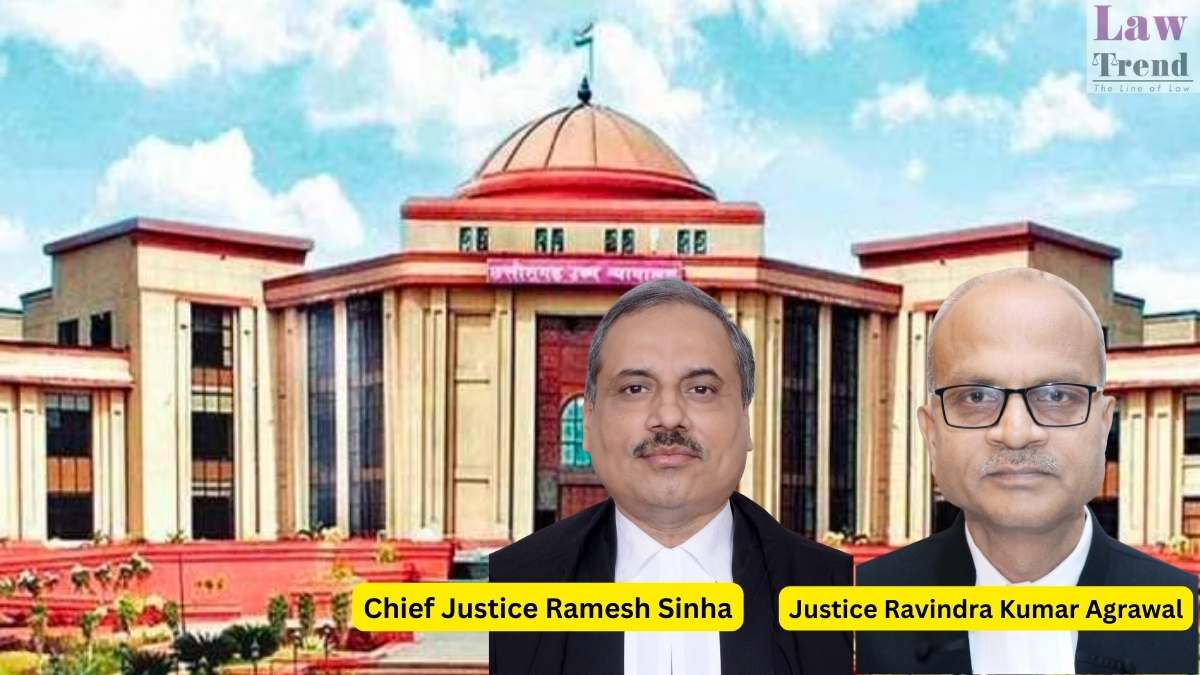
A Division Bench comprising Chief Justice Ramesh Sinha and Justice Ravindra Kumar Agrawal upheld the judgment of the Sessions Judge, Kabirdham, which had sentenced the appellant, Santosh @ Golu Srivas, to life imprisonment under Section 302 of the Indian Penal Code (IPC).
Background of the Case
The prosecution alleged that on November 18, 2019, in village Rabeli, the appellant, who had been consuming alcohol since morning, engaged in a quarrel with his wife, Lata Shrivas. Suspecting her character and aggrieved by her working as a laborer due to poverty, the appellant locked the door of their house, poured kerosene on her, and set her on fire with a matchstick.
The victim managed to open the door while in a burning condition and ran outside to extinguish the flames in a nearby pond. She was subsequently hospitalized at the District Hospital, Kawardha. Her dying declaration (Ex.P-17) was recorded by an Executive Magistrate after a medical officer certified her fitness to give a statement. She eventually succumbed to her injuries on December 9, 2019, due to septic shock resulting from the burns.
Arguments of the Parties
Appellant’s Submissions: Counsel for the appellant, Mr. Saurabh Dangi, argued that the testimonies of the alleged eyewitnesses (PW-1 and PW-2) were unreliable and suffered from material contradictions. He contended that the dying declaration was “doubtful” due to alleged procedural non-compliance and a lack of clear evidence regarding the victim’s mental fitness. Alternatively, he argued that the incident occurred during a “sudden quarrel” without premeditation, suggesting the offense should be downgraded to culpable homicide not amounting to murder under Section 304 IPC.
State’s Submissions: Mr. Priyank Rathi, Government Advocate, supported the trial court’s decision, stating that the dying declaration was “clear, unambiguous, and free from any tutoring.” He highlighted that the declaration was recorded by an Executive Magistrate and corroborated by neighbors who witnessed the victim running toward the pond. Furthermore, the Forensic Science Laboratory (FSL) report confirmed the presence of kerosene on both the victim’s saree and the appellant’s T-shirt.
Court’s Analysis and Legal Observations
The Court focused its analysis on the admissibility and reliability of the dying declaration under Section 32(1) of the Evidence Act. Citing the legal maxim nemo moriturus praesumitur mentire (a man will not meet his Maker with a lie in his mouth), the Bench noted that “truth sits upon the lips of a dying man.”
Referring to the Supreme Court’s decision in Purshottam Chopra v. State (NCT of Delhi) (2020), the Court summarized the following principles:
- A dying declaration could be the sole basis of conviction even without corroboration, if it inspires confidence of the court.
- The court should be satisfied that the declarant was in a fit state of mind at the time of making the statement.
- The percentage and degree of burns would not, by itself, be decisive of the credibility of dying declaration.
The Court also cited the Constitution Bench ruling in Laxman v. State of Maharashtra (2002), observing that “a certification by the doctor is essentially a rule of caution” and the truthful nature of a declaration can be established even in the absence of a formal certificate, provided the recorder ensured the patient’s fitness.
In the present case, the Bench found that Dr. Anjubala (PW-10) had certified the victim as “fit for statement” and that the Executive Magistrate (PW-11) had no motive to depose falsely. The Court remarked:
“Nothing has been extracted from the statements of Dr. Anjubala (PW-10) and Executive Magistrate B. Chouhan (PW-11) to hold that the deceased was not in fit physical and mental state of mind… The statement given by the Executive Magistrate cannot be disbelieved as he is a Government Officer and has no vested interested in either of the parties.”
The Court also noted that the appellant’s conduct—standing idle while his wife was burning—and the FSL findings of kerosene on his clothing further pointed to his guilt.
The Decision
Rejecting the plea for a lesser sentence, the Court held that the act of confining the victim, pouring kerosene, and setting her on fire demonstrated a clear intention to cause death. The Bench concluded:
“Once a dying declaration is found to be authentic inspiring confidence of the Court, then the same can be relied upon and can be the sole basis for conviction without any corroboration.”
Finding the trial court’s appreciation of evidence to be neither perverse nor contrary to law, the High Court dismissed the appeal and affirmed the life sentence.
Case Details
- Case Title: Santosh @ Golu Srivas v. State of Chhattisgarh
- Case Number: CRA No. 206 of 2022
- Bench: Chief Justice Ramesh Sinha and Justice Ravindra Kumar Agrawal
- Date: April 6, 2026




