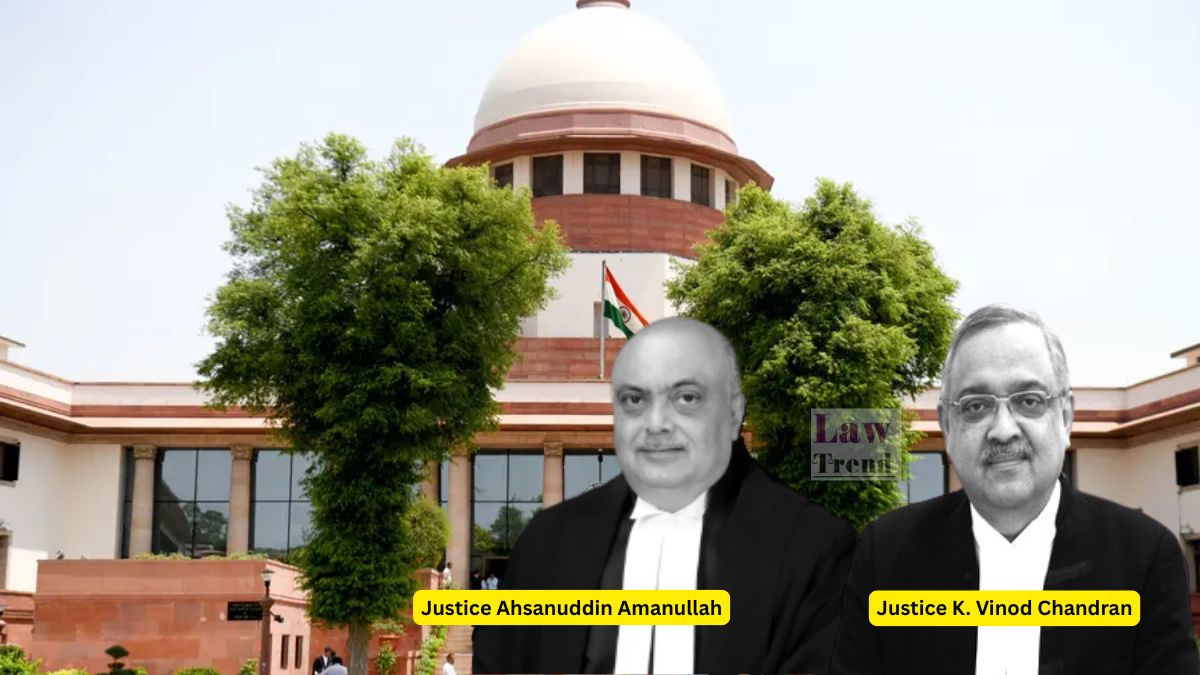
The Supreme Court of India on Tuesday acquitted Jaswinder Singh @ Shinder Singh, setting aside his conviction in a double murder case dating back to 1999. The Bench, comprising Justice Ahsanuddin Amanullah and Justice K. Vinod Chandran, held that there were “absolutely no incriminating circumstances” against the appellant other than vague statements made for the first time before the trial court.
The Supreme Court allowed the criminal appeal filed by Jaswinder Singh @ Shinder Singh against the State of Punjab. The appellant had been convicted for his alleged role as the driver of the vehicle used by assailants who killed two brothers, Shingara Singh and Balkar Singh, on October 14, 1999.
The Court observed that the conviction by the High Court, following a remand, was based on evidence that suffered from fatal omissions and lacked corroboration. Writing the judgment, Justice K. Vinod Chandran concluded that the prosecution failed to establish the appellant’s involvement in the “crime proper.” Consequently, the Court set aside the impugned judgment and ordered the appellant’s immediate release.
Background of the Case
The incident occurred on the evening of October 14, 1999. According to the prosecution, assailants arrived in a blue Tata Mobile 207 near the bus stand at Village Poonia. Two accused persons, Sukhdev Singh @ Deba and Dhalwinder Singh @ Bhinder, allegedly shot Shingara Singh with a .315 bore rifle.
The prosecution claimed that Jaswinder Singh @ Shinder Singh was driving the vehicle. Following the first shooting, the father of the victim, PW-7, rushed home to inform his family. Upon arrival, he discovered that his other son, Balkar Singh, had also been shot dead by the same accused while returning home on his scooter.
The appellant was not initially arrayed as an accused in the police report but was later summoned by the Trial Court under Section 319 of the Code of Criminal Procedure, 1973 (Cr.P.C.) on August 24, 2000.
The legal trajectory of the case was complex. The Trial Court initially convicted the accused, but the High Court reversed this decision and acquitted them. Subsequently, the matter was remanded back, leading to the impugned judgment which affirmed the conviction, prompting the current appeal before the Supreme Court.
Arguments and Evidence
The Supreme Court examined the testimonies of the two key prosecution witnesses: PW-7 (the father of the deceased) and PW-10 (the wife of one of the deceased brothers).
The Testimony of PW-7 PW-7 identified the two other accused as the shooters. Regarding the appellant, PW-7 testified in court that Jaswinder Singh had driven the vehicle and “dragged the son before he was shot by the other two.”
However, during cross-examination, the defense confronted PW-7 with his earlier statement recorded under Section 161 of the Cr.P.C. The Court noted a significant discrepancy: the police statement contained no mention of the appellant alighting from the vehicle or dragging the victim.
The Testimony of PW-10 PW-10, presented as an eyewitness to the second murder, identified the appellant in the dock and stated he was driving the vehicle. However, the Court observed that “there was no statement recorded of the said witness by the police at the first instance,” despite her admitted presence at the scene during the inquest.
Defense Arguments The defense produced DW-1, the Deputy Superintendent of Police (DSP) who conducted the initial investigation. DW-1 testified that both PW-7 and PW-10 failed to cooperate with the investigation despite being summoned. He further stated that he had filed a report finding the appellant innocent.
Additionally, DW-2, the father of the registered owner of the Tata Mobile, testified that he had possession of the vehicle and had “not entrusted the vehicle to either of the accused.”
Court’s Analysis and Observations
The Supreme Court scrutinized the evidence against the appellant, emphasizing the lack of consistency and corroboration.
On the Omissions by PW-7: The Bench termed the omission in PW-7’s police statement regarding the appellant’s overt act as critical. The judgment stated:
“The omission is fatal when we consider that the appellant was not arrayed at the first instance and was summoned under Section 319 of the Cr.P.C. by order dated 24.08.2000 of the Trial Court.”
On the Vehicle and Recovery: The Court noted that while the Tata Mobile was seized the day after the incident, the witness to the seizure (PW-9) spoke only of the other accused being in the vehicle, not the appellant. The Court observed:
“There is nothing incriminating against the appellant found in the vehicle and the vehicle was not even produced before the Court or got identified by the eyewitnesses.”
Furthermore, the Court found that “no connection established between the owner of the vehicle and the appellant herein.”
On Motive and Animosity: The judgment highlighted a “history of animosity” between the families of the accused and the victims, involving illegal activities and narcotics cases. The Court noted that “vengeful actions were taken against each other which have also resulted in the death of members of both the gangs.”
Decision
The Supreme Court concluded that the prosecution failed to prove the appellant’s guilt beyond a reasonable doubt. The Bench held:
“On an overall conspectus, we are inclined to acquit the appellant finding no incriminating circumstance against him but for a vague statement of the appellant having driven the vehicle and the involvement in the crime proper omitted to be stated to the police and for the first time stated before Court.”
The Court clarified that its decision dealt strictly with the lack of evidence against Jaswinder Singh @ Shinder Singh and did not comment on the evidence regarding the other accused.
Outcome:
- The criminal appeal was allowed.
- The judgment of the High Court and Trial Court was set aside insofar as it related to the appellant.
- The appellant was acquitted of the alleged crime.
- The Court ordered that if the appellant is in custody, “he shall be released forthwith,” and if on bail, “the bail bonds shall be cancelled.”
Case Details:
- Case Title: Jaswinder Singh @ Shinder Singh v. State of Punjab
- Case No: Criminal Appeal No. of 2026 (@Special Leave Petition (Crl.) No. of 2026; Diary No. 46882 of 2024)
- Bench: Justice Ahsanuddin Amanullah and Justice K. Vinod Chandran