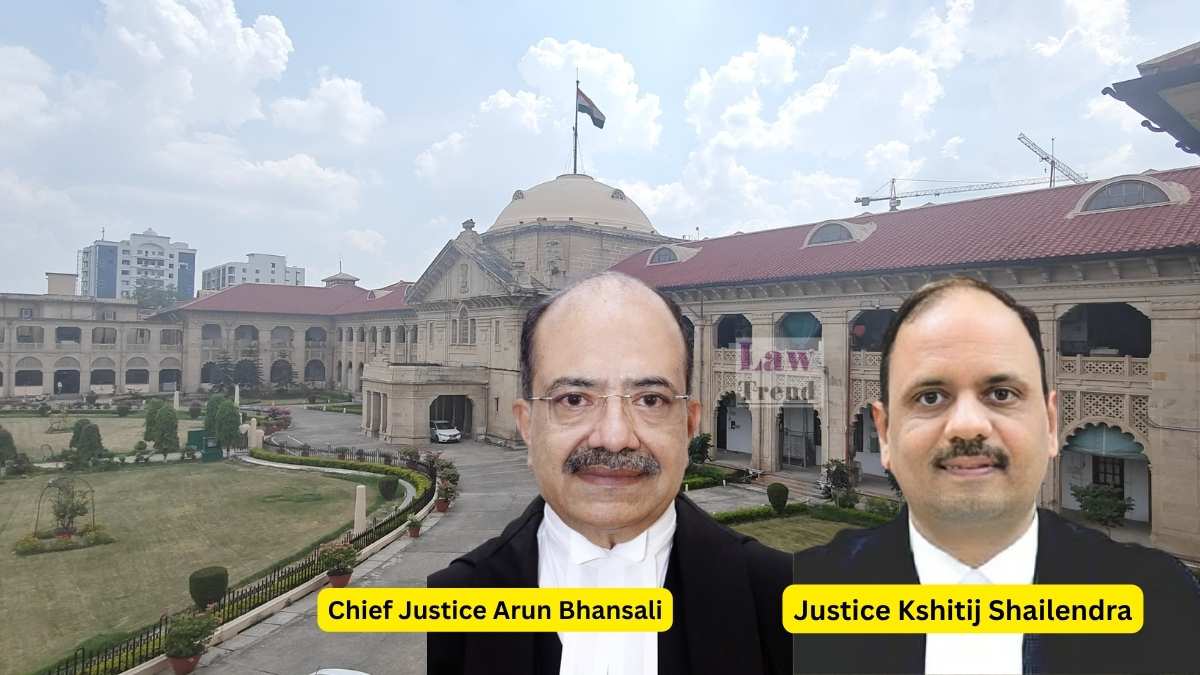
The Allahabad High Court has set aside the orders of the Central Administrative Tribunal (CAT), ruling that State Civil Service officers inducted into the Indian Administrative Service (IAS) on probation are entitled to the same pay scale benefits granted to their juniors in the State Civil Service, as long as they retain their lien on the state post.
The Division Bench comprising Chief Justice Arun Bhansali and Justice Kshitij Shailendra allowed the writ petitions filed by Badal Chatterjee and Shankar Singh, directing the Union of India and State authorities to release arrears of pay based on the pay scale of Rs. 67,000-79,000/- w.e.f. June 20, 2013, along with 6% interest.
The core legal issue was whether an officer inducted into the All India Services (AIS) on probation, while maintaining a lien in the State Civil Services, is entitled to pay upgrades granted to their juniors in the State cadre. The respondents had denied these benefits, arguing that the petitioners were governed by AIS rules and had not been confirmed in the IAS.
The High Court rejected the respondents’ contentions, holding that under Government of India decisions and relevant Office Memoranda, a probationer retains a lien on the State Service and is entitled to all benefits, including confirmation in the Selection Grade, before confirmation in the AIS.
Background of the Case
The leading petitioner, Badal Chatterjee, was a 1979 batch Provincial Civil Service (PCS) officer of Uttar Pradesh. He was inducted into the IAS on probation via a notification dated November 28, 2012. While he was serving his probation period in the IAS, officers of the 1979 PCS batch who remained in the State service were granted the pay scale of Rs. 67,000-79,000/- on June 20, 2013.
The petitioner claimed parity with his juniors in the State cadre, citing his lien on the PCS post. He retired on February 28, 2015, as Commissioner, Food Safety and Drugs Administration. Despite representations and a previous order from the Tribunal directing the authorities to decide his claim, the relief was denied.
The petitioner challenged the denial before the Central Administrative Tribunal (CAT), Allahabad Bench. The Tribunal dismissed the Original Applications (O.A. No. 988 of 2021 and O.A. No. 987 of 2021) on December 23, 2024. The Tribunal reasoned that the petitioner had a “choice to revert back” to the PCS to avail of the promotion and that his service conditions were governed by AIS rules.
Arguments of the Parties
Petitioner’s Submissions: Senior Advocate Rakesh Pande, assisted by Advocates Ashish Pathak, Badal Chatterjee, and Chandan Sharma, argued:
- Clause 4 of Government of India’s Decision (Regulations, 1955): An officer on probation in AIS retains a lien in State Service and is entitled to all benefits accruing in that service.
- Parity with Rajesh Kumar Srivastava: A similarly situated IPS officer, Rajesh Kumar Srivastava, was granted identical benefits after the Lucknow Bench of the Tribunal allowed his claim, which was upheld by the High Court (Service Bench No. 16174 of 2016).
- Office Memorandum dated 01.12.1994: Explicitly states that emoluments of officers promoted from PCS to IAS shall not be less than the emoluments of junior officers remaining in the PCS cadre.
- Discrimination: The distinction drawn by the Tribunal between IAS and IPS cadres was artificial as the governing rules are identical.
Respondents’ Submissions: Represented by the Additional Solicitor General of India, Additional Advocate General Manish Goyal, and others, the respondents argued:
- Relinquishment: Upon joining IAS, the petitioner relinquished the PCS pay scale.
- Non-Confirmation: The petitioner retired as a probationer and was never confirmed in the IAS; thus, he should return IAS benefits.
- Probation Rules: Under the Indian Administrative Service (Probation) Rules, 1954, the petitioner was deemed confirmed only after the extended probation period, by which time he had retired.
- Departmental Exam: The induction was subject to ‘Lekha Pariksha’ (Accounts Examination), which the petitioner did not pass.
Court’s Analysis
The High Court meticulously examined Clause 4 of the Government of India’s decision contained in the Indian Administrative Service (Appointment by Promotion) Regulations, 1955, which states:
“A State Service Officer, on appointment to an All India Service on probation, would retain his lien in the State Service and therefore, be entitled to all the benefits that may accrue to him in that Service (such as confirmation in the Selection Grade of the Civil Service) before his confirmation in the All India Service.”
On Confirmation vs. Probation: The Court rejected the respondents’ argument that benefits apply only upon confirmation. Justice Shailendra observed:
“The provision is apparently meant for the period of probation and cannot be read so as to mean that an inductee in I.A.S. cadre from State Civil Service would get benefits of State Civil Services only on his confirmation. As a matter of fact, words ‘before his confirmation’ appearing in Clause 4 cannot be read as ‘on his confirmation’.”
On Parity with Rajesh Kumar Srivastava: The Court found that the Office Memorandum dated 29.06.1965 (applicable to IPS) and the decision dated 31.10.1966 (applicable to IAS) were “absolutely identical.” Therefore, distinguishing the petitioner’s case because he was in the IAS and Srivastava was in the IPS was unjustified.
On Departmental Examination: Regarding the argument about ‘Lekha Pariksha’, the Court noted that the respondents failed to place any document on record showing that such an examination was ever conducted or that the petitioner failed to appear.
“Non-conduct of such examination by the department itself, cannot be taken as a ground to deny the benefits.”
Criticism of Respondents’ Conduct: The Bench expressed strong disapproval of the authorities’ handling of the matter:
“We seriously deprecate the conduct of the respondents in denying benefits apparently admissible to the petitioner… Lingering on decision on the petitioner’s representation for years together… and, then, seeking to interpret one or the other word or stipulation in either way so as to treat an I.A.S. Officer of their own department as a person inferior to his juniors for no cogent reason at all, clearly reflects ‘red tapism’ on the part of the respondents.”
Conclusion and Directions
The High Court allowed both writ petitions and set aside the Tribunal’s orders dated December 23, 2024.
Directions:
- Respondents are directed to release arrears of pay w.e.f. 20.06.2013, computed on the pay scale of Rs. 67,000-79,000/-.
- Post-retiral benefits shall be revised based on the said pay scale.
- Petitioners are entitled to simple interest @ 6% per annum on arrears w.e.f. 20.06.2013 and on post-retiral benefits from the date of retirement.
- All benefits must be released within two months.
Case Details
Case Title: Badal Chatterjee vs. Union of India and 2 others (Connected with Shankar Singh vs. Union of India and 2 others)
Case No.: WRIT – A No. 5267 of 2025
Coram: Chief Justice Arun Bhansali and Justice Kshitij Shailendra
Counsel for Petitioner: Rakesh Pande (Sr. Adv.), Ashish Pathak, Badal Chatterjee, Chandan Sharma
Counsel for Respondents: A.S.G.I., Manish Goyal (A.A.G.), Akansha Sharma (S.C.), Vivek Kumar Singh