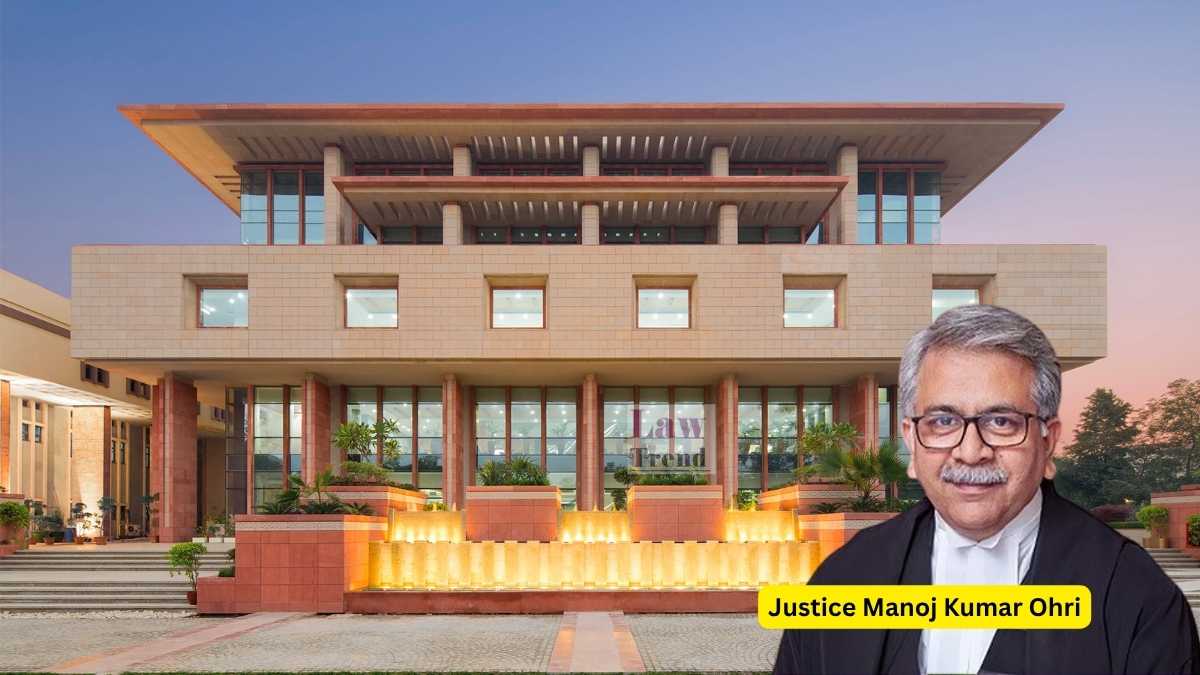
The Delhi High Court has set aside an order of the Railway Claims Tribunal that had dismissed a compensation claim on the grounds that the deceased could not have been a bona fide passenger because the train departed at an “odd time” of 3:00 AM. Justice Manoj Kumar Ohri remanded the matter back to the Tribunal for the awarding of compensation, emphasizing that the Tribunal’s findings were based on “conjectures and surmises.”
Case Background
The appeal, titled Priyanka And Ors v. Union of India, challenged the judgment dated December 12, 2019, passed by the Railway Claims Tribunal, Delhi. The appellants, the legal heirs of the deceased, Sumit, filed a claim stating that on December 17, 2017, Sumit was travelling from Boudaki to Delhi Shahdara with a valid journey ticket.
According to the claim, as the train approached Shahdara Railway Station, the deceased accidentally fell and sustained grievous injuries. He was taken to GTB Hospital, where he succumbed to his injuries. The Tribunal dismissed the claim application, holding that the deceased was neither a bona fide passenger nor was the incident an “untoward incident” under the Railways Act, 1989.
Arguments of the Parties
The counsel for the appellants argued that the deceased was travelling on a valid ticket of Rs. 10/-, which was handed over to the Assistant Sub-Inspector (ASI) by the deceased’s brother. The appellants contended that the Tribunal erred in concluding that the deceased was not a bona fide passenger merely because the train was scheduled to reach Boudaki at around 3:00 AM in the winter, deeming it “unlikely” for someone to board at that hour.
Conversely, the counsel for the Union of India supported the impugned judgment. The respondent argued that the ticket produced was unreliable and that the deceased, a resident of the area near the station, was likely crossing the railway tracks unauthorizedly. The respondent relied on the Divisional Railway Manager’s (DRM) report, pointing out that the body was found on the “North Line” while the train in question arrived on “Line No. 4,” which were not adjacent.
Court’s Analysis and Observations
Justice Manoj Kumar Ohri examined two primary issues: the bona fide status of the deceased and the nature of the incident.
On Bona Fide Passenger Status: The Court rejected the Tribunal’s reasoning regarding the timing of the train. The Tribunal had held that since the train left Boudaki at an “odd time” of around 3:00 AM, the deceased could not have been a passenger. Justice Ohri termed this observation “speculative, and unsupported by the record,” noting:
“It is not uncommon that people would undertake a night journey to reach early at their destination.”
The Court noted that the Train Signal Record (TSR) showed the train arrived at Platform No. 4 at around 4:57 AM, which was consistent with the incident’s timing. The Court held that the recovery of the ticket, along with witness affidavits, discharged the appellants’ initial burden of proof.
On Untoward Incident: The Tribunal had rejected the theory of accidental fall partly because the Medico-Legal Case (MLC) did not record any fractures. However, the High Court pointed out a glaring factual error in the Tribunal’s assessment. The Post-Mortem report explicitly recorded “fracture-dislocation of ribs 1 to 8 on the left side as well as fracture of the pelvic bones.”
Regarding the location of the body, the Court found the DRM report unreliable as it was based on an undated “Naksha Moka” prepared without independent witnesses. The Court observed:
“The mere location of the body, even if accepted, does not, by itself, conclusively establish a case of run-over… the possibility of the deceased having moved towards the adjoining track after the fall cannot be ruled out.”
Legal Principles: The Court reiterated that Section 124A of the Railways Act is a beneficial piece of legislation. Citing the Supreme Court judgment in Union of India v. Prabhakaran Vijaya Kumar, the Court observed that the provisions “must receive a purposive interpretation so as to advance the object of providing relief to victims of railway accidents.”
Decision
The High Court condoned the delay of 255 days in filing the appeal, considering the economic condition of the appellants and the Supreme Court’s orders regarding the limitation period during the pandemic.
Justice Ohri set aside the Tribunal’s judgment, stating:
“The Tribunal, in the present case, adopted an unduly rigid standard of proof, overlooking the beneficial object of the Act… the findings recorded by the Tribunal are based on conjectures and surmises and are contrary to the settled legal position.”
The matter was remanded to the Tribunal to award compensation in accordance with the law, with a direction to ensure disbursement within two months of the first listing on February 27, 2026.
Case Details:
- Case Title: Priyanka And Ors v. Union of India
- Case Number: FAO 55/2021
- Coram: Justice Manoj Kumar Ohri