The Supreme Court has held that the failure to deposit the balance sale consideration within the time stipulated by a Trial Court decree does not automatically render the decree inexecutable or amount to abandonment of the contract, particularly when the decree of the Trial Court has merged with the final decision of the Appellate Court.
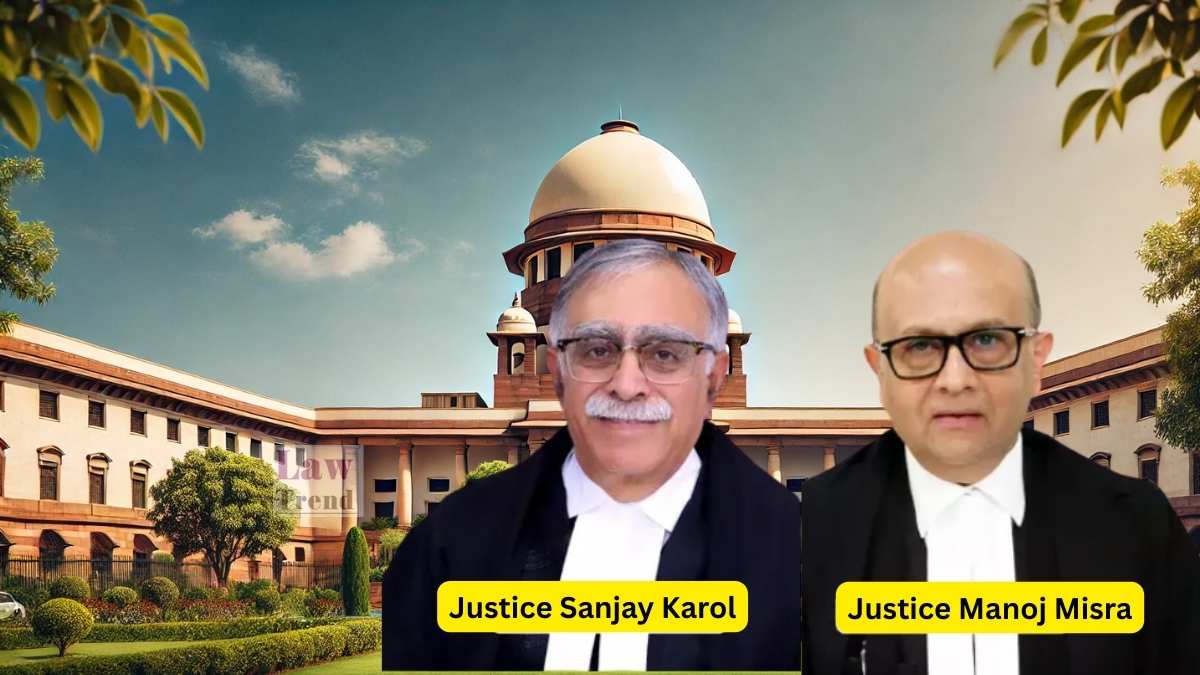
The Division Bench comprising Justice Sanjay Karol and Justice Manoj Misra set aside the judgment of the Punjab & Haryana High Court which had dismissed an execution petition on the ground of delay in depositing the purchase money. The Apex Court restored the order of the Executing Court, directing it to proceed with the execution of the sale deed.
Background of the Case
The dispute originated from an agreement to sell dated December 11, 2004, regarding a plot admeasuring 2 biswas, 10 biswasi in Kalka, District Panchkula. The total sale consideration was fixed at Rs. 9,05,000, out of which Rs. 1,00,000 was paid as earnest money.
When the sale deed was not executed, the Appellant (plaintiff) filed a suit for specific performance. The Trial Court decreed the suit on May 14, 2011, directing the Respondent (defendant) to execute the sale deed on receiving the balance consideration of Rs. 8,05,000 within two months.
However, the First Appellate Court reversed this finding on April 22, 2013, granting only the recovery of double the earnest money. Subsequently, in a Regular Second Appeal, the High Court vide judgment dated February 8, 2016, set aside the First Appellate Court’s order and restored the Trial Court’s decree.
The Appellant filed an execution application on July 4, 2016, and deposited the balance amount in tranches on August 26, 2016, and December 13, 2016. The Respondent raised objections regarding the delay, arguing that the amount was not deposited within the two-month period stipulated by the decree. While the Executing Court dismissed these objections on January 20, 2018, the High Court, in the impugned order dated August 8, 2022, accepted the objections and dismissed the execution petition, holding that the Appellant failed to show readiness by not depositing the money within the extended time.
The Legal Issue
The core questions before the Supreme Court were:
- Whether the delay in filing the execution application and depositing the amount beyond the two-month period fixed by the Trial Court rendered the decree inexecutable.
- Whether the judgment of the Trial Court merged with that of the High Court, and how the time limit for execution should be calculated.
Arguments and High Court’s Reasoning
The High Court had observed that the execution was filed 87 days after the two-month extended time (calculated from the date of the Second Appeal judgment). It held that the Appellant “was not ready with the money” and had failed to move any application for extension of time. The High Court relied on the premise that the Executing Court had no power to extend the time automatically merely upon the filing of an execution application.
Supreme Court’s Observations and Analysis
The Supreme Court rejected the High Court’s “hyper-technical approach.”
On Section 28 of the Specific Relief Act The Court referred to Section 28 of the Specific Relief Act, 1963, which allows the Court to rescind a contract if the purchaser fails to pay the money within the allowed period. However, the Bench clarified that the Court also possesses the power to extend such time.
Referring to the precedent in V.S. Palanichamy Chettiar Firm v. C. Alagappan (1999) and Ramankutty Gupta v. Avara (1994), the Court observed:
“Unquestionably, the power to extend the time granted within the decree for performance of its conditions can be extended on such terms as the Court may deem fit.”
Although no formal extension was granted in this case, the Court held that this should not be fatal to the decree. The Bench relied on the recent decision in Ram Lal v. Jarnail Singh (2025), observing:
“The non-payment of balance sale consideration within the time period fixed by the Trial Court does not amount to abandonment of the contract and consequent rescinding of the same. The real test must be to see if the conduct of the plaintiff will amount to a positive refusal to complete his part of the contract.”
On the Doctrine of Merger The Court emphasized the Doctrine of Merger, citing the recent judgment in Balbir Singh & Anr. v. Baldev Singh (2025) and the established precedent of Kunhayammed v. State of Kerala (2000). The Bench reiterated that “there cannot be more than one operative decree at a given point of time.” Once the High Court (superior forum) disposed of the Second Appeal, the Trial Court’s decree merged into the High Court’s decree.
The Court noted:
“The doctrine of merger, as we have already discussed, means that at one point in time, only one decree can subsist. If the order dismissing the objections has been set aside and the execution petition dismissed, there is no decree that could be executed, and as such, the question of extension of time would not arise.”
On Delay and Readiness The Court found that the Appellant had been held to be ready and willing to perform his part of the contract by the courts below. Addressing the specific delay in this case, the Court noted:
“Even otherwise, given the finding of readiness and willingness, alluded to above, it would be justified to accept that the delay of 27 days would not strike at the heart of the agreement.”
(Note: The Court calculated the delay as 27 days beyond the 60-day period).
Decision
The Supreme Court allowed the appeal, setting aside the High Court’s judgment dated August 8, 2022. The order of the Executing Court dismissing the Respondent’s objections was restored.
The Court directed:
“Let a copy of this judgment be sent to the Executing Court, which shall then proceed in accordance with law to execute the decree of specific performance passed by the Trial Court.”
Case Details:
- Case Title: Dr. Amit Arya v. Kamlesh Kumari
- Case No: Civil Appeal No. of 2025 (Arising out of SLP(C) No. 20091/2022)
- Coram: Justice Sanjay Karol and Justice Manoj Misra
- Citation: 2025 INSC 1486