

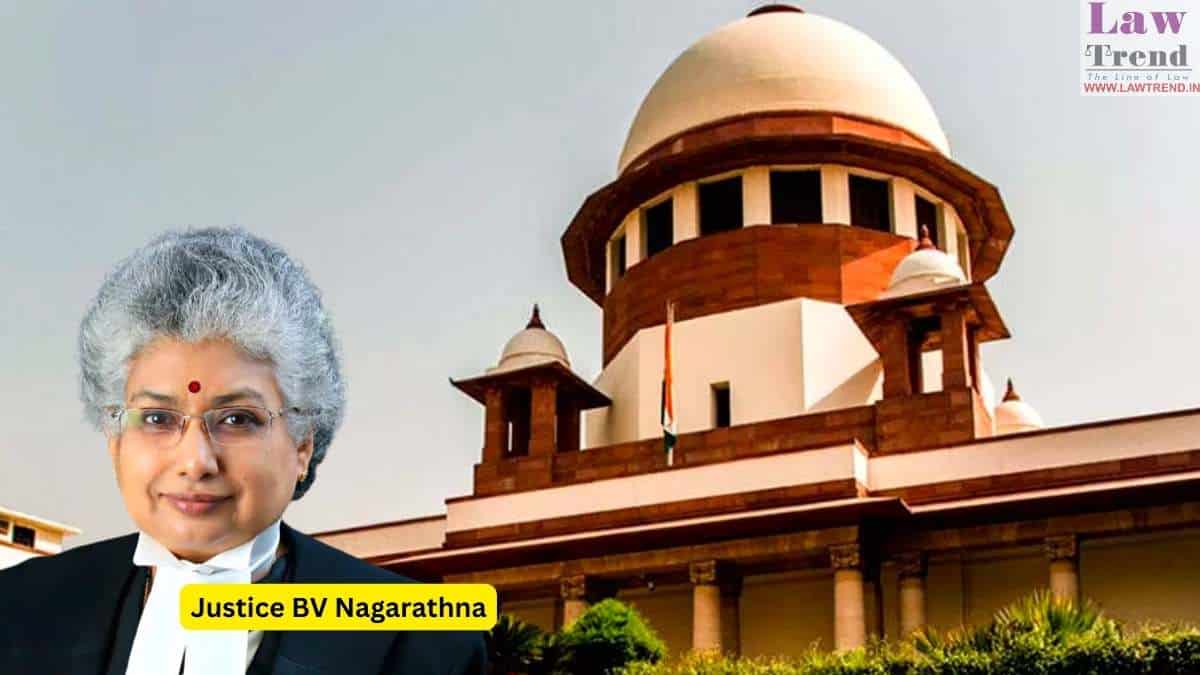
The Supreme Court of India on Tuesday resumed its high-profile hearing into the scope of religious freedom and gender-based discrimination at places of worship, with Justice B.V. Nagarathna pointedly questioning the practice of treating women as “untouchable” based on their menstrual cycles.
A nine-judge Constitution Bench, led by Chief Justice Surya Kant, is currently deliberating on a series of petitions that stem from the 2018 Sabarimala verdict. The bench is tasked with defining the ambit of religious freedom under the Constitution and determining whether certain traditional practices across various faiths violate fundamental rights.
The hearing saw a sharp exchange regarding the application of Article 17—which abolishes “untouchability”—to the exclusion of women from the Sabarimala temple.
Justice B.V. Nagarathna, the only woman on the current nine-judge bench, challenged the logic of periodic exclusion. “Article 17 in the context of Sabarimala, I don’t know how it can be argued. Speaking as a woman, there can’t be a three-day untouchability every month, and on the fourth day, there is no untouchability,” she remarked.
Her comments address the core of a legal debate initiated in 2018, when Justice D.Y. Chandrachud (then part of a five-judge bench) authored an opinion stating that excluding women of a certain age group due to their menstrual status constitutes a form of “untouchability.” He had argued that such practices perpetuate patriarchy and are derogatory to the dignity of women.
Solicitor General Tushar Mehta, representing the Central Government, expressed strong objections to the 2018 observation linking the temple’s restrictions to Article 17. He argued that the Indian social fabric is not as “patriarchal or gender stereotyped” as perceived by Western standards.
Mehta clarified the government’s stance, asserting that the restriction at Sabarimala is sui generis (unique) and based on the age of the pilgrims rather than menstruation itself.
“Let us be clear. Sabarimala concerns only a particular age group. There should be no confusion,” Mehta submitted. “Lord Ayyappa temples across the country and the world are open to women of all ages. It is only one temple which has this restriction.”
The current proceedings are the latest chapter in a long-standing legal battle:
- September 2018: A five-judge bench, in a 4:1 majority, lifted the ban on women aged 10–50 from entering the Sabarimala temple, declaring the practice unconstitutional.
- November 2019: Following review petitions, a bench headed by then-CJI Ranjan Gogoi referred the broader issue of discrimination at religious places—not just in Hinduism but across multiple faiths—to a larger bench.
The nine-judge bench, which includes Justices M.M. Sundresh, Ahsanuddin Amanullah, Aravind Kumar, Augustine George Masih, Prasanna B. Varale, R. Mahadevan, and Joymalya Bagchi, is now hearing these expanded issues. The court previously noted that broad questions regarding religious freedom cannot be decided in isolation without considering the specific facts of individual cases.
The hearing remains underway as the court continues to examine the intersection of “Essential Religious Practices” and the constitutional guarantee of equality.




