NCLT Cannot Declare Title to Disputed Trademark Under Section 60(5) IBC Where Resolution Plan Recognizes Rival Claims: Supreme Court
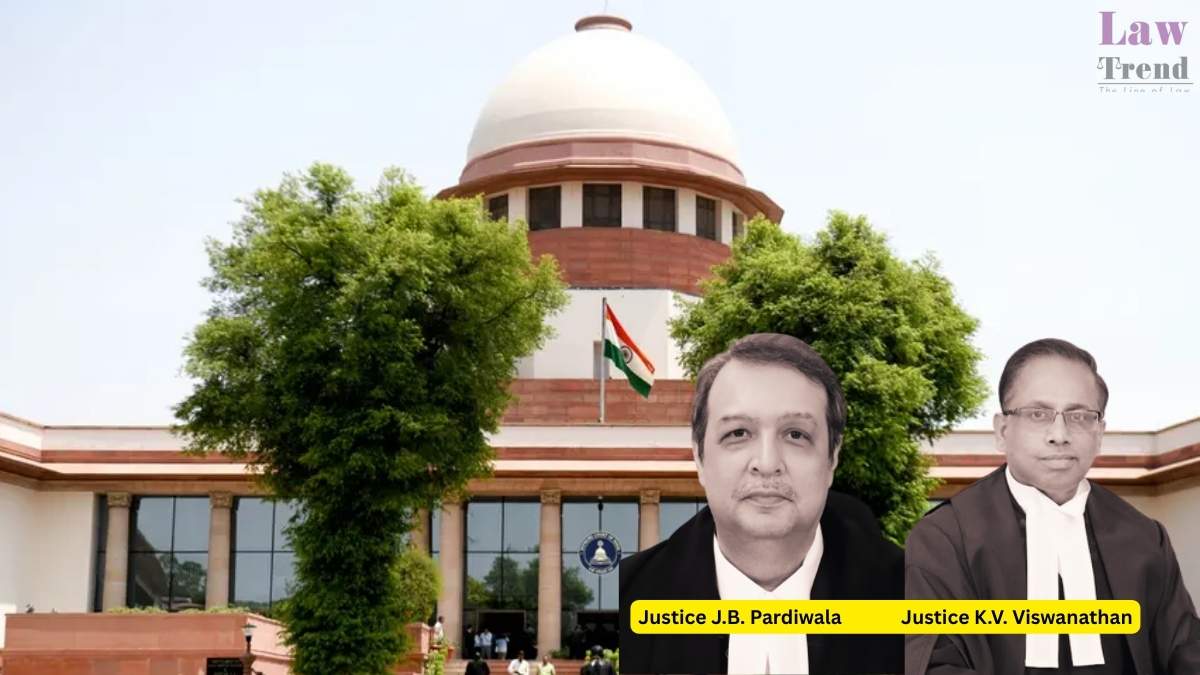

The Supreme Court has held that the National Company Law Tribunal (NCLT) cannot assume jurisdiction under Section 60(5)(c) of the Insolvency and Bankruptcy Code (IBC) to declare the title of a disputed asset in favor of a Successful Resolution Applicant (SRA) when the Resolution Plan itself acknowledges the existence of rival claims.

The Bench of Justice J.B. Pardiwala and Justice K.V. Viswanathan, in a judgment delivered on January 22, 2026, set aside the findings of both the NCLT and the National Company Law Appellate Tribunal (NCLAT) regarding the ownership of the trademark “Gloster.” The Court clarified that the issue of title, in this specific factual matrix, was not a matter “arising out of or in relation to the insolvency resolution,” and thus fell outside the residuary jurisdiction of the Adjudicating Authority.

Background of the Case

The dispute arose from the Corporate Insolvency Resolution Process (CIRP) of Fort Gloster Industries Limited (Corporate Debtor/FGIL). Gloster Limited, the appellant, was the Successful Resolution Applicant (SRA) whose plan was approved by the Committee of Creditors (CoC).

During the approval process, Gloster Cables Limited (GCL/Respondent No. 1) filed an application under Section 60(5) of the IBC. GCL claimed ownership of the trademark “Gloster” based on various agreements, including a Technical Collaboration Agreement (1995) and Deeds of Assignment (2017), executed with the Corporate Debtor. GCL sought a direction that any approved Resolution Plan must exclude rights in the trademark “Gloster” from the Corporate Debtor’s assets.

The NCLT, Kolkata Bench, while approving the Resolution Plan on September 27, 2019, dismissed GCL’s application but simultaneously recorded a finding that the trademark was an asset of the Corporate Debtor. Consequently, the SRA claimed entitlement to the mark.

READ ALSO  Bombay HC directs Mumbai Police to give three-day notice to Arnab Goswami before taking any coercive steps in the TRP scam case

On appeal, the NCLAT set aside the NCLT’s finding, holding that the trademark was not an asset of the Corporate Debtor and that title had vested in GCL. Both the SRA (challenging the NCLAT order) and GCL (challenging the NCLT’s jurisdiction to decide title) approached the Supreme Court.

Arguments of the Parties

The Appellant (SRA) argued that GCL was estopped from questioning the NCLT’s jurisdiction after invoking it. They contended that GCL’s registration of the trademark during the moratorium violated Section 14 of the IBC and that the assignment deeds were undervalued and preferential transactions.

The Respondent (GCL) submitted that the NCLT lacked jurisdiction to adjudicate title disputes that do not arise solely from insolvency. They argued that the Resolution Plan recognized the dispute, and the SRA could not acquire rights superior to what the plan provided. It was emphasized that the trademark had been assigned to GCL before the insolvency commencement date.

The Resolution Professional (RP) argued that the erstwhile management and GCL concealed the agreements, preventing a forensic audit. The RP supported the SRA, contending that the transactions were undervalued and designed to defraud creditors.

Court’s Analysis

The Supreme Court examined the approved Resolution Plan, which explicitly recorded the SRA’s awareness of the rival claims. The plan stated that the SRA “believes” the transfer to GCL was malafide and “understands” the trademark to be the property of the Corporate Debtor.

Jurisdiction Under Section 60(5)(c) of IBC

The Court analyzed the scope of Section 60(5)(c), which grants the NCLT jurisdiction over questions “arising out of or in relation to the insolvency resolution.” Relying on precedents including Embassy Property Developments Pvt. Ltd. v. State of Karnataka and Gujarat Urja Vikas Nigam Ltd. v. Amit Gupta, the Bench reiterated that the NCLT cannot usurp the legitimate jurisdiction of other courts when a dispute does not arise solely from the insolvency.

The Court observed:

READ ALSO  जन प्रतिनिधित्व अधिनियम की धारा 8(3) में निहित विधायी इरादे को विफल करने के लिए मामलों के डॉकेट विस्फोट की घटना को वैध आधार के रूप में नहीं माना जाना चाहिए: सुप्रीम कोर्ट

“We find that the Adjudicating Authority could not have, while approving the plan in the present form, (on which the Committee of Creditors had voted) gone ahead and granted a declaration in favour of the appellant about its entitlement to the Trademark ‘Gloster’.”

Modification of Resolution Plan Impermissible

Citing the judgment in SREI Multiple Asset Investment Trust Vision India Fund v. Deccan Chronicle Marketeers, the Court held that granting a declaration of ownership which was not explicitly secured in the plan amounts to an impermissible modification of the approved plan.

Justice Viswanathan, writing for the Bench, noted:

“As is clear from the statement in the plan filed by the SRA and approved by the COC… all that the SRA does is to assert that the transfer is mala fide and was barred by law… There is no definite assertion about any undisputed claim to the title of trademark ‘Gloster’ and in fact to the contrary as pointed out earlier, it recognizes rival claims.”

Improper Use of Sections 43 and 45 of IBC

The Supreme Court severely criticized the NCLT for summarily holding the assignment deeds as preferential (Section 43) or undervalued (Section 45) without a specific application by the Resolution Professional and without proper enquiry.

“The findings of the NCLT are perverse and in gross violation of the principles of natural justice… If any transaction is sought to be set side as preferential or undervalued, the party moving the application should cogently set out the basis… and the party against whom the application is filed should be clearly put on notice.”

Decision

The Supreme Court allowed the appeals in part, setting aside the findings of both the lower authorities regarding the title:

  1. NCLT Order Set Aside: The Court set aside the NCLT’s finding that the trademark “Gloster” is an asset of the Corporate Debtor.
  2. NCLAT Order Set Aside: The Court also set aside the NCLAT’s observation that the title had vested in GCL.
READ ALSO  सुप्रीम कोर्ट ने आईपीसी की धारा 153ए के तहत अपराध गठित करने की आवश्यकताएं बताईं

The Bench clarified that it was not deciding the merits of the title dispute. The Court held:

“These observations would not come in the way of any other Court or authority deciding the issue of title to the trademark ‘Gloster’, if the parties herein litigate upon and those proceedings will be decided on their own merits uninfluenced by these observations.”

The issue of ownership of the trademark was thus left open to be decided by a competent civil court or authority.

Case Details

Case Name: Gloster Limited v. Gloster Cables Limited & Ors.

Case No.: Civil Appeal No. 2996 of 2024 (with Civil Appeal No. 4493 of 2024)

Coram: Justice J.B. Pardiwala and Justice K.V. Viswanathan

Law Trend
Law Trendhttps://lawtrend.in/
Legal News Website Providing Latest Judgments of Supreme Court and High Court

Related Articles

Latest Articles