Minor Procedural Lapses or Sample-Weight Variations Not Enough to Defeat NDPS Cases: Supreme Court
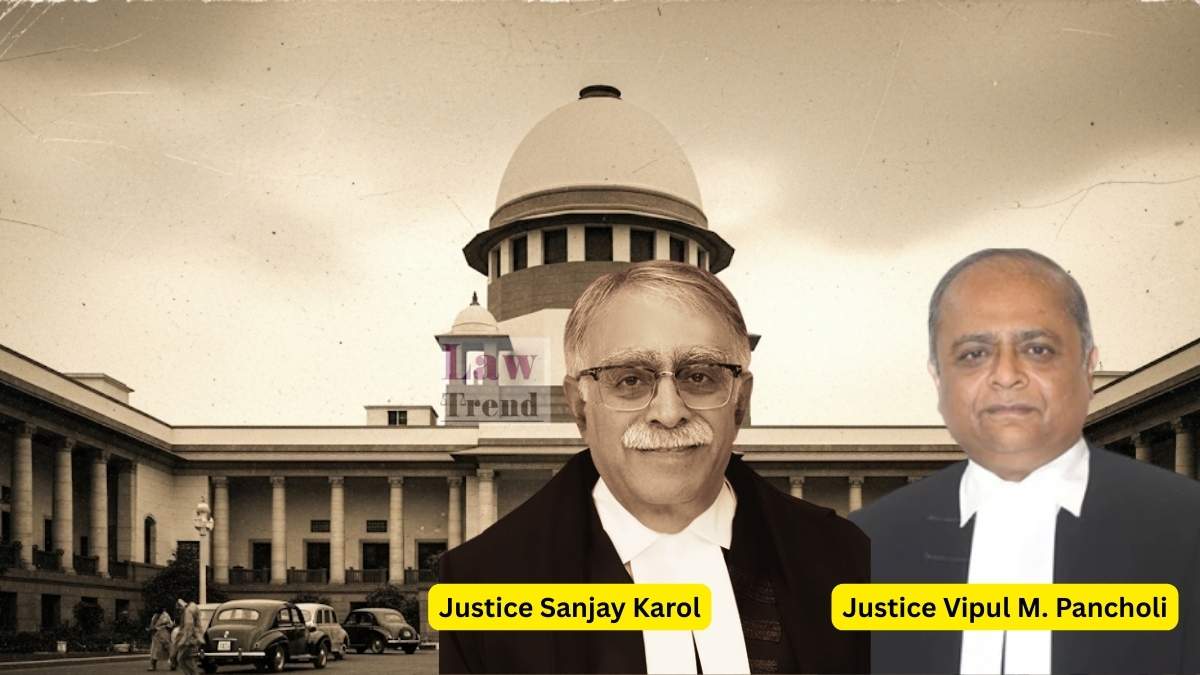

The Supreme Court has upheld the conviction and ten-year sentence of an accused under the Narcotic Drugs and Psychotropic Substances Act, 1985 (NDPS Act), ruling that humanitarian considerations cannot override the statutory minimum punishment mandated by the legislature for offenses involving commercial quantities. The Court further clarified that mere procedural irregularities in sampling, absent evidence compromising the integrity of the seizure, do not vitiate a prosecution case.

The Division Bench of Justice Sanjay Karol and Justice Vipul M. Pancholi, in the judgment delivered on December 11, 2025, dismissed the appeal filed by Jothi Nagajothi against the Madras High Court’s order affirming her conviction.

Background of the Case

The case dates back to September 21, 2019, when a police team led by a Sub-Inspector (PW-1) received secret information regarding the transportation of ganja. Acting on the tip-off, the police intercepted a two-wheeler carrying the appellant (A-2) and her husband (A-1).

Following a search conducted after informing the accused of their rights under Section 50 of the NDPS Act, the police seized 23.500 kg of ganja and ₹21,140 in cash. Two samples of approximately 50 grams each were drawn at the spot, sealed, and marked as ‘S-1’ and ‘S-2’.

The Trial Court, on February 1, 2021, convicted both the appellant and her husband under Sections 8(c) read with 20(b)(ii)(C) and 8(c) read with 29(1) of the NDPS Act. They were sentenced to 10 years of rigorous imprisonment and fined ₹1,00,000 each. The Madras High Court subsequently dismissed their appeal on June 27, 2024.

READ ALSO  Pendency Of Criminal Case At Time Of Making Application Valid Ground For Refusing Post In Police Dept: Karnataka High Court

Arguments of the Parties

The appellant approached the Supreme Court contending that the prosecution’s case suffered from “multiple infirmities.”

Appellant’s Contentions:

  1. Absence of Independent Witnesses: The counsel argued that despite the seizure occurring in a residential locality with 50-60 houses, no independent witnesses were secured, and only police witnesses attested the mahazar.
  2. Violation of Section 52-A: It was submitted that drawing representative samples at the spot without the presence or certification of a Magistrate violated Section 52-A of the NDPS Act. The counsel relied on Simranjit Singh v. State of Punjab and Yusuf @ Asif v. State to argue that spot sampling vitiated the case.
  3. Integrity of Samples: The counsel pointed to the alleged absence of markings ‘S-1’ and ‘S-2’ on sample packets upon the removal of labels and questioned the identity of the samples.
  4. Mitigating Factors: In the alternative, the counsel pleaded for remission or reduction of the sentence to the period already undergone (over 5 years and 9 months), citing that the appellant was only 24 years old at the time of the incident, a first-time offender, and the sole caregiver of a minor child.

Respondent’s Submissions: The State argued that the alleged discrepancies were minor and explained. The counsel submitted that the prosecution case was “firmly proved by the consistent testimony of official witnesses” and that the integrity of the samples was never compromised.

READ ALSO  Whether Application U/s 483 CrPC Seeking Direction to Family Court for expeditious Disposal of Section 125 CrPC is Maintainable? Allahabad HC Answers

Court’s Analysis and Observations

The Supreme Court rejected the appellant’s contentions, addressing each legal issue raised.

On Independent Witnesses The Court observed that the non-examination of independent witnesses is not fatal to the prosecution, especially when official witnesses depose in unison. The Bench noted that the defense failed to cross-examine the witnesses regarding the availability of independent persons. Citing Surinder Kumar v. State of Punjab (2020), the Court reiterated that testimony cannot be discarded solely due to the official status of witnesses.

On Compliance with Section 52-A Addressing the argument regarding sampling at the spot, the Court referred to its recent decision in Bharat Aambale v. State of Chhattisgarh (2025). The Bench observed:

“Mere non-compliance or delayed compliance with Section 52-A is not fatal unless the irregularity creates discrepancies affecting the integrity of the seized substance or rendering the prosecution case doubtful.”

The Court found that the appellant failed to show that the sampling process was unreliable. The judgment noted a clear sequence of events: samples were drawn at the spot, sealed, produced before the Magistrate, and forwarded for analysis pursuant to a judicial order.

On Sample Integrity and Weight Discrepancy Regarding the reduction in the sample weight from “about 50g” to 40.6g, the Court accepted the explanation of natural drying and moisture loss during the 40-day interval between seizure and analysis. Citing Noor Aga v. State of Punjab (2008), the Court held:

READ ALSO  Sec 397 CrPC | Revision Petition on Behalf of Third Party/ Defacto Complaint is Maintainable: Supreme Court

“A slight difference in the weight of the sample is not so material as to undermine the prosecution case, and cannot by itself justify discarding otherwise reliable evidence.”

On Sentencing and Humanitarian Grounds The Court addressed the plea for a reduced sentence based on the appellant’s youth and maternal responsibilities. The Bench held that for commercial quantity offenses, the Court has “no discretion to reduce the sentence below the statutory minimum” under Section 20(b)(ii)(C) of the NDPS Act.

“Humanitarian considerations, though relevant for executive remission, cannot override statutory minimum punishment mandated by the legislature. Thus, no interference with sentence is permissible.”

Decision

The Supreme Court concluded that the prosecution had proved beyond reasonable doubt that the appellant was in conscious possession of a commercial quantity of ganja. The Court dismissed the appeal, upholding the conviction and the sentence of 10 years’ rigorous imprisonment and fine.

However, the Bench granted liberty to the appellant to “pursue any remedy available in law for statutory remission before the appropriate authority.”

Case Details:

  • Case Title: Jothi Nagajothi v. The State
  • Case No.: Criminal Appeal No. 259 of 2025 (Arising out of SLP (Crl.) No. 52102 of 2024)
  • Court: Supreme Court of India
  • Bench: Justice Sanjay Karol and Justice Vipul M. Pancholi
  • Date of Judgment: December 11, 2025
  • Citation: 2025 INSC 1417

Law Trend
Law Trendhttps://lawtrend.in/
Legal News Website Providing Latest Judgments of Supreme Court and High Court

Related Articles

Latest Articles