

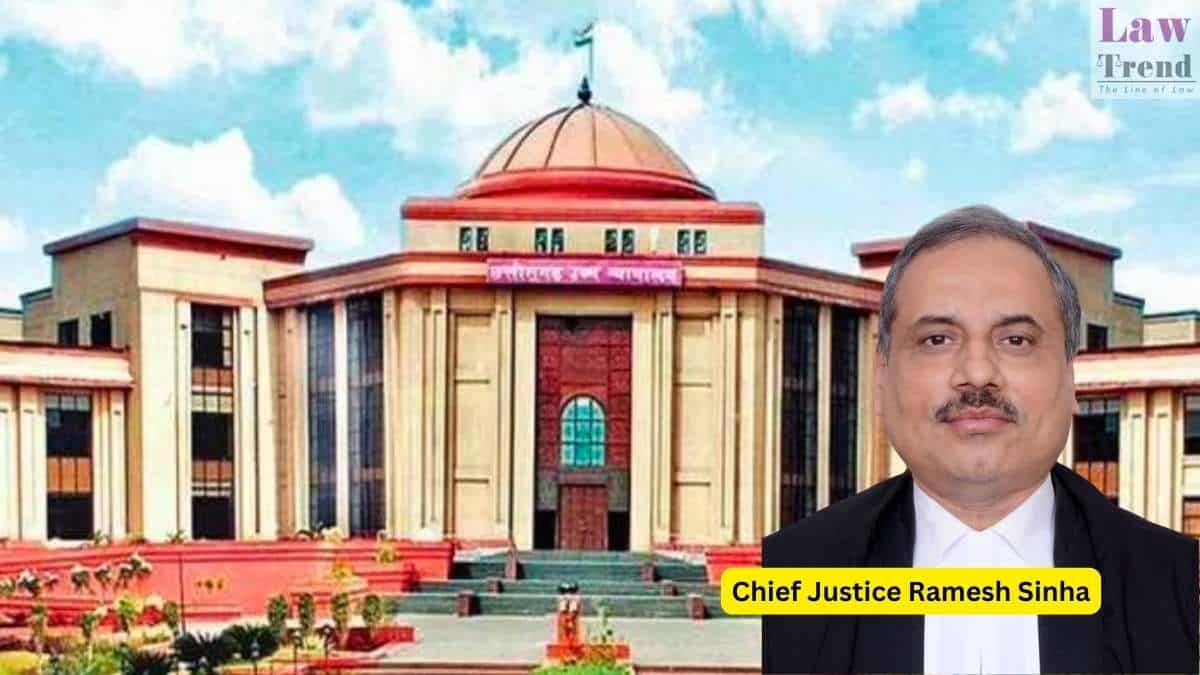
The High Court of Chhattisgarh has set aside the conviction and three-year rigorous imprisonment sentence of a Labour Inspector, ruling that the prosecution failed to establish the “foundational facts” of demand and voluntary acceptance of illegal gratification. Chief Justice Ramesh Sinha held that the uncorroborated testimony of a complainant, particularly when influenced by prior animosity, cannot sustain a conviction under the Prevention of Corruption Act if independent witnesses fail to support the allegation of a bribe demand.
The appeal challenged a 2025 judgment of the Special Judge (Prevention of Corruption Act), Jashpur, which convicted Suresh Kurre, a Labour Inspector, under Section 7 of the Prevention of Corruption Act, 1988. The High Court observed that mere recovery of tainted currency notes, in the absence of reliable evidence regarding a demand for the bribe, is insufficient to bring home a charge under the Act. Consequently, the Court allowed the appeal and acquitted the appellant.
Background of the Case
The prosecution case began with a complaint filed on September 26, 2019, by Ramesh Kumar Yadav (PW-2), who ran an educational society. Yadav alleged that the appellant, Suresh Kurre, demanded a 10% bribe to process a payment of Rs 6,37,000 due to his institution for skill development training. According to the complainant, Kurre initially demanded Rs 1,00,000, which was later increased to Rs 1,90,000 to facilitate the purchase of a motorcycle.
The Anti-Corruption Bureau (ACB) organized a trap on October 14, 2019, after a digital voice recorder was used to capture alleged conversations. During the trap, the appellant was allegedly caught receiving an installment of Rs 40,000. On November 26, 2025, the trial court convicted Kurre and sentenced him to three years of rigorous imprisonment with a fine of Rs 50,000.
Arguments of the Parties
The appellant’s counsel, Senior Advocate Abhishek Sinha, argued that the prosecution failed to prove the essential ingredients of Section 7. He contended that the complainant had a personal grudge against Kurre because the department had initiated recovery proceedings of approximately Rs 7,01,100 against Yadav for financial irregularities. He further argued that as a Labour Inspector, the appellant had no authority to release payments, which was the duty of the Labour Officer (PW-4).
The State’s counsel, Mr. Saurabh Sahu, opposed the appeal, submitting that the appellant was caught red-handed and that the recovery of treated currency notes from his possession established his guilt beyond reasonable doubt.
Court’s Analysis
The Court conducted a comprehensive evaluation of the evidence, identifying several material deficiencies:
1. Failure of Independent Witnesses: The Court noted that the independent panch witnesses, Dr. Vinay Kumar Tiwari (PW-3) and Chetan Sahu (PW-6), did not support the prosecution on the most crucial aspect. “Both these witnesses have categorically stated that they were standing at some distance… and therefore, could not hear the conversation that allegedly took place,” the Court observed.
2. Prior Animosity and False Implication: The Court found that the complainant was facing recovery proceedings for financial irregularities and believed the appellant was responsible for initiating them. The Court remarked: “These circumstances indicate a clear possibility of motive for false implication of the accused.”
3. Absence of Pending Dues and Official Role: The investigation failed to verify if any amount was actually due to the complainant. Furthermore, the evidence of the Labour Officer (PW-4) established that the appellant had no role in processing or sanctioning payments. “The role of the Labour Inspector… is confined only to physical verification… and he has no role in processing, sanctioning or disbursing payments,” the Court noted.
4. Inadmissible Electronic Evidence: The Court criticized the lack of forensic verification of the recorded conversations. “The alleged recorded conversation between the complainant and the accused was not subjected to forensic examination to verify the voices contained therein,” the judgment stated, noting that transcripts alone cannot be accepted in the absence of an audible tape-recorded version.
Citing the Supreme Court’s decisions in K. Shanthamma v. State of Telangana and Rajesh Gupta v. State through CBI, the High Court reiterated:
“The proof of demand of illegal gratification, thus, is the gravamen of the offence under Sections 7 and 13(1)(d)(i) and (ii) of the Act and in absence thereof, unmistakably the charge therefor, would fail. Mere acceptance of any amount allegedly by way of illegal gratification or recovery thereof, dehors the proof of demand, ipso facto, would thus not be sufficient to bring home the charge.”
Decision
The High Court concluded that since the foundational requirement of “demand” was not established, the statutory presumption under Section 20 of the Act could not be invoked.
“The entire prosecution case regarding demand rests solely upon the testimony of the complainant Ramesh Kumar Yadav (PW-2), which does not find corroboration from the independent witnesses,” the Court held. The High Court allowed the appeal, set aside the trial court’s judgment, and acquitted Suresh Kurre of the charges.
Case Details:
- Case Title: Suresh Kurre v. State of Chhattisgarh
- Case No.: Criminal Appeal No. 2674 of 2025
- Bench: Chief Justice Ramesh Sinha
- Judgment Date: March 11, 2026




