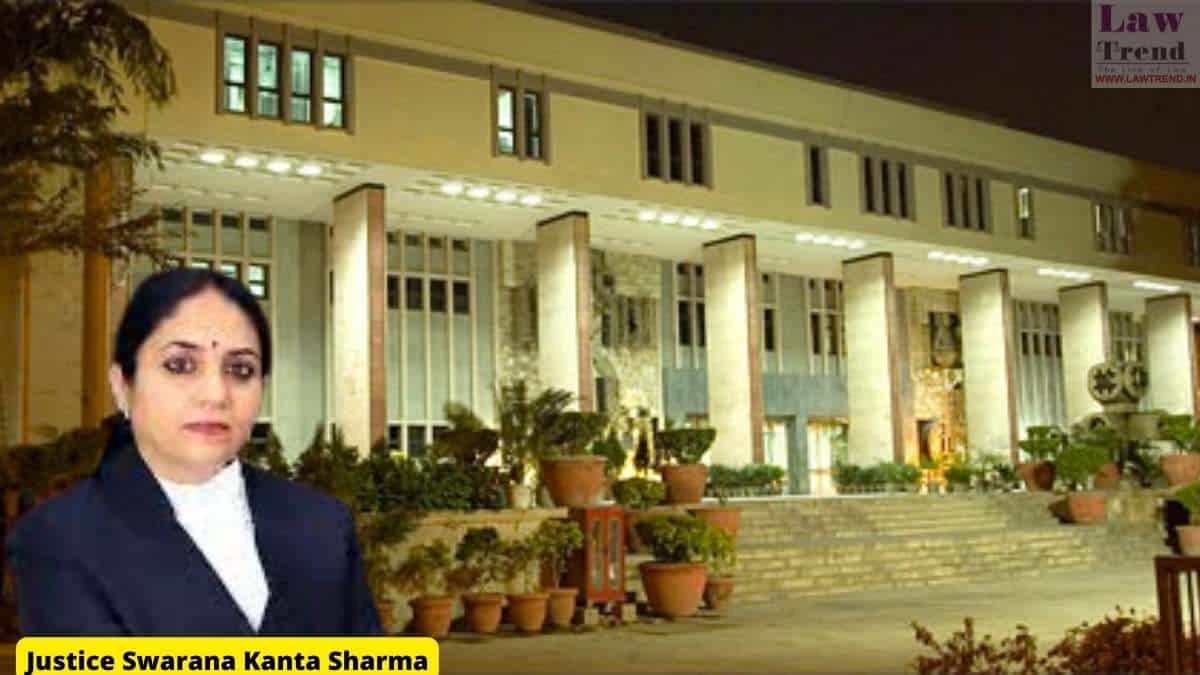
The Delhi High Court has quashed a summoning order and criminal complaint against an individual in a cheque bounce case, observing that mere bald allegations of being involved in “day-to-day business activities” are insufficient to attract vicarious liability under Section 141 of the Negotiable Instruments (NI) Act, 1881, especially when the person holds no formal office in the company.
Justice Swarana Kanta Sharma held that for a person to be held vicariously liable for an offence committed by a company under Section 138 of the NI Act, the complaint must specifically demonstrate that the individual was both “in charge of” and “responsible to” the company for the conduct of its business at the time of the offence.
Background of the Case
The case originated from a complaint filed by Respondent No. 1, Shashi Devi, against M/s Forcia Commodity Solutions OPC Pvt. Ltd. (a One Person Company), its sole Director Ratna Sharma, and the petitioner, Ram Kumar Pathak.
The complainant alleged that the petitioner and the Director induced her to invest ₹6,00,000 in 2015. After partial repayment, a cheque for ₹4,00,000 was issued, signed by the Director (Respondent No. 3), which was subsequently dishonored with the remarks “Refer to Drawer.” The complainant alleged that the petitioner was involved in the day-to-day affairs of the company and acted under the instructions of the Director.
The Metropolitan Magistrate summoned the petitioner on May 26, 2018. This was challenged before the Sessions Court, which dismissed the revision petition on January 28, 2019, leading the petitioner to approach the High Court.
Arguments of the Parties
The petitioner’s counsel argued that Pathak was neither the drawer nor the signatory of the cheque. According to Ministry of Corporate Affairs records, he was not a Director, office bearer, or employee. It was contended that the complaint admitted the co-accused was the “sole Director,” and no material was placed to show Pathak’s specific role in the company’s business.
The complainant’s counsel countered that the petitioner played an active role by approaching the complainant, inducing investment, and handing over the cheque. It was argued that liability under Section 141 does not depend on formal designation if the person is practically in charge of the company’s affairs.
Court’s Analysis and Observations
The Court examined the statutory scheme of Section 141 of the NI Act, which deals with offences by companies. It noted that Section 141 is an exception to the general rule against vicarious liability in criminal law and must be strictly construed.
Citing the Supreme Court’s ruling in S.M.S. Pharmaceuticals Ltd. v. Neeta Bhalla (2005), the High Court emphasized that specific averments are mandatory. The Court further referred to Ashok Shewkramani v. State of Andhra Pradesh (2023), noting:
“Section 141 constitutes an exception to the normal rule that there cannot be any vicarious liability when it comes to a penal provision. The vicarious liability is attracted when the ingredients of sub-section 1 of Section 141 are satisfied. … Merely because somebody is managing the affairs of the company, per se, he does not become in charge of the conduct of the business of the company or the person responsible for the company for the conduct of the business of the company.”
Justice Sharma observed that the complaint itself described the petitioner as “acting under the instructions” of the sole Director. The Court remarked:
“There is no averment, nor any material placed on record by the complainant, to indicate that the petitioner held any office or position whatsoever in the accused company, even as an employee. Therefore, precisely, the petitioner herein has no role or status in the accused company.”
The Court further clarified that even if the petitioner accompanied the Director or handed over the cheque, such actions—whether as a friend, associate, or agent—do not automatically satisfy the legal threshold for criminal liability under Section 141.
Decision of the Court
The High Court concluded that the necessary averments to attract vicarious liability were “conspicuously absent” regarding the petitioner.
“This Court is of the opinion that such averments, even in substance, do not meet the statutory threshold contemplated under Section 141 of the NI Act.”
Accordingly, the High Court allowed the petition and quashed the summoning order and the complaint (CC No. 749/2018) specifically against Ram Kumar Pathak, while clarifying that the proceedings against the other accused persons would remain unaffected.
Case Details:
Case Title: Ram Kumar Pathak v. Shashi Devi & Ors.
Case No.: CRL.M.C. 1143/2019
Bench: Justice Swarana Kanta Sharma
Date: February 27, 2026