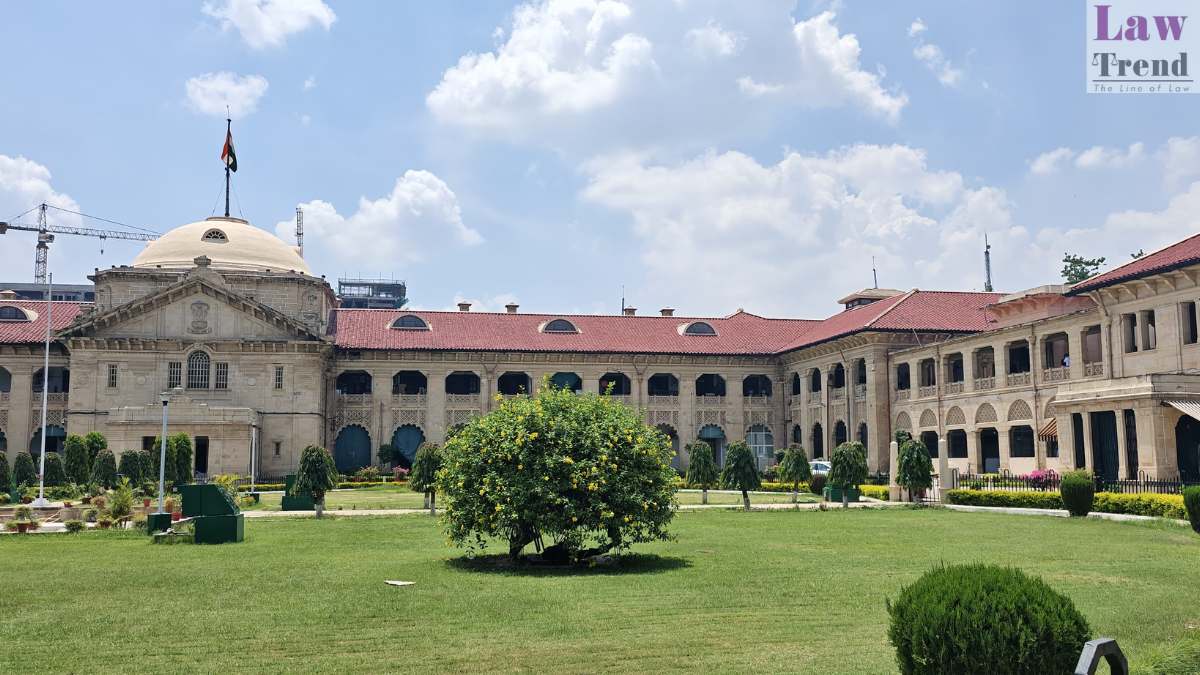
The High Court at Allahabad has allowed a criminal appeal, quashing the summoning order and entire proceedings against an appellant in a case involving alleged caste-based atrocities. In a significant administrative observation, the Court also directed its Registry to discontinue the use of terms like “court below” and “Lower Court,” mandating the use of “Trial Court” or “Special Court” instead.
Background
The case arose from an incident on June 28, 2025, during a tender process at the Zila Panchayat, Mahoba. The complainant, Jai Prakash Anuragi, Chairman of the Zila Panchayat, filed an F.I.R. alleging that Mahesh Tiwari (the appellant) and others disrupted the tender process. It was alleged that Tiwari pushed an employee, while another accused held the complainant and used caste-based slurs.
The appellant was subsequently summoned by the Special Judge (SC/ST Act), Mahoba, in Special Case No. 86 of 2025, under various sections of the Bharatiya Nyaya Sanhita (BNS) and the SC/ST Act.
Arguments of the Parties
The appellant’s counsel argued that the case was politically motivated to prevent the appellant from participating in the tender process. They highlighted a 24-hour delay in the F.I.R. and argued that the complainant’s statements were inconsistent.
The respondent’s counsel countered that the investigation had established a prima facie case. They raised a preliminary objection, citing State of Gujarat Versus Afroz Mohammed Hasanfatta (2019), arguing that the summoning order was based on a valid investigation and should not be quashed.
Court’s Analysis on the Merits
Justice Abdul Shahid observed that the prosecution’s case was riddled with “inherent inconsistencies.” The Court noted that the complainant, a responsible public official, materially changed his version of events across three separate statements. Specifically, the complainant initially named Ankit Shukla but later exonerated him after viewing CCTV footage, claiming he had misidentified the person.
The Court analyzed the CCTV footage, noting it showed the parties interacting in a “normal” demeanor without any apparent altercation. The Court observed:
“The consistent changes in his version and his increasing reliance on electronic evidence over his own ocular account cast serious doubt on the prosecution case.”
The Court further remarked that while electronic evidence is admissible, it cannot be used to completely deviate from the initial ocular averments without raising serious doubt on the entire prosecution story.
Directives on Legal Terminology
A significant portion of the judgment focused on the terminology used by the judiciary and its Registry. Referring to the Supreme Court’s order in Sakhawat and Another v. State of U.P. (2024), the High Court observed that “court below” is not the correct legal terminology for Special Courts.
The Court held:
“It will be appropriate if the Registry of this Court stops referring to the Trial Courts as ‘Lower Courts’. Even the record of the Trial Court should not be referred to as Lower Court Record (LCR). Instead, it should be referred as the Trial Court Record (TCR).”
The Court explicitly directed that the terminology “court below” should be replaced with “trial court” or the specific court involved, such as the “Special Court under the SC/ST Act.”
Decision
Finding that the improvements and inconsistencies in the prosecution’s story could not be judicially accepted, the High Court set aside the summoning order dated October 14, 2025, and quashed the proceedings in Special Case No. 86 of 2025.
Regarding the administrative directives, the Court ordered:
“A copy of this order, for this purpose only, may be placed before the learned Registrar General for perusal and may be considered for implementation of these directions of the Supreme Court after due procedure on the administrative side.”
Case Details Block:
- Case Title: Mahesh Tiwari Versus State of U.P. and Another
- Case No.: CRIMINAL APPEAL No. 11406 of 2025
- Bench: Justice Abdul Shahid
- Date: April 24, 2026