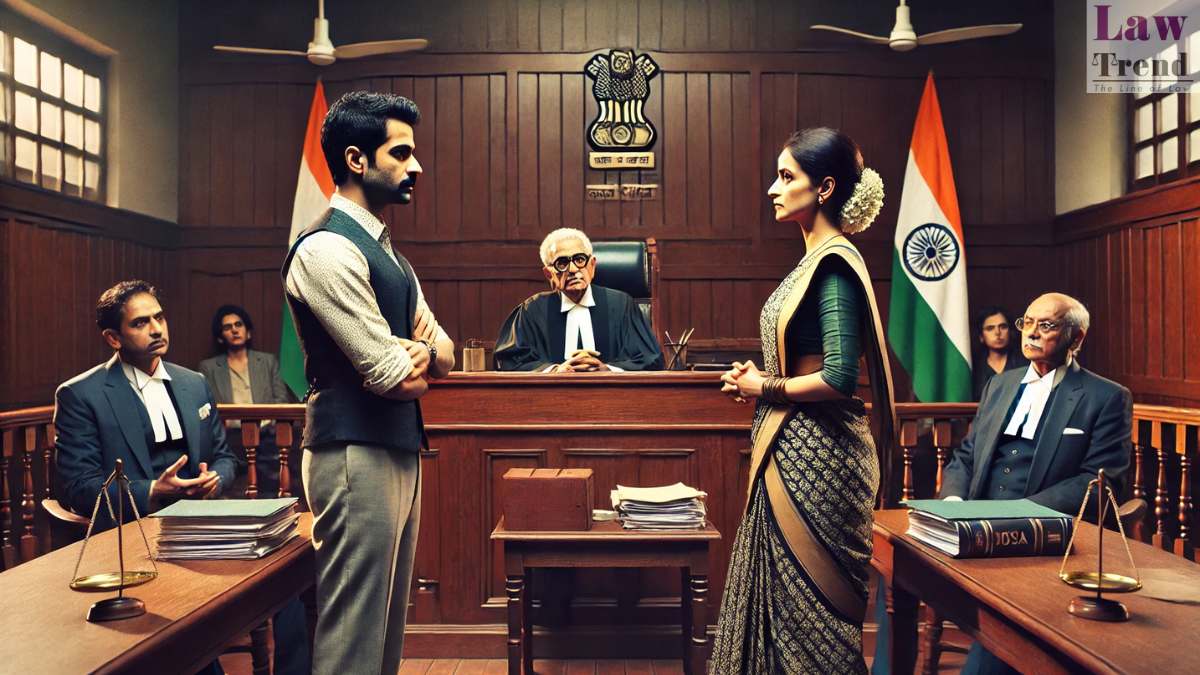
The High Court of Madhya Pradesh has allowed a First Appeal filed by a wife seeking a divorce, observing that marital discord had reached a point of no remedy. The Division Bench, comprising Justice Vivek Kumar Singh and Justice Ajay Kumar Nirankari, held that a long period of continuous separation falls within the ambit of “mental cruelty” under Section 13(1)(ia) of the Hindu Marriage Act, 1955.
The Court set aside the judgment and decree dated May 6, 2015, passed by the Presiding Officer, Family Court, Betul, which had initially dismissed the appellant’s application for divorce.
Background of the Case
The appellant and the respondent were married on July 12, 2008, according to Hindu rites and customs. The appellant alleged that at the time of the marriage, a dowry of Rs. 1,75,000 was demanded and paid by her father. She further stated that the respondent had falsely claimed to be working temporarily at VMB College, Amravati, only to later reveal he had no source of income.
A daughter was born to the couple on September 10, 2009. The appellant contended that she visited her matrimonial home on July 13, 2010, attempting to sustain the marriage, but the respondent showed no interest in continuing the relationship. Since then, the appellant has been living separately, supporting herself and her daughter by taking tuitions.
The appellant filed a petition for divorce under Section 13 of the Hindu Marriage Act on the ground of cruelty. However, the Family Court, Betul, dismissed the suit in 2015, observing that the appellant was living separately without sufficient reason and noting that no FIR had been lodged regarding the alleged cruelty or dowry demands.
Submissions of the Parties
Advocate Sandeep Singh Baghel, appearing for the appellant, argued that the Family Court failed to appreciate that the husband had no earnings and that the appellant was solely responsible for the child’s upbringing. He submitted that the parties had been living separately since 2013 and the marriage had broken down irretrievably.
The counsel highlighted that the respondent’s petition for Restitution of Conjugal Rights (Section 9 of the Hindu Marriage Act) was dismissed by the lower court on January 4, 2023. The court had dismissed it citing the respondent’s conduct and delay, noting that it was filed only after the wife sought maintenance under Section 125 of the Cr.P.C.
The appellant relied on the Delhi High Court judgment in Poonam Wadhwa Vs. Rajeev Wadhwa, which held that financial instability could result in mental anxiety and fall within the ambit of mental cruelty. Reliance was also placed on the MP High Court’s coordinate bench decision in Smt. Saroj Bai Vs. Naresh Kumar regarding desertion.
Advocate Pramod Kumar Thakre, appearing for the respondent-husband, supported the lower court’s decision, terming it a reasoned judgment based on proper appreciation of facts.
Court’s Observations and Analysis
The High Court examined the concept of “mental cruelty” and “irretrievable breakdown of marriage,” referring to landmark Supreme Court judgments, including Samar Ghosh vs. Jaya Ghosh (2007) and Shri Rakesh Raman Vs. Smt. Kavita (2023).
The Bench noted that while the parties lived together for only about a year after marriage, they have been living separately since then. The Court observed:
“From evidence available on record, it is clear that the relations between the parties have evidently grown sour beyond the point of return and such a long period of separation has turned these differences irreconcilable.”
Citing the Supreme Court in Shilpa Sailesh Vs. Varun Sreenivasan (2023), the Court reiterated that while irretrievable breakdown is not a matter of right, the Court must exercise discretion to ensure ‘complete justice’.
The Bench further stated:
“It is evident that in the instant case, marital discord has reached to a point of no remedy and there is a complete irretrievable breakdown of marriage. Therefore, no purpose would be served by insisting the parties to continue their marital relationship which is already dead…”
The Court concluded that the long separation and the breakdown of the bond fell within the ambit of mental cruelty under Section 13(1)(ia) of the Hindu Marriage Act.
Decision
The High Court allowed the First Appeal, setting aside the 2015 judgment of the Family Court, Betul. The marriage solemnized between the appellant and the respondent on July 12, 2008, was dissolved by a decree of divorce. The Court ordered the parties to bear their own costs.
Case Details:
- Case Title: Kavita Vs. Sudhakar Rao Sukhsohale
- Case No.: First Appeal No. 238 of 2017
- Coram: Justice Vivek Kumar Singh and Justice Ajay Kumar Nirankari
- Counsel for Appellant: Shri Sandeep Singh Baghel
- Counsel for Respondent: Shri Pramod Kumar Thakre