

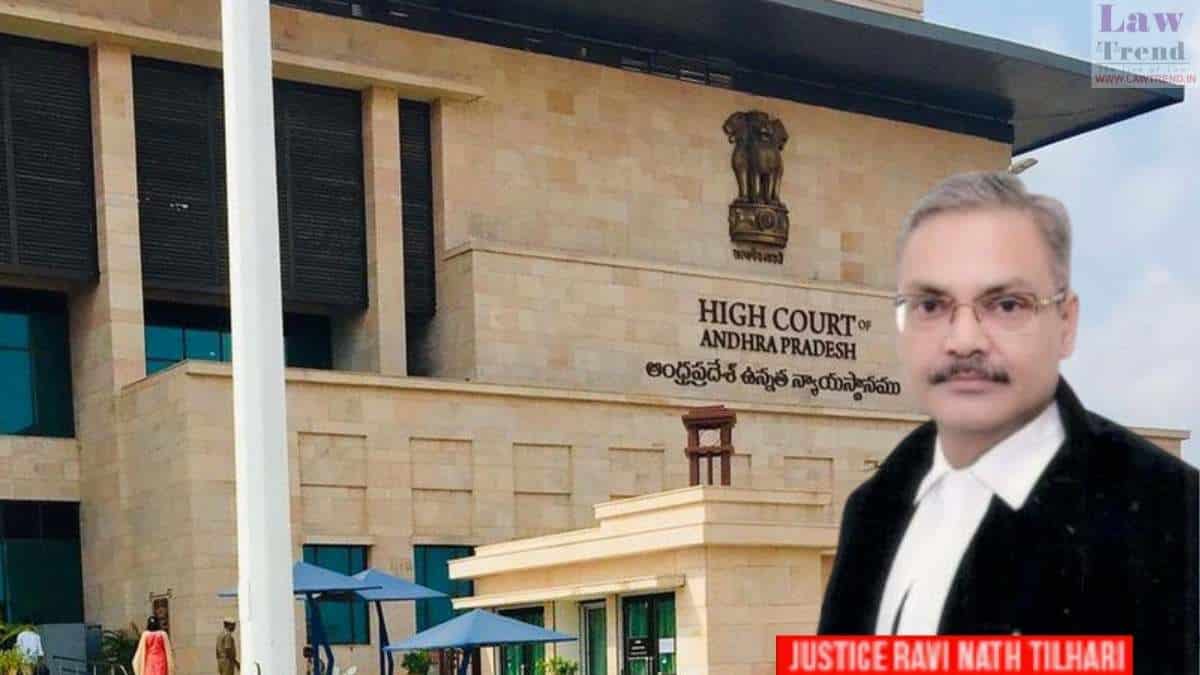
The High Court of Andhra Pradesh has dismissed a Civil Revision Petition, affirming that an application for amendment of pleadings under Order VI Rule 17 of the Code of Civil Procedure (CPC) cannot be allowed after the commencement of trial unless the applicant demonstrates “due diligence.” The Court observed that ignorance of framed issues does not constitute due diligence and that such belated applications can be seen as attempts to prolong litigation.
Background
The petitioner, Surisetty Appala Raju, filed a suit (O.S. No. 1094 of 2014) against eight respondents seeking a mandatory injunction for the removal of a wall and a permanent injunction against further construction. In 2025, approximately 11 years after the suit was instituted and during the stage of evidence (cross-examination of DW 2), the plaintiff filed I.A. No. 317 of 2025 seeking to amend the prayer clause.
The proposed amendment sought to add a declaration that the constructions made by the defendants in an extent of 11 square yards were illegal, along with a consequential mandatory injunction. The trial court (VI Additional Civil Judge, Senior Division, Visakhapatnam) rejected the application on July 28, 2025, citing a lack of due diligence and the advanced stage of the trial.
Arguments of the Parties
For the Petitioner: The learned counsel for the petitioner argued that amendments can be allowed at “any stage of the proceedings.” He contended that “commencement of trial” in the context of the proviso to Order VI Rule 17 CPC should be understood in a limited sense, meaning the final hearing and addressing of arguments. Since arguments had not yet been reached, he submitted the trial had not “commenced” in a way that would bar the amendment. He further stated that the amendment was only in the prayer clause and would cause no prejudice to the defendants.
For the Respondents: The counsel for the respondents argued that the trial had clearly commenced as issues were framed and witnesses were being cross-examined. He contended that the plaintiff’s plea—that they were unaware of the framed issues for eight years—did not meet the legal standard of “due diligence.” He characterized the application as a tactic to drag on proceedings in a decade-old suit.
Court’s Analysis
The matter was heard by Justice Ravi Nath Tilhari. The Court focused on the proviso to Order VI Rule 17 CPC, which states:
“Provided that no application for amendment shall be allowed after the trial has commenced, unless the Court comes to the conclusion that in spite of due diligence, the party could not have raised the matter before the commencement of trial.”
On “Commencement of Trial”: The Court rejected the petitioner’s narrow interpretation of “commencement of trial.” Citing Baldev Singh v. Manohar Singh (2006), the Court clarified that while the expression is understood in a limited sense, all stages after framing issues—including filing documents and examining witnesses—fall within the trial. Justice Tilhari noted:
“If the submission of the learned counsel for the petitioner is accepted that unless all those things are taken together the trial has not commenced, that would amount to rewriting the proviso to Order 6 Rule 17 CPC and in that case the use of expressions ‘commencement’ and ‘due diligence’ would be rendered nugatory.”
On “Due Diligence”: The Court defined “due diligence” as the “diligence reasonably expected from, and ordinarily exercised by a person who seeks to satisfy a legal requirement.” The petitioner’s claim of being unaware of the issues framed by the trial court was dismissed as “not believable.” The Court remarked:
“The plaintiff’s awareness or no awareness about the issues framed is of no relevance in the matter of amendment of plaint… The plaintiff has failed to prove the due diligence in filing the application for amendment of plaint filed after the commencement of trial.”
On the Necessity of the Amendment: The Court observed that the proposed amendment to seek a declaration of “illegality” was redundant, as the court could grant a prayer for demolition if it found the construction illegal during the trial, even without the specific declaratory prayer.
Decision
The High Court concluded that the trial court was correct in rejecting the application. The Court found that the application was filed after the commencement of trial without proving due diligence and was intended to prolong the suit filed in 2014.
The Civil Revision Petition was dismissed with no order as to costs.
Case Details:
- Case Title: Surisetty Appala Raju v. Gotimukkala Perraju and 7 others
- Case No.: CIVIL REVISION PETITION No. 2225 of 2025
- Bench: Justice Ravi Nath Tilhari
- Date: 10.04.2026




