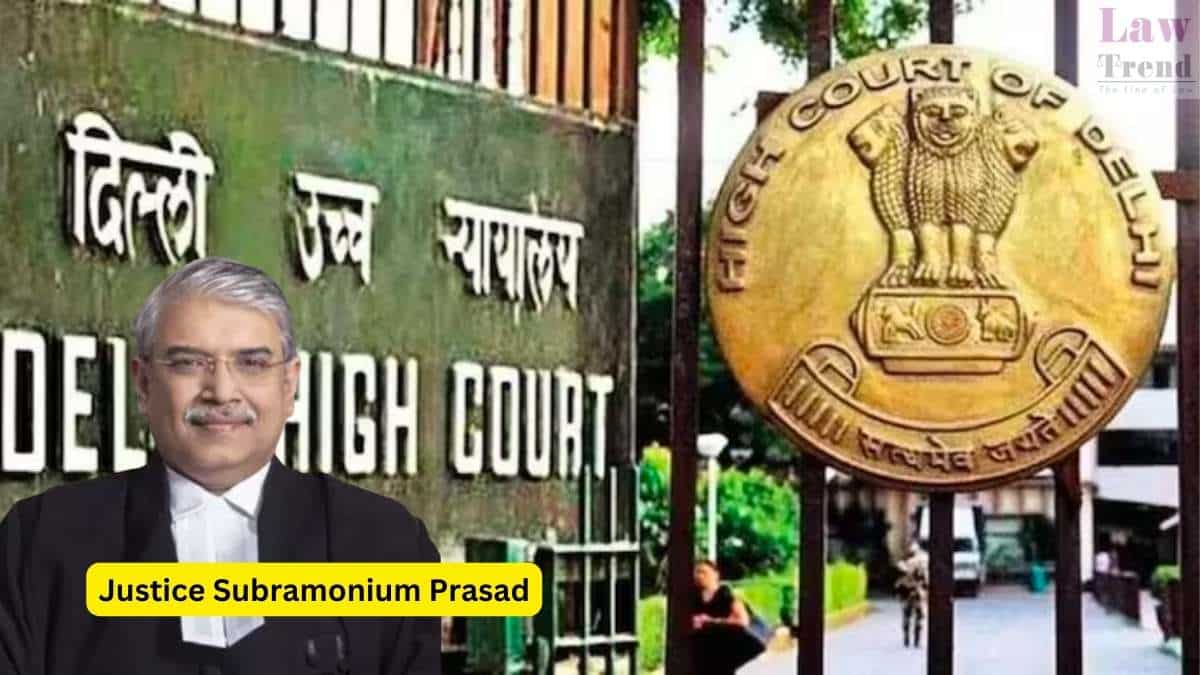
The High Court of Delhi has ruled that a petition seeking Letters of Administration on the ground of intestacy is not maintainable when the petitioner acknowledges the existence of a Will, even if its validity is disputed. The Court held that the genuineness and validity of a testamentary instrument must be adjudicated exclusively in proceedings where the Will is propounded.
Background of the Case
The legal dispute surrounds the estate of the late Arvind Singh Mewar, who passed away on March 16, 2025, in Udaipur. He was survived by four Class-I legal heirs: his wife, Vijayraj Kumari Mewar; his son, Lakshyaraj Singh Mewar; and two daughters, Bhargavi Kumari Mewar and Padmaja Kumari Parmar.
Padmaja Kumari Parmar initially filed a testamentary petition in the High Court of Judicature at Bombay seeking Letters of Administration on the premise that her father died intestate. Although acknowledging the existence of a purported Will dated February 7, 2025, she alleged it was procured through undue influence while her father was non compos mentis, legally blind, and suffering from severe physical and mental infirmities.
Conversely, her brother, Lakshyaraj Singh Mewar, filed a petition in the High Court of Rajasthan at Jodhpur, seeking Letters of Administration with the Will annexed under Section 276 of the Indian Succession Act, 1925. He claimed to be the universal legatee under the registered Will, asserting that the testator was of sound mind and had previously executed a General Power of Attorney in his favor.
The Supreme Court transferred both petitions to the High Court of Delhi to be heard together to avoid multiplicity of litigation and conflicting findings.
Arguments of the Parties
Senior Counsel appearing for Padmaja Kumari Parmar argued that the petition founded on intestacy under Section 278 was maintainable because the Will was legally invalid and incapable of taking effect. Relying on Section 3(g) of the Hindu Succession Act, it was contended that the testator should be deemed to have died intestate. The petitioner further argued that she was not required to seek a specific civil declaration to invalidate the Will and that the burden of proving the Will rested entirely on its propounder, relying on the precedents in Lalitkumar v. Sunita, Sambhaji Vishnu Kharat v. Sarjerao Kharat, and Venigalla Koteswaramma v. Malam Pati Suryamba.
In contrast, Senior Counsel for Lakshyaraj Singh Mewar raised a preliminary objection regarding the maintainability of the intestacy petition. It was argued that under the scheme of the Indian Succession Act (Sections 218, 232, 276, and 278), once a Will surfaces, the estate cannot be treated as intestate. The respondent contended that any grant of Letters of Administration on the footing of intestacy would be liable for revocation under Section 263 of the Act, and thus, questions regarding the validity of the Will must exclusively be examined by a testamentary court where the Will is propounded.
The Court’s Analysis
Justice Subramonium Prasad evaluated the statutory framework of the Indian Succession Act and distinguished between intestate succession (Section 278) and testamentary succession (Section 276).
The Court observed that while proceedings for the grant of probate or Letters of Administration are proceedings in rem, a Will cannot be proved or disproved in parallel proceedings founded on intestacy. The Court stated:
“The mere assertion that a testamentary instrument is invalid does not render the estate intestate, since intestacy arises only upon failure to establish a valid testamentary disposition.”
“Once a Petition seeking Letters of Administration with the Will annexed has been instituted, the question of the due execution, genuineness and validity of the Will must be adjudicated within those proceedings, wherein the testamentary instrument is propounded.”
Addressing the petitioner’s argument that the Will was void and vitiated by suspicious circumstances, the Court clarified the jurisdictional boundaries:
“A decree declaring a Will to be invalid, void, or vitiated by suspicious circumstances can be granted only by a competent civil court in appropriate proceedings instituted for that purpose.”
The Court distinguished the cases relied upon by the petitioner, noting they arose in the context of civil partition suits rather than testamentary proceedings under the Indian Succession Act. Instead, the Court relied upon established precedents including Chiranjilal Shrilal Goenka v. Jasjit Singh, Administrator General v. State, Bindia Kriplani v. Naresh Nathulal Pal, Peter John D’Souza v. Armstrong Joseph D’Souza, and M.A.I. Kovoor v. Thomas IPE Kovoor (Jr.) to conclude that parallel continuation of an intestacy petition is legally unsustainable when the Will’s validity is already the subject matter of contemporaneous testamentary proceedings. The Court also noted that under Section 295, the proceedings propounding the Will take the form of a regular civil suit once they become contentious.
Decision
The High Court dismissed the petition filed by Padmaja Kumari Parmar (TEST.CAS. 2/2026), observing that no cause of action subsisted in the intestacy petition following the filing of the petition for Letters of Administration with the Will annexed (TEST.CAS. 4/2026).
The Court granted Padmaja Kumari Parmar the liberty to raise all grounds and contentions regarding the suspicious circumstances surrounding the Will by filing an appropriate reply in TEST.CAS. 4/2026, where the validity and proof of the alleged Will are to be adjudicated.
Case Details:
- Case Title: Padmaja Kumari Parmar v. Lakshyaraj Singh Mewar and Ors. & Lakshyaraj Singh Mewar v. State of Rajasthan & Ors.
- Case No: TEST.CAS. 2/2026 & TEST.CAS. 4/2026
- Bench: Justice Subramonium Prasad
- Date of Decision: March 17, 2026